The Fonda Theatre in Hollywood has hosted plenty of dramatic underplays from legends like the Rolling Stones, Tom Petty and Green Day. But there was something especially poignant about Paul McCartney’ two-night stand at the 1,200-capacity theater in March, winding up to the Fonda’s 100th anniversary celebrations this October.
“It was insane,” said Becky Rosen-Checa, the venue’s talent buyer with promoter Goldenvoice. “The whole year leading up to it, it was like a CIA recruiter coming down the line. I was like, ‘Until this is publicly announced, I don’t even believe that this is happening. I can’t let myself believe that this is happening because it’s so crazy.’”
But the Fonda just has a certain Old Hollywood magic that makes legends want to return to their club days.
“There’s a really iconic photo from the McCartney show where everyone’s cheering for him and he’s standing on center of the stage,” said Roxanne Majich, the venue’s general manager through concert promoter Goldenvoice. “These acts have built their careers and then want to come back and give back to the fans that made them who they are.”
The Fonda has always been an especially glamorous, Spanish Colonial jewel box in the city’s flagship nightlife neighborhood. It’s kept that status for generations, even as the neighborhood changed and the offerings shifted from theater to film to concerts. While Goldenvoice plans for its next century, it is taking a beat to reflect on a room that’s become emblematic of being on your way in L.A.
“I just think it just became everyone’s favorite venue,” said Donna Busch, Goldenvoice’s vice president of talent buying, who booked the venue from 2003 to 2025. “You know that if you play there, and you sell it out, your career’s on the up.”
The Fonda Theatre opened in 1926 as Carter DeHaven’s Music Box. The theater, with its hacienda-style roof tiles, dramatic street-front balcony and rooftop overlooking Hollywood Boulevard, and ornately painted interior woodwork, was a favorite in Hollywood’s first golden age. It hosted live theatrical productions of “Chicago” with Clark Gable and the stage incarnation of “Dracula” with Bela Lugosi, who reprised the role in the 1931 film.
“They had really grandiose ideas for this place,” Majich said. “You hear stories that there was a lot of illicit drinking and whatnot during Prohibition upstairs in this speakeasy area, because while it was exposed to Hollywood Boulevard, you could still cover it up. Who knows if it’s true, but it’s fun to talk about.”
The space housed a CBS broadcast suite and a few theater incarnations before transitioning to the Pix Theatre in 1959, where it would later host the premieres of “Jaws” and “Rocky.” (Fans attending shows today might think the giant neon “Pix” sign in the lobby is an Instagram backdrop — it’s the old marquee.)
The room reverted back to live theater in 1985, and Goldenvoice, fresh off the inaugural Coachella in 1999, began booking shows there in 2002 as the Henry Fonda Theatre. The company took over all talent buying in 2005, and after a name change to the Music Box in 2007, signed onto manage the venue’s operations in 2012, when it finally settled on the final name of the Fonda Theatre.
Since then, a Fonda gig has been a marker of transitioning from clubs to theaters, and an intimate room for arena acts to return to their roots. The show list is staggering — the Rolling Stones, Green Day on the “American Idiot” tour, the reunion of Tom Petty’s Mudcrutch, Metallica, Paul Simon, Red Hot Chili Peppers, Billie Eilish, Radiohead, Beastie Boys. The venue was a pivotal location in the American EDM boom, when dance acts like Justice proved they could sell tickets to headline shows. The Fonda hosted Foo Fighters’ last U.S. show with late drummer Taylor Hawkins, and recent fame-tipping sets by pop superstars Chappell Roan, Sabrina Carpenter and Olivia Dean.
“I think it’s in part luck, but if you’re doing a good job booking the room, you’re able to book these acts that are going to blow up and you don’t even really know it,” Rosen-Checa said. “We had two nights of Adéla that were booked way before she blew up, and they sold out immediately. But between the time they went on sale to her show, she became exponentially bigger. She could easily sell 10,000 tickets in L.A., and it’s one of those ‘You were either here or you weren’t’ moments.”
There have been a few hairy nights over the years — In 2014, Mac DeMarco famously jumped off the upper balcony into the crowd, a fall that would have killed him if he had landed wrong.“I remember the general manager being like, ‘What? Why did you let this happen?’” Busch said. “It’s not like he said, ‘Hey, you mind if I jump off the balcony?’”
No hard feelings, though. This year, for the formal 100th anniversary celebration, Goldenvoice invited DeMarco back, where he covered Michael Jackson’s “Human Nature” in his underwear. Other acts like Suicidal Tendencies, Cuco, Animal Collective, Flying Lotus and Remi Wolf that had formative shows there performed for the occasion as well.
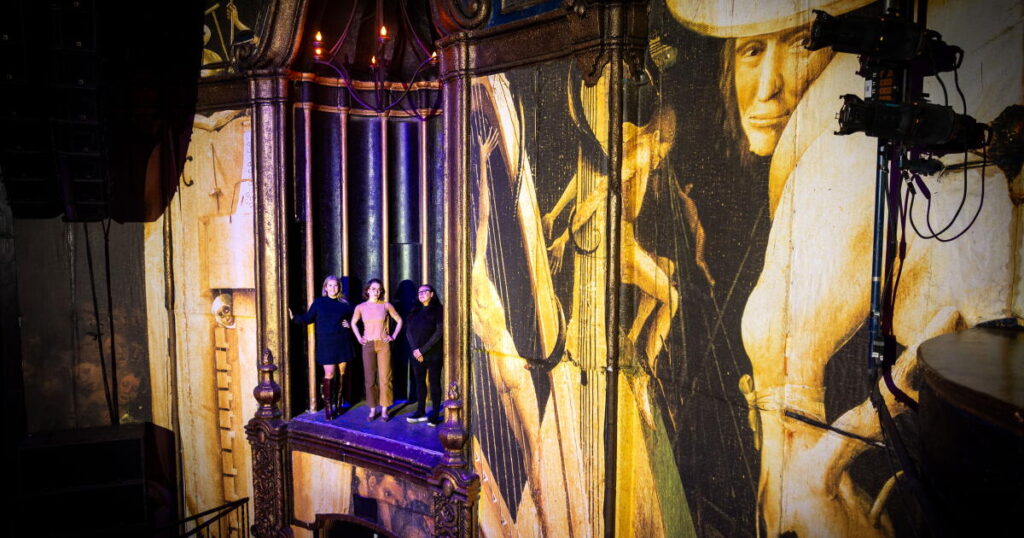
While the Fonda has been restored and revamped over the years (including the addition of a Hieronymus Bosch mural), Goldenvoice doesn’t have any deep-gut renovations planned like those at its other centenary venue, the Shrine. All the quirks that artists love, like the opera-style alcoves where you can plant a B-stage performance, or the ladder that takes you from the underground dressing room to peek out just below the stage front, are intact. The only big new plans are turning the old “speakeasy area” on the rooftop into a Tiki bar.
As one of Goldenvoice’s crucial local venues, on L.A.’s most famous entertainment drag, the Fonda’s managers are hopeful that incoming mayor Nithya Raman will help juice the local entertainment economy and continue to make progress on street safety in the neighborhood. (The Democratic Socialists of America’s Los Angeles chapter hosted a fundraiser at the Fonda in May.) “I’m excited to see what she has to offer,” Majich said of Raman. “I think that’s part of her goals coming in.”
L.A. is lucky to still have a few surviving venues from the dawn of the city’s showbiz glamour. For any local artist who plays there, or a veteran coming home to their faithful, that feeling from 1926 still holds — you’ve arrived.
“Before you leave, you should stand on the stage,” Busch told a Times reporter, who finally got to walk out under that spotlight (albeit, to an empty room in the middle of the day). “Once you’re on the stage, it feels different than when you’re looking at it. It’s actually very close and intimate. You’re like, ‘Oh my God.’”
The post The Fonda Theatre, a jewel of Old Hollywood, turns 100. Please don’t crowd-surf off the balcony appeared first on Los Angeles Times.