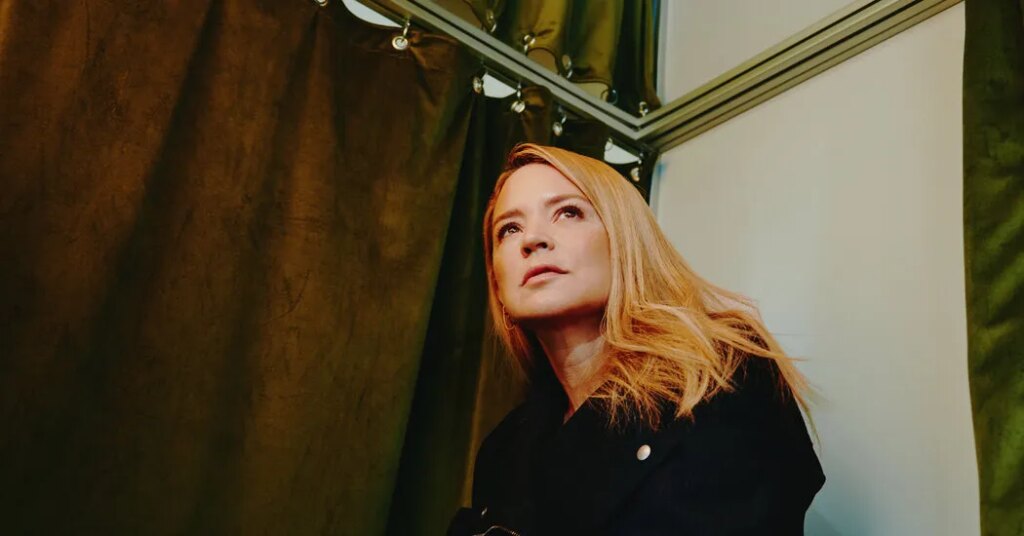
Well before Virginie Efira became one of France’s most celebrated and in-demand actors, she was a weather forecaster. A reality dating show host. The face of “Nouvelle Star,” the French version of “American Idol.”
But over the past decade, Efira’s profile has risen at a dizzying speed for an artist who’s lived several lives — and who works in an industry that tends to devalue women as they age. Efira, 49, has received six best actress nominations (and one win) from France’s prestigious César Awards. She has worked with international auteurs like Paul Verhoeven and Asghar Farhadi. And at this year’s Cannes Film Festival, she took home the best actress prize — an award she shared with her co-star Tao Okamoto — for her performance in “All of a Sudden.”
All she had to do was learn Japanese.
In the film — the latest by Ryusuke Hamaguchi, who won an Oscar in 2022 for “Drive My Car” — Efira plays Marie-Lou, the overworked but devoted director of a Paris nursing home fighting to revolutionize her workplace’s methods. As she struggles to bring in new compassionate practices, whose benefits will be fully reaped only after years of costly training, she meets an avant-garde theater director named Mari (Okamoto) with whom she almost immediately develops a profound connection. Mari has terminal cancer, but that only seems to strengthen the women’s bond in a film that asks what it means to fully recognize people whose illnesses can too easily define them.
“It’s a crazy thing to make a film about hope when all things seem hopeless,” Efira said in an interview at Cannes this year. “Especially in France, a country that’s so cynical.”
As a member of the audience attending one of Mari’s plays, Marie-Lou asks a question — to the surprise of the French crowd — in fluent Japanese. From here, the two women continue their chat on a walk along the Seine river, switching fluidly between Japanese and French as they discuss their lives and their ideas about capitalism, mortality and the nature of time.
When Marie-Lou is called in to work an emergency overnight shift, Mari joins her, and begins integrating herself into the nursing home, eventually leading workshops for the residents. The women’s conversations are long, digressive and intimate, which meant Efira needed a command of Japanese that extended well beyond phonetic memorization.
“Japanese grammar indicates a way of thinking and articulating ideas that’s not at all like French, and the speed and intonations you use can also change the emotions of what you’re trying to say, so I needed to wrap my head around all of this,” Efira said.
She was offered the role of Marie-Lou two months before filming began, and immediately threw herself into a rigorous Japanese-learning regimen that also involved listening to recordings of Hamaguchi reading the script. “I carried his voice around with me day and night,” Efira said.
Hamaguchi said he had been a fan of Efira since watching her play a lusty, duplicitous nun in Verhoeven’s “Benedetta” (2021), but he was nevertheless impressed by the actress’s willingness to be vulnerable. The director has a distinct way of preparing his actors that involves intense rehearsals in which the performer and character merge, but in the case of “All of a Sudden,” Efira and Okamoto also had to “perform through each other” and create their performances “by listening and watching each other carefully,” Hamaguchi said.
For Okamoto, who underwent her own French language crash course for the film, the reciprocal nature of the process left a deep impression. “My performance was a result of what Virginie gave me in return,” Okamato said. “I had never experienced such an incredible connection with a scene partner before.”
Efira, a French citizen who was born and raised in Belgium, had wanted to be an actress since she was a little girl performing in school plays and marveling over films like “Mary Poppins.” In her 20s, she had abandoned hope of breaking into the business when — “like in an American movie,” she said — she was asked if she wanted to be on TV while working as a bar hostess. Thus began her run as a television personality, and by the mid-aughts, after a string of voice acting roles for children’s animated films, she began making a name for herself as a funnywoman in French rom-coms.
“As I got older, I became less afraid of failure,” Efira said. “When I was on television, I had a distance from my work that allowed me to make fun of myself, and so I found room to experiment in comedy,” she said, adding that French popular comedies weren’t as “interesting as American ones — but I thought, if I could be like France’s Drew Barrymore, that wouldn’t be such a bad thing.”
Efira began taking on a more active role in her movies over time, accepting the part of an older woman who falls for a man 20 years her junior in “It Boy” (2013) on the condition that she could consult on the script. Her real breakout, however, came with Justine Triet’s “In Bed With Victoria,” another May-December comedy that was a cut above her previous films, and that showcased Efira’s dramatic range.
She said that the “snobbism” of the French film industry made it difficult for TV and comedy actors to be considered for serious cinematic roles, but Efira’s star rose alongside that of Triet, who cast Efira as the lead in her next film, “Sibyl,” a cerebral dramedy about a love triangle. After “Sibyl,” Triet and Efira parted ways, and Triet’s next movie, “Anatomy of a Fall,” won the Palme d’Or and an Oscar, but Efira was plenty occupied with challenging roles in prestige dramas like “Paris Memories,” in which she plays the survivor of a terrorist attack.
“Virginie approaches things through mastery and control,” Triet said, “but what interests her is the realm of madness, of losing herself in a role. Once she feels confident, she has no limits.” Triet added that she considered the actress a lifelong friend and one of her defining collaborators.
In conversation, Efira is intimidatingly nonchalant and talks about the arc of her eclectic and ever-evolving career with a serene matter-of-factness. “There are good things and bad things about coming into your own later in life. People no longer expect you to be anything, but you, yourself, have a better sense of who you are,” she mused. “What does it mean to be a woman over 40, to have a past and things that came before you? There’s a freedom in being able to determine that.”
The post A French Star’s Latest Reinvention? Acting in Japanese. appeared first on New York Times.