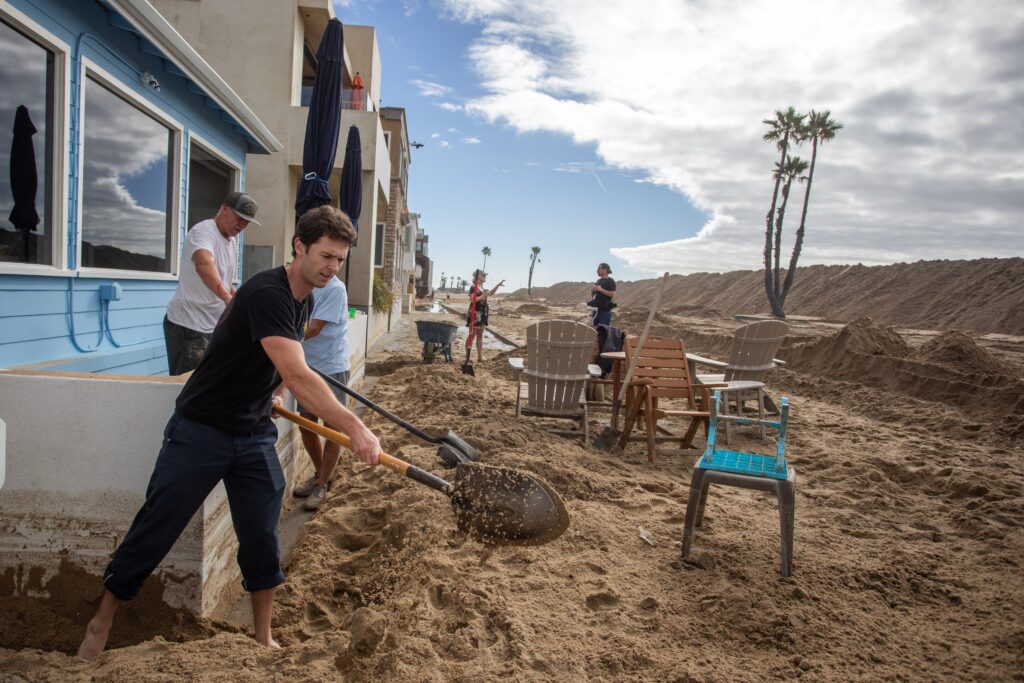
Beachfront residents in Dana Point spent hundreds of thousands of dollars this fall to build a rock wall between them and the waves wrecking their dream homes. But it may not be enough to protect them from the confluence of events set to wallop California’s coast this week.
The waves predicted will likely “breach over their rock armoring and over sea walls and probably into some living rooms,” said Donal Russell, general manager of the local government agency that oversees the vulnerable homes on Beach Road.
There’s not much residents can do.
“Homeowners now, they just duck and cover,” Russell said. “Make sure your plywood barriers over your windows is secure, get your patio furniture off your deck, and just batten down.”
Rising sea levels, driven by the warm waters of record-breaking El Niño, will collide with an extra-high “king tide” and big waves generated by a storm in the Gulf of Alaska, threatening coastal communities already battered by earlier flooding.
Northern Californians will get the added effect of heavy rain.
The mayor of San Francisco warned of “high tides and rain that this city has never seen before,” asking the public to avoid all but essential travel in the days leading up to Thanksgiving. The National Weather Service in the Bay Area said low areas would be prone to flooding, including San Francisco International Airport; airport officials said they have sandbags and backup pumps ready.
Marin County urged residents to “avoid nonessential travel” during peak tide hours Tuesday through Thanksgiving. In the far north, Humboldt County issuedevacuation warnings for two small communities at risk of flooding.
And Southern California cities like Newport Beach, Seal Beach and Long Beach have put up miles of sand berms, some 15 feet tall or higher, to try to keep the ocean back.
In Dana Point, in southern Orange County, Russell said this year’s surf has been more destructive than anything he’s seen in 30 years as district manager. “I hope it’s not the new normal,” he said. Ten homes have recently been “red-tagged” as uninhabitable due to sea damage; some are now demolished.
Dana Point Mayor John Gabbard said he’s worried a storm could compromise the road that runs behind the beach homes. “Then we have to start talking about evacuations,” he said.
“It’s gonna be a tough week for a lot of folks — not just Beach Road,” Gabbard said.
Sea levels are already higher than usual along California’s coast because of El Niño, a natural warming of the tropical Pacific Ocean that occurs every two to seven years.
Trade winds that usually push warm tropical water toward the western Pacific have occasionally reversed this year. That set off Kelvin waves, bulges of warm water that surged east, piled up along the coast of South America and spread north and south. A marine heat wave off California is raising sea levels even further.
This week’s king tide will surge about eight feet in Southern California, according to Dave Munyan, meteorologist at the National Weather Service in San Diego, posing a particular threat to lower-lying communities that already saw flooding last month.
Last month’s damage occurred when the ocean was “fairly quiet,” Munyan said. “It was just the tides alone that contributed to the coastal flooding we saw.”
This week, a storm brewing in the Pacific could add waves of more than five feet — maybe eight, he said.
The king tide is arriving a week after a powerful stormthat soaked much of California and left some roads and buildings flooded. Earlier storms eroded beaches and battered oceanfront homes.
“We have already seen flooding this season and that occurred with blue skies and no rain,” Marin County Executive Derek Johnson said in an advisory last week. “With Thanksgiving travel, king tides and rain potentially coming together, we need everyone to take this seriously.”
Officials around the state say they have prepared, staging equipment such as sandbags and pumps ahead of time. California declared a statewide emergency over El Niño in September.
But there’s only so much communities right on the coast can do in the face of long-term sea-level rise, said Gary Griggs, a coastal scientist and professor at the University of California at Santa Cruz.
Sea walls and interventions such as sand replenishment for eroding beaches are “Band-Aids,” Griggs said.
“In the long run it’s going to be managed retreat or unmanaged retreat, and that’s challenging in California — because people that live on the coast in California don’t want to be managed, and don’t want to retreat,” he added.
Meteorologist Ben Noll contributed to this report.
The post California braces for more record tides and big waves that could batter coast appeared first on Washington Post.