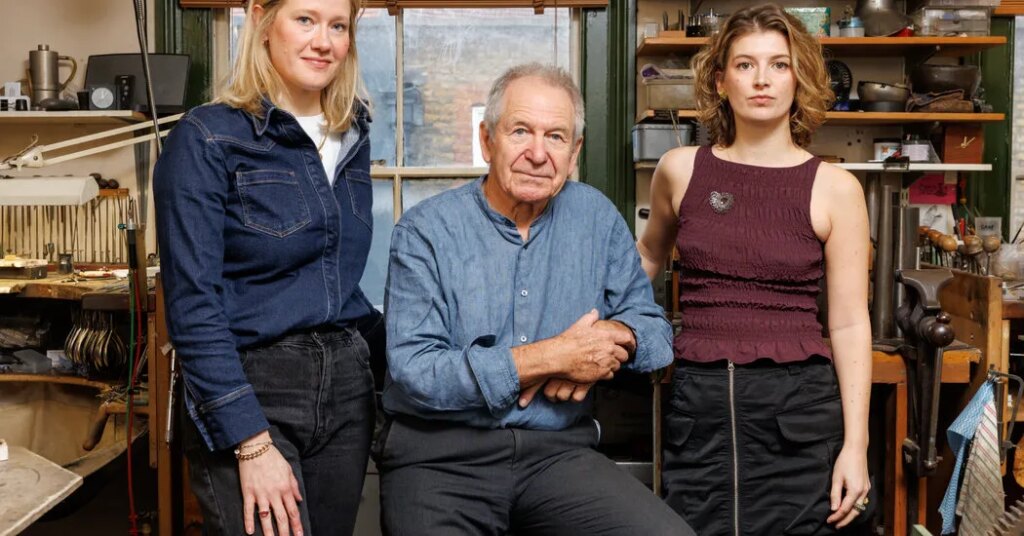
On the top floor of a Grade II-listed Georgian building in London’s West End there is a jewelry workshop. Here, the transmission of craft skills across generations, which has been happening for centuries, continues to this day.
“This could even be the oldest jewelry workshop in London by the fact it was established in 1840 and is still going,” said Tom Scott, 80, who first rented the space in 1968, when he graduated from Hornsey School of Art. He has been working as a goldsmith here ever since.
Over the decades that he has worked in this 300-square-foot space, Mr. Scott’s clients have included rock stars, Russian oligarchs and royalty as well as prominent jewelry houses such as Grima, founded by the renowned ’60s designer Andrew Grima.
On one shelf is a catalog detailing Mr. Scott’s 1971 solo exhibition at Wartski, the prestigious jewelers and antique dealers in London.
“Tom comes from an era of experimentation, when bold, organic forms were incorporated into beautiful wearable art and technical challenges were welcomed and overcome,” said Joanna Hardy, a jewelry specialist, TV personality and member of the senior leadership at the Goldsmiths’ Company, which operates the London Assay Office. “There is no such phrase as ‘That can’t be done’; instead, it is always, ‘Let’s try this.’”
Describing Mr. Scott as a “master craftsperson,” she continued: “Tom’s workshop is a hidden treasure, much like Tom himself. Only recently has he begun sharing his workshop with two young goldsmiths — Georgie Carton and Megan Brown — passing on his invaluable gold smithing skills to the next generation.”
An Influence
Ms. Carton, who now creates pieces under her Georgie Carton brand, was introduced to Mr. Scott in 2020 while she was working at the London jeweler Graff. “Meeting him was a real ‘sliding doors’ moment, and without it, I don’t know where I’d be,” Ms. Carton, a 37-year-old jeweler, said.
She graduated in 2010 with a degree in psychology, but four years later, when she was working in her uncle’s jewelry store in Dublin, she realized she loved the industry and wanted to be part of it. So she retrained from 2016 to 2018 at the British Academy of Jewellery, now defunct, in London.
She moved into Mr. Scott’s workshop in mid-2020 and, for the last two years, has divided her time between it and McKenna & Co., a jeweler in the Knightsbridge area.
“From Tom I’ve learnt to assemble jewelry nontraditionally and traditionally,” she said. “Through him, I’ve been able to work on and complete Grima pieces, which have, without question, influenced the way I approach my own work, whether it be an alternative way of setting stones or texturizing metal or using diamonds as a way to compliment a piece, rather than making the diamonds the focal point.” For example, a 22-karat Yellow Gold Stacking Ring is 2,000 pounds ($2,680) and £2,750 with diamonds.
Among Ms. Carton’s most important commissions was a pair of 18-karat gold badges that, with Mr. Scott’s guidance, she completed in 2025 for the incoming prime warden and the first female clerk of the Goldsmiths’ Company.
She said she engraved the badges with what is known as a Florentine finish: “I don’t think you can beat the silklike look it gives.”
In the Blood
Craft, specifically weaving, is in Ms. Brown’s blood. Her family’s Yorkshire woolen mill, Alfred Brown, is a worsted suiting specialist that was established in 1915 and has been in the family for five generations.
Its influence can be seen in her work, such as the bespoke Houndstooth Sapphire Ring, which displays a 1.68-carat emerald-cut yellow sapphire (price on application).
The band, which is 12 millimeters (0.5 inches) wide, was woven by hand from platinum and 18 karat white gold wire, a technique that Ms. Brown described as “technically demanding” and creating “a fluid, textile-like structure.”
In the workshop, Ms. Brown learned from Mr. Scott how to make wire in shapes such as circular, triangular or square: Molten gold is poured into an ingot mold, which has narrow channels to create rods in the proper shape. Once cooled, the rods are then sent through a rolling mill machine and, finally, pulled through what is called a draw plate to produce the desired shape and width. (A French draw plate dated May 1771 is still in use in the workshop.)
“We still use the same tools that have been passed down from generations of makers,” said Ms. Brown, 31. “Tom has taught me that you can adapt and create a lot of the tools yourself, which has been helpful when making my handwoven work, which lends itself to this traditional way of working.”
Ms. Brown graduated with a fashion degree from Edinburgh College of Art, but decided her interest in fabric and weaving was more suited to jewelry and established Megan Brown Jewellery in 2016.
She went on to study at Bishopsland Educational Trust in Oxfordshire, which specializes in silver smithing and jewelry training, and did a residency from 2022-23 at Sarabande, a foundation established in 2007 in London by the fashion designer Alexander McQueen.
She moved into Mr. Scott’s workshop in 2023, the same year she became a freeman, or entry-level member, of the Worshipful Company of Gold and Silver Wyre Drawers, one of London’s traditional livery companies, or guilds.
Ms. Brown described the arrangement with Mr. Scott as an “informal apprenticeship.”
“To me, he’s a master more than a goldsmith,” she said, “mentoring me so that he might pass on his knowledge to a new generation.”
In 2025 Ms. Brown’s designs debuted at Dover Street Market in London and Joyce Hong Kong. And in March, during Paris Fashion Week, her jewelry in 18-karat woven gold, called Replica, inspired by her collection of bespoke jewelry, debuted at the NouvelleBox exhibition. The collection, at £1,000 to £12,500, now is sold on Ms. Brown’s website, meganbrownjewellery.com.
“Everything is hand made by me first,” she said. “Then molds are made of the pieces. I cast it, finish it and Tom sets it all here. With Replica, even though it’s a collection that’s repeated, it’s still all made within this one room.”
Ms. Brown has been active in the jewelry community. In July she participated in a panel on “British Mastery: Textile Techniques in Goldsmithing,” part of the annual Gold + Diamond Conference in New York City. Then, in September during the Goldsmiths’ Fair in London, she was part of a panel discussion led by Bella Neyman, the founder of NYC Jewelry Week.
“I was so pleased to discover Megan’s work,” Ms. Neyman wrote in an email. “I think her technique of weaving gold wire is exceptional. She is not only following the longstanding tradition of weaving with gold by creating tightly knit designs — although she still makes them her own through asymmetry and the stone settings — but she is now experimenting with looser weaves, and the results are just exquisite.”
Ms. Brown is scheduled to display her work at Sarabande’s House of Bandits jewelry event from Nov. 23 to 29 at 40 Duke, Selfridges’s private members club off Oxford Street. And she is preparing a few one-of-a-kind pieces using Old Mine-cut diamonds and Asscher-cut emeralds in woven 18-karat gold, platinum and palladium settings for the Thesis Gems & Jewelry event on Dec. 6 in San Francisco.
“I began designing and making jewelry over a decade ago,” she said. “It’s surreal to think that in that time I’ve developed this unique technique that I’m now recognized for across the world.”
The post Transferring Goldsmith Skills From One Generation to the Next appeared first on New York Times.