South Korea’s education minister has resigned after intense backlash against new rules meant to prevent cheating using artificial intelligence during the country’s high-stakes college entrance exams.
Choi Kyo-jin announced his resignation on Sunday in response to “criticism or blame from the public for failing to prepare adequately in advance.” The Ministry of Education had announced the new exam measures on Tuesday, just two days before nearly 500,000 South Koreans took the hourslong College Scholastic Ability Test, also called Suneung.
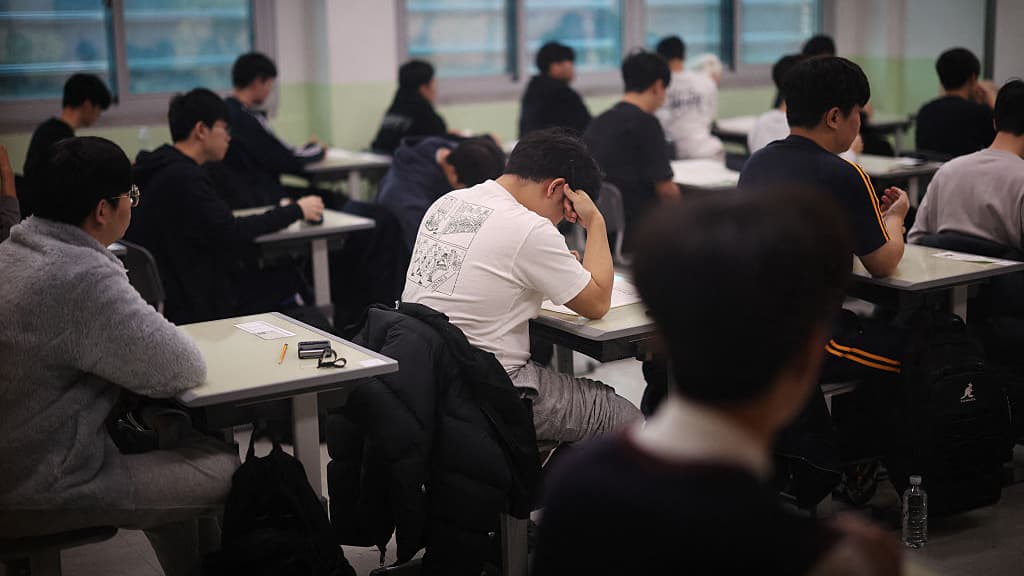
Under the new rules, test-takers were required to have their glasses inspected, cover their shirt buttons to prevent the use of cameras, and roll up their sleeves. Alerts were also sent to all cellphones across the country at random times to expose any devices that students kept with them during the exam. The alerts used the country’s emergency alert system, typically reserved for a natural disaster. The government deployed additional invigilators, who received video training a day before the exam. Authorities also shut down public Wi-Fi around test centers.
The measures drew fierce criticism. Some teachers said the inspections may have made their students nervous or distracted. “It is sad to see children who should be focusing only on the exam so on edge. They worry that what they wear or how they handle a pencil in the exam room could make them look suspicious,” a high school teacher told Korea JoongAng Daily.
“This year, problems like AI cheating meant one change after another right up until the exam, so the students are even more nervous,” another teacher said.
One student told the New York Times that she was anxious that another student might have brought in a phone, which would cause the loud alert to go off and disturb everyone else in the room.
Students, parents, and opposition political parties called for a postponement. Jang Dong-hyeok, the leader of the People Power Party, posted that the exam “must not be forced ahead when its fairness is not guaranteed.” The Reform Party urged the government to consider postponing the exam in order to ensure reliable anti-cheating measures.
After the exam went ahead as scheduled, pressure mounted on Choi to resign.
Test-Takers’ Solidarity, an association of high school seniors and other exam candidates, called for the minister’s resignation. The group said in a Nov. 21 statement that schools did not uniformly implement the rules, and described the last-minute changes as a “dereliction of duty” by the ministry.”
Another group of high school and college students announced plans to hold a rally in December, demanding better measures to ensure academic integrity and calling for universities to postpone admissions announcements.
Teachers’ unions also said the measures shifted responsibility to invigilators without adequate support or preparation.
The Korean Federation of Teachers’ Associations (KFTA) called for Choi to resign in a Nov. 17 statement, saying, “Will hurriedly selecting supervisors today, training them tomorrow, and deploying them the day after tomorrow really create the expertise to identify sophisticated AI cheating?”
Gruelling exam culture
South Korea’s college entrance exam is so critical that the country nearly comes to a standstill for the eight hours that it takes place. During the listening portion of the test, flights are grounded and construction paused. Authorities restrict traffic around test centers and ask the public to keep noise down, while public transit and work hours are adjusted to minimize disruptions. Test makers and reviewers are kept in isolation for 40 days before the exam to keep the questions secret.
The exam, which includes sections on Korean, English, math, history, and other subjects, plays a major role in determining which universities in the country students can get into. The country’s three most prestigious universities—Seoul National University, Korea University, and Yonsei University—said they planned to offer a total 12,200 places for the 2027 academic year, or around 2.2% of this year’s exam registrants. The exam was first held in 1993.
Competition for elite university places has fuelled a “cram” culture, with many students spending years preparing for the national exam. Families spent 27.5 trillion Korean won ($20 billion) on private lessons for elementary, middle, and high school students in 2025. The same year, around 3.8 million students took private lessons, including at the 95,000 private academies, or hagwons, registered across the country.
A 2025 national mental health survey found that more than half of high school girls and a third of high school boys “usually” felt a lot of stress. Rising suicide rates among teenagers have also prompted concerns about academic pressure. In June last year, the death of three students at an arts high school in Busan prompted a special audit. Police said the students appeared to have been struggling with anxiety about their futures. The audit did not establish what led to their deaths, which authorities suspected to be suicide, although it uncovered cases of employee misconduct.
The stakes of the exam also put more pressure on preventing cheating and ensuring fairness. In December 2025, the head test maker issued an official apology and resigned after test takers complained about an overly difficult English section. Only 3.11% of test takers earned the highest grade in English last year, half the share from the year before.
Grappling with AI in schools
Concerns about possible cheating using AI grew ahead of Thursday’s test. Nearly 700 posts calling for stronger safeguards against AI-assisted cheating and a postponement of the exam appeared on the online Q&A board of the institute that sets the test, as of 9 a.m. on Nov. 16.
The government had initially set rules focused on smart glasses. But officials announced the additional measures after the top scorer on South Korea’s certified tax accountant exam admitted on Nov. 15 to using a miniature camera, smartphone, and generative AI to cheat.
The government has tried to clamp down on suspected AI-assisted cheating. Prior to the test, President Lee Jae Myung offered a reward of at least 100 million won ($75,000) to people who reported cheaters. The Ministry of Education also warned that cheaters could face criminal charges. The government said it would seek legislation for cheaters to be banned from retaking the exam for up to 10 years.
“Cheating on exams using advanced equipment is no different from stealing the scores of hundreds of thousands of examinees who worked hard,” Lee posted on Nov. 17. “If anyone is considering cheating on the exam, please do not ruin your life by hoping for a lucky break. Give it up for your own sake and everyone else’s.”
According to the ministry, 111 people were suspected of using electronic devices to cheat on the exam, including 54 who were caught through the nationwide phone alerts. Authorities set up a task force to review Wi-Fi and Bluetooth signals recorded by invigilators during the test to catch other suspicious cases for investigation. Lee said AI companies would also provide user records to the government of questions photographed from the test during the exam period. The government did not name which companies had agreed to share data, and no companies have publicly commented.
But the cheating controversy has intensified debate on how, and whether, the government can ensure fairness without creating undue stress. On Friday, Lee called for a sweeping overhaul of national exams. The country’s National Education Commission was already considering more written and essay questions on the test. Some education officials also proposed giving universities more discretion in how they select students, with the exam acting more as a qualifying exam.
The exam rules are not the first instance of the South Korean government seeking to get to grips with rising AI use. Last year, South Korea’s National Assembly reclassified AI-powered digital textbooks as optional supplementary materials, scaling back the previous administration’s planned nationwide rollout of AI textbooks.
Around the world, authorities have taken different steps to deter cheating using AI. In China, major tech companies temporarily disabled features like image recognition and question answering during the 2025 national university entrance exam, also called gaokao. China’s education authorities have long taken extreme measures to curb cheating, including jail time for violators and flying drones over testing centers to scan for signals.
Norway’s education directorate locked computers for selected exams this year, curtailing students’ online access to digital resources provided with the exam.
Other governments have grappled with setting the boundaries for AI use in schools and among youth.
In New York City, public schools blocked ChatGPT on school devices and networks in early 2023. The district imposed a moratorium on student-facing generative AI through eighth grade and limited high school students to approved tools for this school year.
Read More: School Phone Bans Show Small Learning Gains. Are They Worth It?
Meanwhile, the Australian state of New South Wales rolled out its own chatbot for public school students last year. The chatbot is designed to guide students through questions and prompt them to reason through their answers.
The post South Korean Education Minister Resigns After Backlash Toward Anti-AI Measures appeared first on TIME.