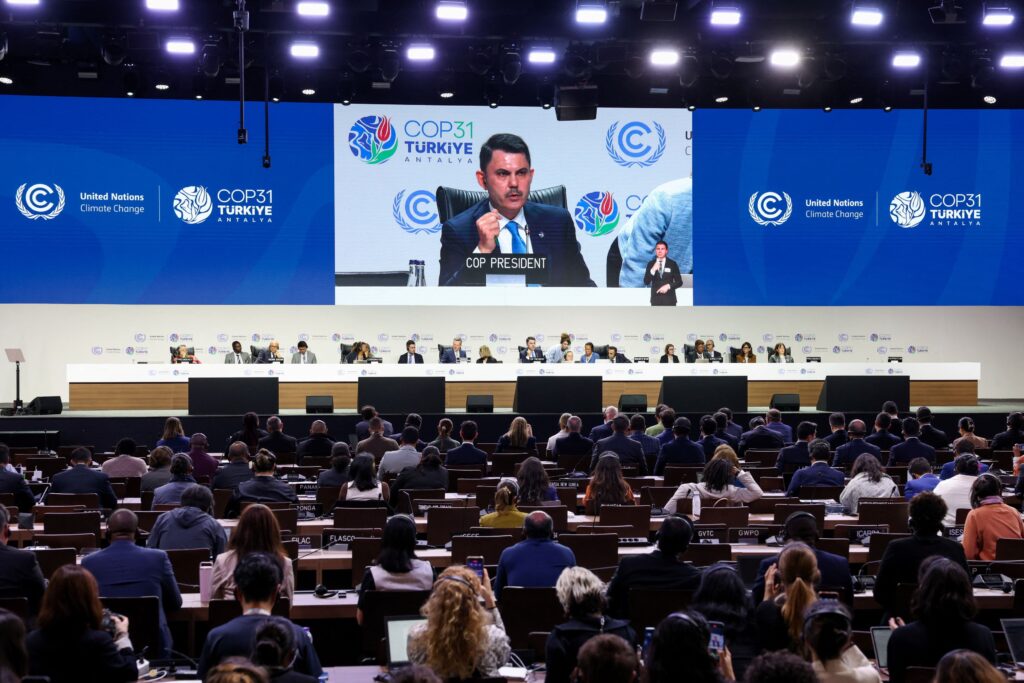
The U.N. climate summit in Turkey broke down Sunday, after stark disagreements over the future of fossil fuels kept countries from reaching consensus on a proposed agreement for tackling global warming.
The negotiations’ collapse — the first in over a decade — underscored the deep rift between oil producers and other nations, who had pressed for a more meaningful deal as evidence of climate-fueled damages continue to mount.
As it became clear that the 31st U.N. Climate Change Conference, known as COP31, would not produce an agreement, U.N. Secretary General António Guterres blamed the breakdown on “powerful fossil fuel interests,” which he said have held too much sway over climate negotiations and blocked policies that would rein in uncontrolled warming.
“There may be no consensus in the negotiating room, but there is no ambiguity in the science,” he said. “Those who profit from the destruction of our planet must never dictate the terms of the fight to save it.”
The disappointing outcome comes at the end of a year marked by deadly heat waves, destructive wildfires and devastating floods, which scientists project could become the hottest on record.
Just months before the conference began, a panel of U.N. researchers published a first-of-its-kind report warning that humanity had run out of time to prevent temperatures from exceeding 1.5 degrees Celsius (2.7 degrees Fahrenheit) above preindustrial levels — a key threshold set in past climate talks. Only by zeroing out greenhouse gas emissions and deploying technology to pull carbon out of the atmosphere can the world protect people and ecosystems from potentially irreversible impacts, the researchers said.
Yet the draft text of the summit’s cover decision — a broad political document used to communicate the world’s overarching priorities — excluded any explicit reference to fossil fuels, the primary driver of human-caused climate change. The proposal instead referred indirectly to an agreement reached at COP28 in Dubai, which committed countries to a transition away from fossil fuels, without repeating that pledge.
Saudi Arabia and other major oil and gas producers pushed back hardest against having any fossil fuel language, and the United States, which typically works to broker the consensus required for any agreement, declined to send a delegation to the talks this year.
As talks entered their final days, President Donald Trump — who has twice withdrawn the U.S. from the Paris climate agreement — was at a summit with Russia’s Vladimir Putin and China’s Xi Jinping, where the leaders committed to “increase the production and supply of refined petroleum products.”
Some of the strongest pushback to the draft cover decision came from the European Union, which formally objected to text it said fell “well short” of what was needed to fight climate change.
“We will not accept negotiating backward in time, and we will not accept a COP that greenwashes fossil fuel,” Irish Climate Minister Darragh O’Brien said, speaking on behalf of the E.U.
David Waskow, director of international climate initiatives for the World Resources Institute and a longtime COP attendee, said he had never seen a collapse of this kind before.
While other summits have broken down while negotiating major new agreements or hammering out complex rules for implementing treaties, nations failed to agree on a basic path forward on “some of the most fundamental divides in a world facing overshoot of 1.5 degrees,” he said.
Some negotiators also faulted the leadership of Turkey and Australia, which co-hosted the summit. At the chaotic final plenary, negotiators argued and interrupted one another, and E.U. officials walked out before the session had ended.
In a short speech, COP31 President Murat Kurum of Turkey conceded defeat, saying, “We recognize that there is no consensus on this document. Therefore, these decisions have not been adopted.”
Negotiations among nearly 200 countries ran into their second day of overtime — making the climate summit the longest in history. It surpassed COP25, held in Madrid in 2019, which ran more than 40 hours beyond its scheduled conclusion.
Petro-states argued that individual countries should decide for themselves how to meet their energy needs, and they pushed heavily for carbon-capture technologies instead of a collective commitment to a phaseout.
Russian climate envoy Ruslan Edelgeriyev told reporters earlier this month that with the energy market already under “excessive pressure” from “the well-known strait [issue] and other factors,” a reference to the U.S. blockade of the Strait of Hormuz during its war with Iran, talk of such a phaseout is “absolutely inappropriate, because it will additionally affect the price.”
Russia and Saudi Arabia have repeatedly pushed to weaken climate commitments at the U.N. talks, often with success. At COP28 in Dubai, countries led by Russia, the world’s second-biggest gas producer, won a paragraph recognizing that “transitional fuels” can play a role in the energy transition. At COP30 in Brazil, Russia and Saudi Arabia opposed creating a process or timetable to move away from fossil fuels, and the final agreement did not mention fossil fuels at all.
Though COP31 began with a call to power more of the global economy with electricity, preferably from sources such as solar and wind, Sunday’s draft text removed explicit references to tripling global renewable-energy capacity and doubling the rate of energy-efficiency improvements by 2030. Instead, it called more broadly for efforts to “increase clean energy,” improve energy efficiency and deploy other low-emission technologies.
That shift left the commitment less specific about how countries should achieve the target. The draft did not require the additional electricity to come from renewable sources such as wind and solar, leaving the door open to electrification powered by coal and natural gas.
A proposal to accelerate the deployment of carbon capture utilization and storage — technology that sucks up emissions from power plants and other point sources and either reuses the gases or injects them deep underground — also proved a flash point. Opponents said the language, which called for capturing a gigaton (or 2.2 trillion pounds) of carbon by 2035, would enable continued reliance on polluting fuels without reducing the amount of carbon already in the atmosphere.
Harjeet Singh, an India-based climate activist and adviser to the Fossil Fuel Non-Proliferation Treaty Initiative, applauded negotiators for rejecting the text, which he said “would have made Antalya the COP that opened the floodgates to carbon capture.”
“No deal is better than a deal that locks in failure,” he said.
Li Shuo, a Washington-based climate analyst at the Asia Society Policy Institute, said several geopolitical and economic factors hampered the talks, including Trump’s tariffs, the Ukraine war’s impact on Europe and the United States’ lack of participation.
“The big-picture storyline here is the tremendous amount of challenges that the international climate agenda is facing,” he said.
Beyond discussions of fossil fuels, he added, the talks were inhibited by a lack of funding from wealthy countries to support lower-income regions struggling to deal with climate impacts already underway.
Developing nations fought to secure an agreement to triple adaptation financing to $120 billion by 2035. They also sought greater contributions to a loss and damage fund established at COP27 to compensate vulnerable nations for the disasters they could not avoid.
But the absence of the United States, the world’s richest nation and biggest historical emitter, as well as belt-tightening measures and weakened climate policies in the E.U. meant those calls went unanswered. China, which sees itself as a developing nation despite being the world’s second-largest economy, has not filled the financial void left by the U.S.
“We are witnessing human suffering on an unimaginable scale, and we had hoped this COP would take steps to protect people from the worsening climate crisis,” Tasneem Essop, executive director of the activist group Climate Action Network International, said in a statement. “Instead, rich nations gutted the very measures that could have made a difference.”
“This was the worst COP ever,” she added.
The post COP31 negotiations break down as countries fail to agree on climate deal appeared first on Washington Post.