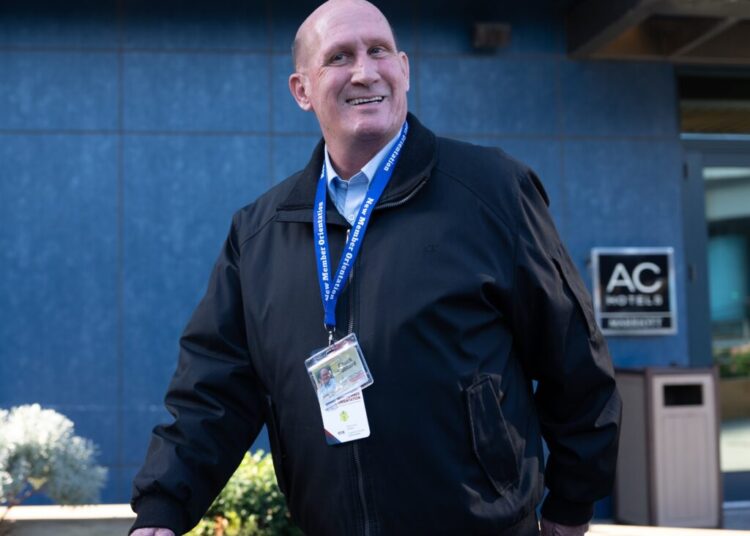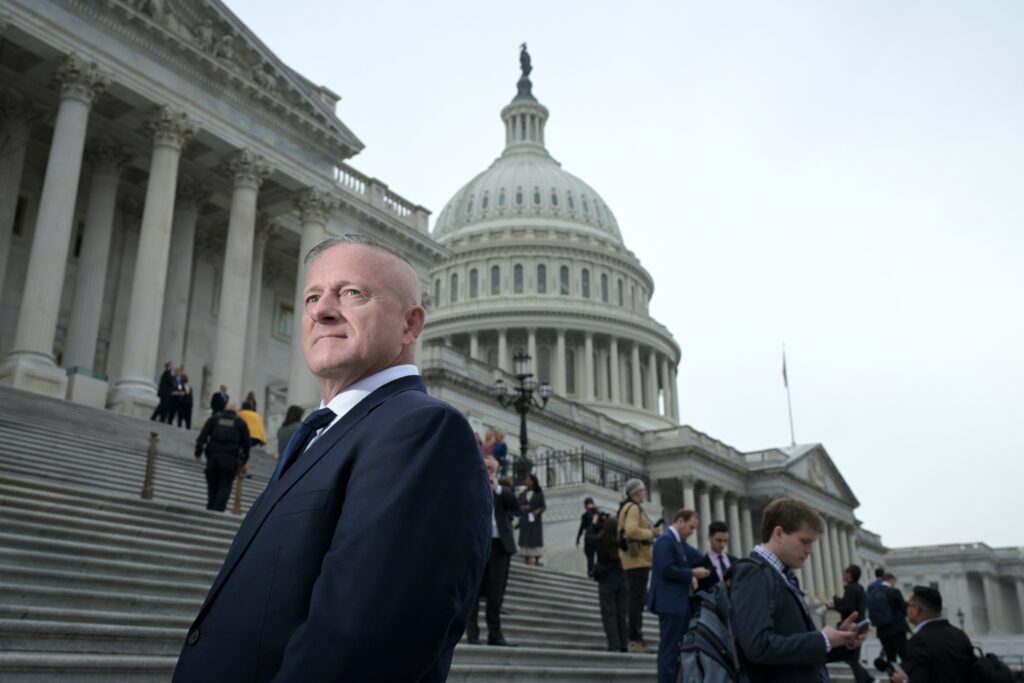
To hear Richard Ojeda tell it, life is a series of ass whoopings. You want respect? Prove you’ll square up.
The 56-year-old combat veteran grew up fist-fighting so frequently that he was invited to try out for his high school wrestling team. He has a history of outrageous statements and online spats, including one in which he wished cancer on a local prosecutor, that have led to legal battles.
Now, he’s coming to Congress — a long-shot candidate swept into the House by the blue wave that buoyed Democrats across the country. Ojeda notched a victory that the party particularly relished, toppling Richard Hudson, the seven-term congressman from North Carolina who chaired the GOP’s congressional campaign arm in a district that was considered a Republican stronghold.
On Capitol Hill, lawmakers these days know that hamming it up for social media is just another part of the job. But theatrics alone are insufficient to pass legislation or to keep your seat. Voters this year showed some of the Hill’s biggest personalities the door. Reps. Lauren Boebert, Nancy Mace and Jasmine Crockett are all on their way out after congressional tenures marked by attention-grabbing moments.
Ojeda knows what he wants to fight for. Cracking down on Big Pharma is a priority for Ojeda, who was raised in a community devastated by the opioid crisis. A veteran of a 24-year military career, he wants to end the Iran war and impeach Defense Secretary Pete Hegseth. He’s determined to pass legislation reversing the Citizens United court ruling, which helped unleash sketchy and unlimited campaign spending.
Achieving his lofty goals would require a serious commitment to learning the parts of the job that a camera won’t catch.
A new Congress presents endless opportunities to get attention: hearings, interviews, high-stakes votes, all of it translating into the potential for exposure and followers, with no shortage of people and situations he’d find infuriating.
Other work on the Hill is less visible: The negotiation, research and compromise that leads to successful bills, and the unglamorous labor of actually legislating.
As Ojeda prepares to step on to his biggest stage yet, he could rise to the office, or he could succumb to impulse and empty performance like others before him.
“I’m Richard Ojeda,” he told The Washington Post, reflecting on his transition into the new job. “But I have to elevate myself to be Congressman Richard Ojeda.”
The question now: Will he?
“Hard launching the new ‘Belt to Ass Congressman’ from North Carolina,” Ojeda’s team posted on X, as he sat in the first day of freshman orientation in Washington. It was a nod to another post that had ricocheted around social media, in which Ojeda had used the phrase to call for accountability for Hegseth and Trump border czar Tom Homan.
“I grew up in a place where, if you did the wrong things, you got your belt to ass!” Ojeda later explained to a reporter.
In a narrow mountain valley called Whitman Creek, Ojeda was raised by a family that knew how to tussle. His father moved to the United States from Mexico, eventually bringing the family to southern West Virginia. Picked on for speaking Spanish, Ojeda’s father changed the way he pronounced his last name to an Americanized, hard “J” – the way his son now says it. Ojeda’s family members worked in the mines and were often on strike, he said. They didn’t shy away from picket lines that turned violent.
Ojeda was a brawler, too. “I was small, so I had to feel I had to compensate,” said Ojeda (an aide says he is 5-foot-8). After high school, Ojeda joined the Army. He deployed to Iraq, Afghanistan, and, after the 2010 earthquake, to Haiti. Ojeda spent around 16 years at Fort Bragg, North Carolina, in the district he will soon represent.
Abroad, 13 of his friends were killed in action, he said — men whose names are tattooed on his back, among the ink sprawling across his rib cage, shoulders, legs and feet. Five times, Ojeda had close calls himself, surviving an ambush, an IED attack and near-capture, he said. He was decorated with two Bronze Stars and retired as a major.
At home, Ojeda was losing friends and family to the opioid epidemic.
Back in West Virginia, he formed an organization called the Logan Empowerment Action and Development community organization, focused on fixing local problems, and holding food and clothing drives.
Half the battle, he learned, was getting attention — especially from leaders, whom he often felt weren’t doing enough. Ojeda began running for office himself.
In 2014, Ojeda ran for Congress in West Virginia’s 3rd District. He didn’t make it past the primary. In 2016, he ran for the West Virginia state Senate and won. Days before his primary, Ojeda was attacked at a campaign event by a man he knew. He was beaten so severely that he was knocked out and hospitalized with broken bones in his face. The man faced prison time over the assault.
In 2018, Ojeda again ran an unsuccessful congressional bid. Then, he launched another campaign — this time, for president. He dropped out after less than three months. In 2020, he ran for the U.S. Senate seat held by Sen. Shelley Moore Capito (R-West Virginia). He lost in the primary. That year, Ojeda and his wife, Kelly, moved back to North Carolina. In 2025, he launched another campaign for Congress, this time, challenging Hudson, chair of the National Republican Congressional Committee.
Over the course of his back-to-back campaigns, Ojeda drew national attention — in part for his populist platform that fueled Democratic hopes of winning over rural voters in Trump country.
He also made headlines over ugly incidents where he lashed out at others online.
In 2018, a man Ojeda knew posted a video on Facebook criticizing Ojeda’s driving. Ojeda, then a state senator running for Congress, fired back with an angry video of his own on his campaign Facebook page, criticizing the man for supporting Ojeda’s opponent in a previous race and calling for the man’s employer to fire him over what Ojeda described as driving recklessly in a company vehicle. In a subsequent lawsuit, the man said Ojeda also called his employer, and he was fired shortly after.
In a recent interview, Ojeda said he responded that way because he “was being messed with.” Ojeda acknowledged he called the man’s employer, but said he was told the firing was already in the works. The case was settled privately.
In September 2020, two months before his presidential run, Ojeda posted a 23-minute video to his Facebook page criticizing how authorities had handled the criminal case against the man who assaulted him, court documents show.
“I wish cancer upon you!” Ojeda said in the video, a statement directed at the Logan County prosecuting attorney.
Ojeda later sued a Republican who used snippets of the video in a campaign ad. The case was dismissed.
“I don’t wish cancer upon anyone, but I do wish that justice would have been served,” Ojeda told The Post last week.
“I was extremely angered. I was almost murdered,” he said, reflecting on his comments. He said he had felt betrayed by the plea deal that was reached with his attacker. Then, he was angry that the man was released earlier than he had expected. “That’s why I said I wish cancer on these people, because you know what, they made my wife and my children have to show up in a daggone emergency room and look at me on a damn table covered in blood.”
An aide pointed out that he has not been involved with such incidents in the last few years. “We’ve seen him transition from what it means to be a combat soldier to someone who’s running for office. And it’s been a slow process,” the aide said.
“I grew up in the combat arms,” Ojeda added. “When you grow up like that, it goes with you.”
He’s not planning to bring some of those tactics to the U.S. Capitol, he said. But it also isn’t yet clear where he draws the line. “I’m not going up there to get in fistfights in the damn hallways,” Ojeda said. “But make no mistake. I’m also not going to go up there and get pushed around by people.”
This month, as the first day of orientation drew to a close, Ojeda filed into the House chamber with his new colleagues to hear from a man he hated: Speaker Mike Johnson (R-Louisiana).
But when Johnson stepped up to the lectern, he had a question — where was Richard Ojeda?
The speaker of the House had seen a video Ojeda had posted after his win. In it, Ojeda leans over his father on election night and delivers an unexpected update: His son was going to Congress. His father beams. “I love you,” they tell each other. “We did it.”
The moment was captured in a video that Ojeda posted on social media when he shared the news that, just three days after his victory, his father had died.
Johnson lost his own father three days before winning his first election to Congress, he told Ojeda.
“The fact that he spoke of my father on that floor, it made him human in my eyes,” Ojeda said. “I’m a liberal, and he’s a conservative. But I’m not going to look at him with hatred anymore.”
That doesn’t extend to all Republicans, apparently. Days later, Ojeda expanded the list of targets he deems in need of a “Belt to Ass” to include Transportation Secretary Sean P. Duffy and Homeland Security Secretary Markwayne Mullin.
On his website, he started selling “Belt to Ass” T-shirts, 100 percent cotton.
The post A lifelong brawler is coming to Congress. Does he have a next act? appeared first on Washington Post.