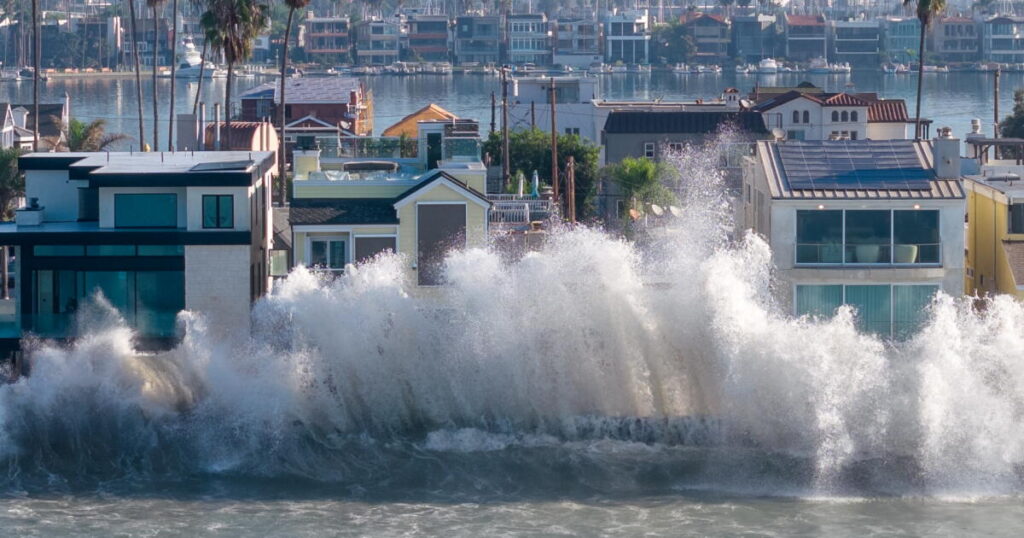
In just the first weeks of a record-breaking El Niño, images of tidal flooding and wave-shattered boardwalks have laid bare the futility — and immense cost — of trying to hold back the rising sea.
The wreckage is a visceral glimpse into what a few additional feet of sea level rise could look like along California’s coast, and some experts say it’s time to rethink how to face the future.
Rather than pour millions of taxpayer dollars into emergency seawalls, sandbags and berms that will inevitably wash away, why not help local governments buy up properties at risk of falling into the ocean in the next decade or two — and then rent them out at market value to recoup costs? And once the flooding becomes untenable, officials could demolish the properties and perhaps restore the area as a public beach, or marsh or some other form of natural protection from the sea.
But this plan only works, experts say, while there’s still time.
This buy-and-rent-back strategy won widespread support in the state Legislature when the bills were proposed in 2021 and 2022, but the legislation was ultimately vetoed by Gov. Gavin Newsom.
Now, climate adaptation experts say it’s not too late to try again. Even a pilot program could be game-changing.
“What was great about this proposal is still great about this proposal,” said A.R. Siders, a nationally recognized expert on community relocation at the University of Delaware’s Disaster Research Center. “This is a real opportunity for California to take leadership on this. …It’s low risk, too: It sounds expensive, but the cost of buying a few properties is not that high in the grand scheme of how much money we pour into disaster response.”
At least $8 billion to $10 billion in property along the California coast could be underwater by 2050, with an additional $6 billion to $10 billion at risk during high tide, according to legislative analysts, who sounded the alarm in 2019 and reported that any action, or lack of action, within 10 years could determine the fate of the state’s iconic shoreline.
But the matter remains a tough balancing act. There are only so many ways to protect critical infrastructure, homes, beaches and neighborhoods from the rising sea, and each option comes at a cost and is fraught with controversy.
Take seawalls, which tend to be the default response for a community facing disaster. While seemingly effective in protecting homes and infrastructure, seawalls essentially kill beaches — disrupting the natural migration of the shoreline and drowning out the sand in front of the wall until it narrows or vanishes altogether.
Adding sand to an eroding shoreline has also become a go-to response for communities, but this race against nature requires constant upkeep — and lasts only as long as the sand stays on the beach.
And then there’s managed retreat — creating a proactive, orderly process to relocate properties and critical infrastructure far enough from the water to make room for the next few decades of sea level rise. This option often pencils out as the most cost-effective and forward-thinking, but the logistical challenges of translating short-term interests (preserving property values) into long-term planning (getting out of harm’s way before the water arrives) have been a political nonstarter.
These difficult questions weighed on Sen. Ben Allen (D-Santa Monica), who proposed the buy-and-rent-back idea in 2021 through Senate Bill 83 as a possible way forward.
The voluntary program would have given homeowners the chance to move on their own terms — and sell their beachfront properties while they still have value, Allen said. Taxpayers, in turn, wouldn’t be burdened with the shocking costs of cleaning up after an emergency. An oft-cited study by the National Institute of Building Sciences found that society as a whole saves at least $6 in avoided costs for every $1 spent to acquire or demolish flood-prone buildings before disaster hits.
“The idea was, how do we change the game with regard to the costs and liabilities?” Allen said. “We saw the enormous political, moral, ethical dilemma that these cities were facing along the coast … and yet they were being pressured by homeowners — who, quite frankly, had an existential crisis on their hands.”
Allen, who is about to complete his final term in the state Senate, reflected this month on the work that went into developing this novel proposal. He and his staff had consulted legal experts at UCLA, coastal planners and local elected officials — as well as both Democratic and Republican lawmakers, who helped refine the details of the bill after each committee hearing.
“We don’t want this to be a net loss to taxpayers. In some cases it could even be a gain. …The whole idea of this proposal is: It pays itself off because we’re getting on top of this early,” Allen told fellow lawmakers in 2021. “Think about the cost and lives that could’ve been saved if California had taken more action decades ago to better mitigate against the threat of today’s wildfires.”
From January through September of 2021, Allen’s buyout proposal sailed through every committee in the state Legislature and received a 33-2 vote of approval in the Senate. The bill went to Newsom’s desk with no registered opposition, but after weeks of silence, it was quietly vetoed amid a batch of other rejected legislation.
In his official veto message, the governor said the bill did not comprehensively address its cost, which was likely to be carried out over several decades.
Allen tried again the following year with an even more refined version of the bill, Senate Bill 1078. He consulted with the state’s chief fiscal officer at the time, Betty Yee, and received even more support from local governments as far up the coast as Humboldt County.
Once again, the bill was vetoed. In the years since, Californians have continued to experience the same, increasingly overwhelming cycles of disaster. Big swells blasting Capitola’s wharf apart became Exhibit A of the January 2023 storms, and in Huntington Beach just last month, more than 114 homes and other structures were damaged by seawater.
“Everything that we’re seeing with El Niño right now shows that we need a planning mechanism like this,” said Julia Stein, deputy director of UCLA School of Law’s Emmett Institute on Climate Change and the Environment. Stein, who helped Allen’s team develop the buy-and-rent-back proposal, said “the problem is only going to intensify and this would help people move in a non-catastrophic, non-traumatic way before the disaster hits.”
Charles Lester, director of UC Santa Barbara’s Ocean and Coastal Policy Center and a former executive director of the California Coastal Commission, agrees.
If there is no plan in place for communities to move away from the ocean in an orderly way, he said what ends up happening is ad hoc boulders piled up on beaches — and homeowners left on their own to navigate the aftermath of a disaster through insurance and our society’s emergency response mechanisms.
He points to a recent study by graduate researchers at UC Santa Barbara that starts to crunch some of the cost-benefit numbers and shows the financial feasibility of a buy-and-rent-back program for such communities as Pacifica, Carpinteria and Stinson Beach.
“Look at what’s happening in places like Pacifica, which I worry may become just the default: unplanned retreat,” Lester said. “We end up with the private parties staying on the edge as long as they can stand it, and then we have things fall apart in quick fashion.”
Out by the churning waters off Pacifica, a seaside town just south of San Francisco, the wreckage of the record-breaking 2015-16 El Niño still haunts the town.
Aerial videos in 2016 captured a row of apartment buildings teetering on the edge of a wave-pummeled cliff — images that shocked the nation. The crumbling properties remain fenced off to this day. An eminent domain battle dragged out for years, and the public got stuck with the bill.
Responding to the emergencies from just that one season cost $16 million for Pacifica — no small sum for a town whose $36 million operating budget at the time relied mostly on property taxes.
These costs have weighed on John Keener, who winces when he thinks back to his time as mayor. On a recent late-afternoon walk along the shore, he sighed as he reflected on so many similar disasters playing out across California — whether in Long Beach, Newport Beach or any other town now facing what Pacifica had to endure. He could only hope that our fear of change does not leave us with another 10 years of repeating the same mistakes.
“The one regret that I have … was this idea of having a city or state entity buy up endangered properties and lease them back to folks,” Keener said. His shoulders slumped as he thought of all the homes along Beach Boulevard still trying to hold back the ocean and the community’s beloved Chit Chat Cafe, which had to be demolished in June after the town’s concrete pier cracked one too many times.
“If that program had passed … say if we were now a few years in, some of these properties would have probably been halfway paid for by now,” he said. “What happened instead was … nothing.”
The post As El Niño and rising seas batter California homes, experts point to a novel buyout solution appeared first on Los Angeles Times.