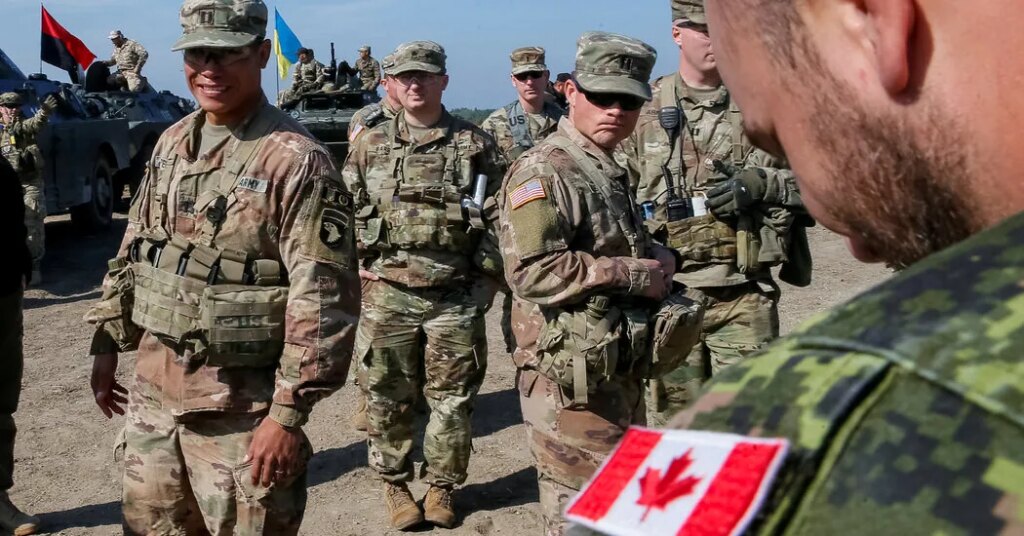
The Department of Defense recently circulated a memo asking staff to restrict social and informal interactions between U.S. military personnel and their Canadian counterparts, Senator Mike Rounds, who was briefed on its contents, said in an interview on Saturday.
The directive is the latest sign of deteriorating relations between the allies since President Trump returned to office.
Mr. Rounds, Republican of South Dakota, said the directive was written several months ago but was only recently signed or authorized. He described it as making no changes to formal military activities but discouraged some informal or social contact between American and Canadian officers.
David McGuinty, Canada’s defense minister, acknowledged the new U.S. directive but said that it made no material difference to the vast, longstanding military cooperation between the two nations, including the world’s only joint airspace command, NORAD.
Mr. Rounds said a congressional delegation was briefed on the memo’s contents through established channels with the Defense Department’s legislative affairs office. Mr. Rounds spoke in Halifax, Nova Scotia, where the delegation is attending the Halifax International Security Forum, an annual gathering of global defense leaders.
“I think there were some social events where our officers and some of their officers were getting together in some social events, apparently,” Mr. Rounds said. “There’s a desire, I think, to put some emphasis on maybe getting some agreements on military purchases or cooperation on those types of things before we move forward with a normalization of social activities,” he added.
Mr. McGuinty told reporters in Halifax that he had been briefed on the existence of the Pentagon document but had not read it. He insisted there were no operational changes to the collaboration between the two militaries.
“I checked with our top military folks. They see no evidence of change. We continue to cooperate, we continue to work together,” Mr. McGuinty said in Halifax.
Senator Tim Kaine, Democrat of Virginia, who is also part of the delegation, echoed that message.
“It’s not about NORAD. It’s about NATO. It is not about defense exercises,” he said.
Both Mr. Rounds and Mr. Kaine spoke to The New York Times in interviews on Saturday in Halifax.
He said the information allowed senators to reassure Canadian officials they were meeting during the delegation trip to the security forum, who initially feared the directive might signal a broader retreat from bilateral military cooperation.
“Once we were able to discern the negligible impact it would have on any of our relationships, it was a lot easier to explain to our Canadian counterparts,” Mr. Rounds said.
The Department of Defense said in a statement that the new guidance does not affect intelligence sharing, NORAD, or NATO operations.
“DoW is prioritizing opportunities for bilateral cooperation that strengthens the defense of our Homelands and shared hemisphere, while supporting Canada’s ability to meet NATO obligations,” said Chief Pentagon spokesman Sean Parnell.
The existence of the memo was first reported by The Washington Post.
The document and underlying policy are the latest in a series of episodes that have strained relations between the United States and Canada since Mr. Trump returned to office. His administration has imposed steep tariffs on Canadian goods, repeatedly antagonized the country’s leaders and called into question the longstanding partnership between the neighbors.
“The tone is bad and it is unnecessary” Mr. Kaine said during a new conference, reflecting on the memo as part of a series of actions by the Trump administration that have been viewed as disruptive to the U.S.-Canada relationship.
“This is an own goal,” said Senator Chris Coons, Democrat of Delaware, who is expected to chair the Foreign Relations Committee when the Democrats take the Senate majority next year. “I’m relieved this has no significant operational impact.”
Dustin Volz contributed reporting from Washington.
The post Pentagon Issued Memo Limiting ‘Social Activities’ With Canadian Military appeared first on New York Times.