With a very strong El Niño underway this winter, and questions growing about whether California levee systems can handle the potential surge of floodwater across the Central Valley, the state may soon see how well one of its oldest flood-management strategies holds up in a new form. Floodplain restoration, which reconnects rivers to land where floodwater can safely spread, slow down and sink into aquifers, has become a growing bet for the state. California has invested $40 million in floodplain restoration for the San Joaquin Valley since 2023 and set aside an additional $21.5 million to kickstart floodplain and habitat restoration projects along rivers in Kern, Kings and Tulare counties.
The idea of giving rivers room to overflow isn’t new. More than a century ago, after floods in 1907 and 1909 that extended down the Sacramento River, California turned away from relying on levees alone and began building the Sutter and Yolo bypasses, broad floodplains that let the river spill out rather than break through.
Projects such as Dos Rios State Park, which opened to the public in 2024 near Modesto, bring that same principle to the San Joaquin Valley, which never got such a system. What they lack is scale: Julie Rentner, president of River Partners, the nonprofit helping restore these floodplains, estimates the state needs 50 more projects like Dos Rios. With El Niño approaching and much of the $10-billion climate bond voters approved in 2024 still unspent, there may be an opening.
Advocates say the projects can lower downstream water levels and can reduce flood risk for vulnerable communities, from Stockton and Grayson in the San Joaquin Valley to Hamilton City in the Sacramento Valley. But expanding them means pushing against what Rentner calls a deep inertia: a habit of funding maintenance of existing flood infrastructure instead of rethinking how rivers can flow to benefit the public.
A century-old idea
Six large concrete structures line the Sacramento River between Mt. Shasta and the Sacramento-San Joaquin River Delta, all with one primary purpose: to divert excess water over the banks and into an adjacent basin or bypass. Some of that water rejoins the river; some spreads across low-lying wetlands or agricultural lands, where it can recharge groundwater.
The largest of these bypasses, the Yolo, can carry roughly four times the Sacramento River’s flow. The Army Corps of Engineers now calls it “a 100-year-old nature-based solution,” and researchers have held it up as a national model for flood control that coexists with fish, wetlands and farming.
The state is still investing in that system. Preparing for El Niño, Gov. Gavin Newsom celebrated the completion of the nearly $31-million Tisdale Weir Rehabilitation project, an upgrade to an old flood-control structure in Sutter County.
The San Joaquin Valley has nothing on that scale. The proposed Paradise Cut Bypass Expansion project would provide similar protection for at-risk areas in Stockton. But that project has been mired in planning for a generation.
“The magnitude of the water that needs to move through a flood bypass there in the South Delta is much much bigger than what the Paradise Cut project can advance,” Rentner said, adding that floodplain restoration is needed too. “It’s a very good flood expansion project. We still need a couple more big bypasses like that, if Stockton’s going to be as protected as Sacramento is.”
Dos Rios: A test case
“There was a time when I was 7 or 8 years old, where we couldn’t get to Modesto because the only road that led to Modesto would get flooded,” said Lilia Lomeli-Gil, a resident of Grayson, a small agricultural town downstream from the San Joaquin and Tuolumne rivers.
Just upstream, on land that flooded just as routinely, the state and its partners have tried something different: letting it flood on purpose.
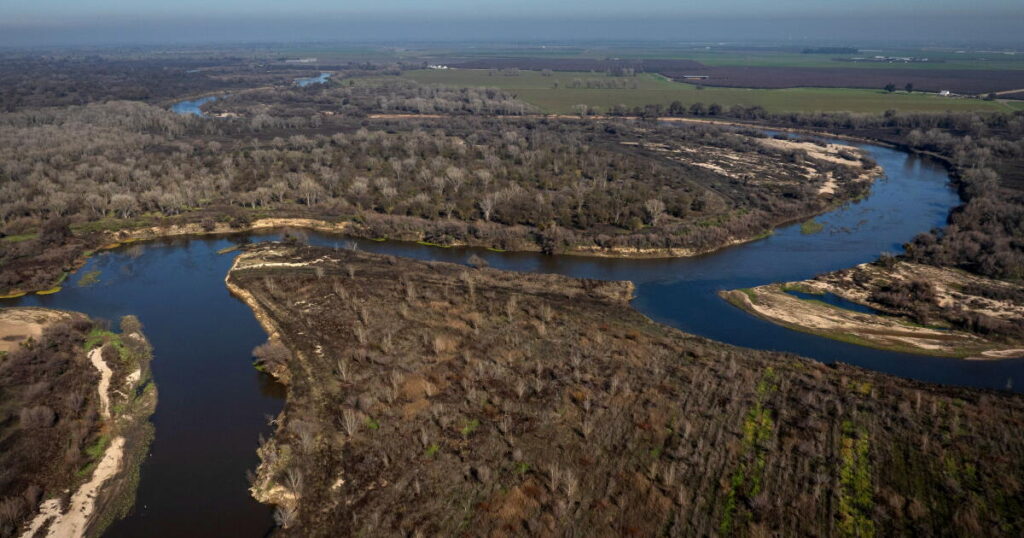
Dos Rios State Park, located roughly eight miles west of Modesto where the San Joaquin and Tuolumne rivers meet, used to be home to two dairy farms before River Partners acquired the land in 2012. Once flood-prone farmland, those farms struggled with staying profitable, according to Rentner, experiencing routine floodwater seepage and salt inundation that damaged the soils.
River Partners aims to seek out similar kinds of land, working with farmers and landowners in flood-prone regions to convert it back to a floodplain with public benefit.
The 2,100-acre restoration is the state’s largest public-private floodplain project. Newsom’s 2026-27 budget summary heralds Dos Rios as a major accomplishment: the state’s first new state park in a decade, restoring former agricultural lands to provide floodplain habitat and boost climate resilience. The state counts it toward its nature-based climate targets, and advocates see it as a blueprint.
The 2023 winter storms put it to the test. Rentner said there is no way to isolate the performance of a “sponge” or “shock absorber” in the flood system, since the hydrology is too large and complex. But the floodplain performed as designed, she said, reducing flooding as far as 4 miles downstream with no infrastructure damage or significant erosion.
In 2023, the floodwater spread wide across the restored land.
“The extent of floodplain inundation was huge,” Rentner said. “Just 10 years ago, in the 2017 high-water event, the river in this location was about a quarter-mile wide in flood stage, and almost 2 feet deeper — meaning much more pressure on downstream levees.”
What’s holding the floodplain solution back
Rentner remembers the Dos Rios area roughly 25 years ago, when she first moved to the valley. River Partners spent 14 years on the project, from buying the land to finishing the last pieces this year. Rentner said that California needs about 100,000 more acres of floodplain restoration, and that the state should invest more in expanding flood-system capacity, rather than maintaining existing systems.
Some of that money could come from Proposition 4, the 2024 initiative that set aside $3.8 billion for drought, flood and water supply.
Expanding the approach takes more than money, said Jane Dolan, president of the Central Valley Flood Protection Board.
“It’s all tight budgets, huge demands,” she said. “And it takes some analysis and field work and some cooperation from property owners and civic leaders as to where to start.”
The coming winter may test recent restoration efforts and bring renewed attention to the San Joaquin Valley, where communities around Stockton, Manteca and Lathrop lack the kind of bypasses that protect the Sacramento Valley, and floodplain restoration efforts there have been stuck in planning for years.
“The next step is: How do we get to implementation of the shovel-ready projects, and how do we get to the next chunk of land acquisition and restoration that we know we need to do,” Rentner said.
Rodriguez is a reporter for CalMatters. This story, which was made possible in part by support from the James Irvine Foundation, is part of a partnership between CalMatters and Grist, a nonprofit environmental media organization.
The post Letting rivers flood on purpose worked at Dos Rios. Can California do it 50 more times? appeared first on Los Angeles Times.