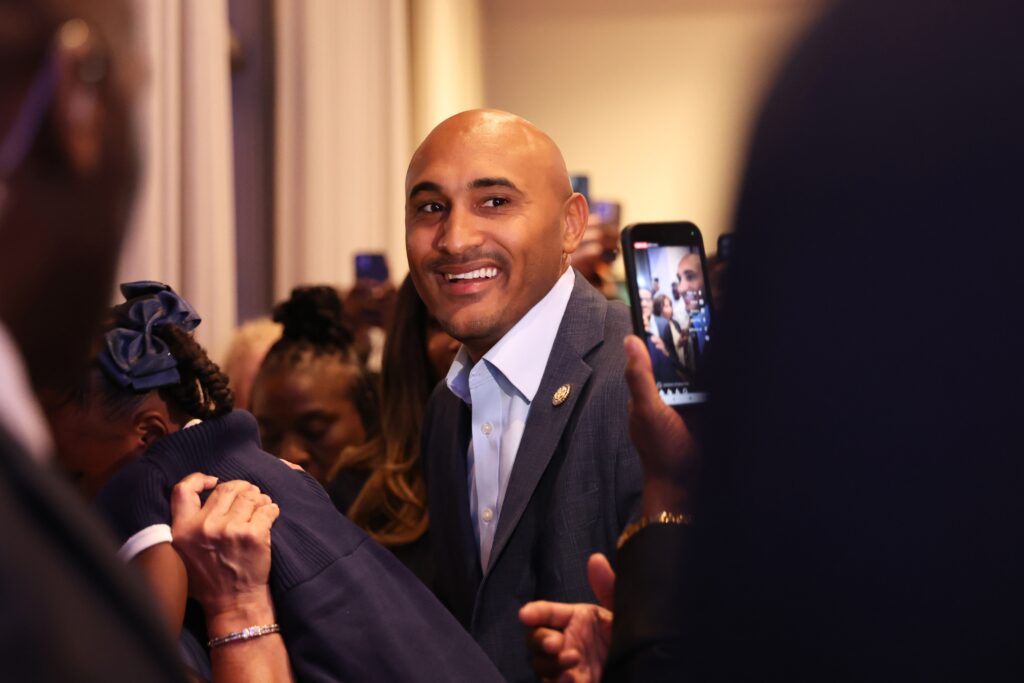
MONTGOMERY, Ala. — Minutes after his opponent conceded the race for Alabama’s 2nd Congressional District, Rep. Shomari Figures weaved his way through a small Italian restaurant where a swell of supporters were cheering for him. He made his way to the stage, still contemplating how he managed to win a seat designed explicitly for him to lose.
Black voters turned out with unbridled enthusiasm. Trade wars and actual wars led to wallet-clenching costs for both the farmers in his district raising cows and the families who wanted to eat those cows. Weekends were spent shaking hands at arts festivals and jamborees and church services. And on the night before the big day, in a state where there was no early voting, Figures headlined a politically oriented pep rally featuring hip-hop star Lil Baby, whose musings about hustle and ambition sent students at Alabama State into arm-waving, hip-shaking mania.
But as Figures looked into the crowd on election night and spotted the woman in the crowd with silver hair and thin eyeglasses, he realized the biggest factor of all.
Sheyann Webb-Christburg was just 8 years old when she walked across the Edmund Pettus Bridge, the youngest person among hundreds peacefully protesting for their right to vote. She had been on her knees praying when police sprayed tear gas and set dogs loose to attack them, which sent her running. The horrifying spectacle of racial violence spurred one of the most transformative pieces of legislation of the 20th century: the Voting Rights Act of 1965.
“Seeing what’s happening with the Voting Rights Act, this [win] means something a little different,” Figures said from the stage. “This one is for you.”
Figures, 41, is the last beneficiary of one of the law’s most powerful planks — that states must draw maps to give minority communities an opportunity to elect lawmakers who reflect their values. He had not even served a full term before the Supreme Court nullified the very law that created his seat, unleashing a new era that threatens the existence of predominantly Black, Asian American and Hispanic districts across the country.
A community’s racial demographics do not guarantee such representation when state lawmakers draw lines for congressional districts. The VRA was their safeguard.
Representation Redrawn
A series on how politics is changing after the Voting Rights Act
Back in 2023, a federal court cited the VRA when it deemed that one more predominantly Black district needed to be drawn in Alabama. Figures, a member of one of the state’s most powerful Black families, won the seat the following year.
Since then, the Trump administration has mounted an unprecedented assault on the achievements of the civil rights era. Black unemployment has skyrocketed as the federal government pushed out scores of employees from what was once one of the most integrated workforces in the country. Civil rights investigations at schools have been frozen. Disproportionate numbers of Black service members are having their promotions blocked by the Pentagon.
But civil rights organizations found none of those policies as catastrophic as the Supreme Court’s decision in April in Louisiana v. Callais, which freed politicians to dilute the voting power of Black communities. Lawmakers in Alabama and elsewhere across the country didn’t waste much time redrawing plurality-Black districts like Figures’s to make them Whiter, more conservative and more Republican.
Figures won his race, this time, riding a wave of an election in which no Democratic incumbent in Washington lost his or her seat. But a broader battle continues to be waged across the country about the meaning, and the impact, of representation in the halls of power. Whose voices should get amplified? Whose should be disregarded?
Those debates will play out in the U.S. Capitol and in state capitals across the country as lawmakers find themselves at an inflection point, reexamining policies and practices of redrawing electoral maps while balancing political opportunity and ethical responsibility.
“Without a Voting Rights Act, without the protections of it, they could draw this district down to be 10 percent African American voting-age population,” Figures said. “And so there’s no floor. And that is the problem.”
In the final months of the election, The Washington Post trailed Figures’s fight to keep his seat and interviewed dozens of residents about the meaning of diverse representation. They repeatedly pointed to the flow of federal dollars into Black neighborhoods as well as a sense of pride and purpose that can be more felt than measured — especially in a city like Montgomery, the birthplace of the civil rights movement.
Figures is 6-foot-3 and lithe, caramel-colored and bald with a small, thin mustache. He carries a cadence and collegiality that is typical of a staffer who grew up in Obama’s Washington, button-downs and slack pants and Nike Air Maxes and “who do you know?” His warmth — a trademark of his mother, state Sen. Vivian Davis Figures — can mask his policy brain, which many of his elders say is reminiscent of his late father, Michael Figures.
Both traits were on display on election night, when he thanked everyone from his chief of staff to his wife to his baby’s caretaker before sliding into discussions about bankrupt hospitals and the cost of fertilizer. Webb-Christburg, now 70, waited for him as he climbed off the stage. She hugged him and thanked him for the recognition. But she did not want him to forget the magnitude of the mantle he now carried as the country wrestles with its civil rights history.
“Congratulations,” she said. “You know, there’s still much more work to do.”
Growing up in a predominantly Black section of Mobile, Figures often thought about a quote from the end of the 1991 movie “Boyz N the Hood.” In the scene, Ice Cube’s character, Doughboy, questions why his brother’s death was not featured on a local news broadcast. “Either they don’t know, don’t show or don’t care,” the character remarked.
Figures felt the same way about lawmakers he saw on television, who never seemed interested in tackling the issues that bothered his friends he met at the community basketball courts and football fields. He can only remember seeing his congressman visit his school once.
“They either don’t know what happens in your neighborhoods because they don’t come [or] because they didn’t grow up in those neighborhoods,” Figures told me.
Figures benefited from seeing a different version of political leadership back home.
He was the second of three children in one of the state’s most powerful Black families. His mother, Vivian, was on the city council. His uncle, Thomas, was an assistant U.S. attorney who helped to successfully prosecute the largest chapter of the Ku Klux Klan for one of the country’s last known lynchings. His father, Michael, had integrated the law school at the University of Alabama and successfully represented the family of the victim, Michael Donald, in a civil suit that left the group bankrupt.
Michael Figures’s biggest preoccupation, though, was electing Black people into state office. He had started back in the 1970s, after police faced few consequences for assaulting Black residents.
“We were protesting, but we realized we needed someone on the inside,” said Merceria Ludgood, a former teacher and attorney who worked with Michael at his law firm and later became a county commissioner.
On weeknights, Figures and Ludgood arranged clandestine meetings with a group of Black lawyers, teachers and postal workers in a small room at the YMCA on the Black side of town. There, they strategized how to get people who looked like them into positions of influence. The Voting Rights Act was their tool. As courts forced local governments to comply with the law, the group would brainstorm local leaders whom they could encourage and support to run for elected office.
“We got our first Black members of the legislature in ’74, and then we got school board members in ’76 and ’78,” Ludgood recalled. “And then also in ’78, we got our first Black senator from this area since Reconstruction — and that was Michael.”
As a state senator, Michael Figures continued to invite Black residents to his house for planning sessions on recruitment over his fried chicken and his wife’s gumbo. They focused on local and state elections, believing a federal seat was out of reach.
There was one local Black candidate that he did not support — his wife, Vivian, when others in the group encouraged her to run for city council in Mobile’s 1993 elections. He tried to imbue what he called the “three B’s” — be there, be on time, be prepared — to his children, but enjoyed the everyday practices of cleaning the yard with them on Saturdays and having lunch at McDonald’s. He feared that council job would lead to Vivian taking work home, disrupting their sense of normalcy.
But he relented when Vivian decided she would run anyway. He helped her strategize, and she sang “I Will Always Love You” to him at the victory party.
In 1996, when Shomari was 11, the family was sitting at the dinner table when Michael, then 48, suddenly lost consciousness and collapsed. He never came back home. Doctors determined Figures’s dad had a brain aneurysm. Two days later, he was pronounced dead.
“My life turned into a whirlwind,” Vivian said. Immediately, friends began to wonder if their push to get her to run for city council was an act of providence, setting her up to run for her husband’s seat. “And here I am, a single mother of three when Michael was such, such a grand participant in their lives.”
On the day of his father’s funeral, Shomari made sure to be at school so he could be marked present. A short time later, Vivian told her children she was thinking about replacing Michael in the state Senate. Shomari was so thrilled that he ran upstairs and grabbed his dad’s old campaign hat and began marching around the house.
Figures graduated from law school and then followed in the political family’s footsteps — working as liaison to the Justice Department in the Obama White House, then as a staffer to Sen. Sherrod Brown (D-Ohio) and deputy chief of staff to Attorney General Merrick Garland. He was considering moving to the private sector when, in 2023, the political fortunes of Mobile began to change.
A federal court essentially agreed with what Figures and the other Black leaders concluded in the 1970s: It seemed too difficult for a Black person to win a congressional election. Even though 26 percent of the state was Black, there was only one predominantly Black district in the state’s seven-person delegation. In its ruling, the court cited one of Michael’s old redistricting cases, Figures v. Hunt. They mandated the state create a new “opportunity district.”
On paper, the new court-approved 2nd District resembled the tail of a small mammal, stretching from the border through the capital of Montgomery to the rural Black Belt to the historic city of Tuskegee before cresting in the Gulf of Mexico. It would be about 50 percent Black and encompass Figures’s hometown of Mobile.
That meant Figures had a chance to be the congressman that he had wanted to have when he was growing up.
“At the end of the day, pound for pound, the communities that I grew up in, communities where my folks come from historically, they don’t see their members of Congress and because they don’t see them, they’re not top of mind,” Figures said. “I saw the potential in this role.”
He bought a house in Mobile in May 2024, moved back home, and won a crowded primary. Adline Clark, a family friend who represented Mobile in the State House, presumed Figures had a good chance because of how much his family was beloved in the city. Vivian was still a senator and Michael was now something of a folk hero — the nicest community center in the city was named after him; a mural of him and his brothers was painted on a building downtown.
Clark knew she did not need to mention the racial significance of the election if she simply mentioned the last name Figures to voters.
“They just got it,” Clark said.
And then, on election night, Ludgood was coming home when she saw a group of young women racing to get to the Michael Figures Community Center before the polls had closed.
“They are having their Obama moment,” she said.
Figures won the race. But the community’s new political power would be precarious.
When Figures got to Capitol Hill, Rep. Sanford D. Bishop Jr. (D-Georgia), an old family friend, gave him a word of advice and a warning. The advice: Establish relationships. The warning: Do good for your district before it gets taken away.
Since his election to Congress, Bishop had seen his district swing from 56 percent Black to 59 percent White and back to 50 percent Black as his state redrew maps to comply with the Voting Rights Act.
“I have been very much involved with voting rights and the implementation of the Voting Rights Act; I’m a product of it,” Bishop recalled saying to Figures. “But the most important thing is that once an individual is able to get into the arena, it’s your ability to deliver, to use the political process to deliver for your constituents — whomever they are — that keeps you there.”
So Figures worked on his reputation. He started fist-bumping members on the other side of the aisle before taking his seat at committee meetings. Inside his office, a black and silver belt sat on his couch honoring him as the MVP in the Lawmaker vs. Lobbyist basketball game.
“The best part of my game is clearly the ability to pick up the slack left behind from Sho. Just playin’,” a teammate, Rep. Blake Moore (R-Utah), told me. “A shared love of sports uniquely unites people, and it’s especially true in the halls of Congress.”
He hoped those relationships would make it easier to bring money back home. Like many Black lawmakers from the South, he figured his district would benefit from the 2022 decision from Congress to resume the process of setting aside money for community projects, commonly known as earmarks. It was a chance for Figures to provide support for struggling communities that may have been overlooked.
In total, Figures brought in nearly $18 million in federal money to his district during the 2026 fiscal year. The freshman netted more money than about 70 percent of lawmakers in Congress, a Post analysis of earmark data showed, and slightly more than the average lawmaker representing Alabama.
More than the dollar amount, Figures prided himself on how the earmarks were distributed. He got money for a police station in the majority-Black city of Tuskegee and money to upgrade police equipment in Mobile.
He facilitated that department donating three police cars to the cash-strapped majority-Black city of Georgiana. He emphasized the importance of rural hospitals and sent $1 million to a hospital in Clark County and $375,000 to help the city of Eufaula purchase a new MRI machine.
“I’m a Republican, and Shomari has been the one who has kept in touch and kept us informed about things probably as good as any of them,” said Jack Tibbs, Eufaula’s mayor. “Actually, better than any of them.”
Back in Mobile, local leaders had repeatedly asked their lawmakers to attempt to find money to improve Africatown, a historic neighborhood that was settled by Africans forcibly transported here on the country’s last slave ship. Each time, nothing.
But in 2026, Figures framed support for Africatown in a way that would appeal to leery conservative colleagues. More so than focusing on Black history, he made a pitch that asked for money for Auburn University, which could work with a development organization in Africatown, to rebuild housing. He found them $2.5 million.
“For all of these years, we’ve been declined, declined, declined, declined,” Ludgood recalled. “And things were changing.” Four months into 2026, things changed again.
After the Supreme Court erased the heart of the Voting Rights Act in Louisiana v. Callais, President Donald Trump hoped to use the ruling to build his party’s majority. He pressured Republicans to take the unusual step of redrawing districts in the middle of the decade, abandoning the conventional practice of rethinking congressional boundaries every 10 years.
Alabama Gov. Kay Ivey acceded to his wish, and the state legislature reshaped Figures’s district to make it more difficult for him to win. His district now resembles a mitten, wider and more stout than before. With Montgomery at the center, the district now enveloped a new military base and communities of White peanut farmers who lived in a conservative area known as the Wiregrass. The Black population in the district dropped from 50 percent to 40 percent.
State Rep. Marcus Paramore, a Republican who hails from the Wiregrass, argued that the issue with the previous map went beyond race. When Figures’s district was created, it was then tied to the interests of cities on the Gulf Coast. “It’s a different culture over there,” Paramore said.
But what comprises the culture of a congressional district? For Figures, there was a culture threading the places he represented. From Africatown, where enslaved people settled, to Tuskegee, where the airmen flew, to Montgomery, where a seamstress started a movement — there was a rich legacy of Black history, and then Black disenchantment, that tied them together.
“There’s certainly more symbolism to this race than I think any other race in the country,” Figures told me. “And so for them to redraw the district in a way that aims to eliminate someone who was a beneficiary of the Voting Rights Act — which came about because of the efforts, the struggles, the violence, the protests, the marching, the organizing in Montgomery, Alabama — then yes, this is a centerpiece of the pushback because this district is a centerpiece of the racial struggle for equality in this nation.”
Figures’s state senator, a Democrat, tried to push back against the Republican plan. His state senator was also his mother, Vivian, who had to balance maternal comfort with political fury.
“If you were a minority, how would you like to be treated? Wouldn’t you want representation?” Vivian recalled saying to her Republican colleagues. “I just couldn’t see how people who call themselves Christians, and laugh in your face every day or give you a hug here and there, could do this.”
Before the state Senate took its final vote on the measure, a strong storm blew over the capitol that caused the lights to dim and sirens to blare. “God doesn’t like ugly,” warned Vivian Figures as she and her colleagues evacuated.
Her vote was an “oh, hell no!” when approval of the new maps came up. She lost, 27-8. When the vote was tallied, her breathing got heavy and she needed to be escorted out. “It was my first panic attack,” she recalled.
The district would no longer include Mobile, Figures’s home, “the reason that I was elected in the first place,” he said. It severed Clarke County, “which sentimentally was very important to me because that’s where both sides of my family came from, going back to slavery.” It was a “disheartening” response from a state that Figures argued too often belittled the contributions of its Black residents.
“We deserve, as Black people, a fair opportunity on more than just the football fields of Tuscaloosa and Auburn,” he said during a state legislative hearing, in a room named after his father.
But then he tapped into his father’s analytical skills. He and his staff calculated that the redrawn district had 60 percent of the same residents, so he was not starting from scratch. He reviewed the election data to discover that the last Democrat elected statewide, Doug Jones, had won the district by 12 points in 2018 against a scandal-plagued Republican candidate, and lost the district by one point in his reelection bid against Tommy Tuberville.
He realized he had an advantage over his opponent by being an incumbent and felt confident he would get support from national organizations who were angry about the Trump presidency and the destruction of the Voting Rights Act. If he could excite Black voters in Montgomery and young voters while appealing to fed-up White conservatives, Figures said, he thought he would have a path.
“They are saying it’s over, but they haven’t seen what I see,” his wife, Kalisha, recalled him saying.
In August, Figures leased a new home in Montgomery so he could live in the district he wanted to represent.
“I watched my father drop dead at a dinner table a week after I turned 11,” he told me. “Ever since then, it’s just like you squeeze out every positive element of everything you can. You don’t have time to sit here and continue to argue and cry about the district. The district is set. It is what it is right now.”
His opponent, Rhett Marques, was born and raised in the Wiregrass, a former tire shop owner who became state representative. He championed his relationship with Trump, who campaigned for him, and lambasted Figures for being new to his own district.
On the trail, Figures focused on his track record and the high price of gas. He dared young people and Black people to defy stereotypes of not wanting to vote. Rarely did he dive into the details of the contours of the district — national organizations and allies were doing it for him.
In Tuskegee, Mayor Chris Lee decided he needed to do everything he could to help Figures defy the odds and win back the seat. His city depended on it.
The city had an outsize impact on Black history. It’s where Booker T. Washington theorized about racial progress and George Washington Carver ran groundbreaking experiments at Tuskegee University. Decades of disinvestment led to its blight, and the downtown was now a rustic collection of empty storefronts. Since 1980, its peak population of 13,000 has declined by almost a third.
Figures got the city the money to help build a new police station, but Lee most appreciated the additional help that had nothing to do with legislation. A few months ago the city’s only dialysis center abruptly gave its clients a 30-day notice of its closure, Lee said. He said he was glad he finally had a lawmaker in Washington who could call the company and flex his influence. Just through reaching out, Lee realized the tangible impacts of the VRA on a community that was often politically ignored.
Figures called the company and explained that such an abrupt closure would be devastating in an area in which 1 in 5 residents are diabetic. The nearest facility was more than an hour away. After Figures’s call, the center agreed to stay open for 60 more days.
Lee rejoiced and Figures visited the center a month later to see how everything was going. There was an affable receptionist at the front desk, but no medical staff. No patients were actually being served.
Figures was apoplectic. But the company’s promise, and then its recanting, showed Lee and Figures both the problems and the possibilities that can come with a member of Congress getting involved. Companies listen, but they also need to see a track record of impact to have a representative’s force feel recognizable and formidable.
“We were really getting started with his real impact,” Lee said. “They’re trying to take it away.”
On a Saturday in early October, Figures and his family tried to find new voters. They drove down a highway that faded into a two-lane state road scaling up and down the bluffs of Alabama, past Dollar Generals and Julia’s Homecooking restaurant and gas stations where the price was $4.09. And then deeper still, to places where the gas stations had gone out of business and then there were vast expanses of grass and cotton. And then, 81 miles and a world away, Figures and his family found a parking space in a nearby bank in Ozark, population 14,000, for a local arts and crafts festival.
This city was one of the biggest in the Wiregrass. Sixty percent White, 30 percent Black in a county where 76 percent of voters in 2024 backed Trump — a place that was new to his district and that could doom his electoral prospects.
A local pop-punk band crooned songs of teenage longing from the amphitheater, while smoke from the grill of a local Black church wafted through the air. The local lodge was selling raffle tickets for a gun giveaway, and, at the far end of the festival, the Sons and Daughters of the Confederacy manned a booth wearing battle flag T-shirts that said “Keep Our History Alive.”
The local mayor was waiting for Figures as he entered and offered a piece of advice. “Every time you see a person, talk to them,” he said. “Otherwise, people here will get offended.”
As goes Congress, so goes a street festival. He walked by the men at the lodge who shook his hand and asked that he join the raffle to win the Ruger 10/22. Figures offered them $5 for one ticket. He headed to the local Republican Party’s booth. “Good to see y’all out here,” he said, as he extended his hands to them, before moving on.
Figures never made it to the Sons and Daughters of the Confederacy table at the other end of the festival. He kept on being stopped by people who wanted to meet him. Almost all of them were Black.
“I’ve seen you on TV,” Alexandra Bean, 37, told him. “You know I’m going to vote for you. It’s good to see someone different running for office.”
“Take God with you,” another woman told him. “Don’t change, be who you are.”
The sky soon became gray, and thick raindrops began to pour. It was only then, as Figures and his family made their way to their car, that for once, a White person stopped him. But she had no apparent interest in politics.
“What a cute baby,” she said, pursing her lips at his 11-month-old, Ezrah, while cooing and shaking his little hand.
On the day that would determine his political future, Figures woke up before sunrise, minutes before now 1-year-old Ezrah started his early morning cry.
Disciplined about wearing his sneakers when campaigning, he put on the wrong shoes — Cole Haan ZeroGrands — and forgot to drink his coffee before he, his wife and their youngest son jumped into the Ford Expedition to carry out his plan to touch every part of the district. He wore a pair of jeans and a white “Figures for Congress” T-shirt.
He cast his ballot at his new precinct at a church in the town of Pike Road — a bedroom community where John Lewis had been born to sharecroppers. He drove past cotton fields and then past an old movie theater turned nightclub turned abandoned, blighted eyesore.
Across the street, the mayor of Tuskegee waited for him. It was about 10 a.m., and there were no lines. One 21-year-old woman who walked up said she was voting for Figures after she had heard his desire to make life less costly at the Lil Baby concert. “I mean, I would have voted for him anyway, but I felt more inspired,” Shakayla Washington, a 21-year-old security guard, said.
Minutes later, a thin young man in a black sweatshirt riding a scooter sailed to the front of the building. It wasn’t very dramatic, but the mayor took it as the best sign he had seen all morning. “When I see a young guy pulling up on the scooter, that’s when I know,” Lee said to Figures. “We’re going to break records.”
Figures stayed for about 20 minutes before jumping back into his car and driving past the colonial homes of Eufaula, where the MRI machine was on its way, and then to a community center in Phenix City. It was sleepy there, too, and Figures and his staff began calling election officials to see if they were having better luck in Montgomery.
“They are saying they’re voting at Obama levels in Montgomery,” said Figures, which is what he wanted to hear.
He then went deeper into his district, traveling more than two hours, to Dothan, in the Wiregrass. He stopped at a community center with a large pavilion and shiny playground equipment and mostly White voters headed to the ballot.
Virtually no one paid him attention, so he got back in the car and crossed the railroad tracks and stopped at a community center on the Black side of town.
“Hey Ms. Doris!” one of his staffers said to a woman hustling inside. Another woman drove past in an old sedan with her windows down and honked her horn. One man with a gray beard and a baseball cap got on Facebook Live using one of his two cellphones.
“Everyone come out and vote here!” he told his followers. “We are going to be out. Someone is going to break out the grills. There will be music!”
A woman jumped out of her car just next to Figures, who waved and smiled at her. She ignored him.
“I don’t need to meet the man; I need to vote for the man,” she said, running into the polls. “And then I gotta go back to work.”
And then, to another community center, where Black residents’ cars were filing into the parking lot, each of them honking at Figures.
“Everyone knows you because you’re always on TV here,” said an old family friend.
“Yeah,” Figures said. “I hate to spend all that money, but that’s what you have to do to get things done.”
“It’s going to happen,” she said. “Have you seen the lines in Montgomery?”
It was close to 4 p.m. when Figures finally saw the lines in Montgomery. The local Hyundai plant had just gotten out and the parking lot was full at City of Refuge church. A man, walking with his 5-year-old son, gently patted Figures on the shoulder.
“Don’t worry,” he said, “we got your back.”
The sun fell, and Figures changed into a light-blue button-down and headed to an office space down the street with paper bags covering the doors and windows. Inside, a staff of 30 people or so had built a war room for him to track numbers.
All but a handful were Black and young, and he thought about what a blessing it was to be building that kind of political leadership in Alabama, no matter what happened. As they shouted “Keisha!” when Georgia’s Keisha Lance Bottoms became the country’s first Black woman governor and saw Democrat after Democrat win their races, Figures barely cracked a smile. He stared at a laptop screen, making sure his staff remembered the task.
“Did anyone check on Montgomery?!” he yelled.
One person who was checking on Montgomery, at a small restaurant in the Wiregrass, was his Republican opponent. Rhett Marques had looked at the numbers and decided that Figures had cut into his lead so much in the Wiregrass that he could not overcome the overwhelming support that Figures was having in the city.
A little after 9:15 p.m., Marques called to concede. “I’m praying for you,” Marques said.
Figures nodded and hugged his family. The room cheered, and he walked a block and a half around the corner to the Italian restaurant where people were eating skewers and sliders. His wife and their four children followed behind him. And there was Vivian Figures, who stood behind her son, applauding a victory that felt as personal as it did political.
Sometimes, it was hard for Figures to disentangle the specific problems of his local district from the national implications of his race. Not just for him, but for his family and his people, whose existence in the United States had always been connected to how they should be represented at the ballot box.
Even in victory, that challenge didn’t disappear. His mind was preoccupied with thoughts of what might come next. Of the ways he might help Mobile, and the rural Black Belt, even if he no longer represented it. Of a new hospital for Tuskegee. Of how a new Democratic majority could pass a new version of the Voting Rights Act that the Supreme Court wouldn’t be able to rip apart so easily. Of Webb-Christburg’s sacrifice for voting rights, which offered both a hope and a challenge. Of his father, who had taught him about the three B’s, and of himself, who now was living a political career that was beyond his dad’s political imagination.
Chris Hacker and Clara Ence Morse contributed to this report.
This story was supported by the Pulitzer Center.
Methodology
To analyze Figures’s community project funding, The Post used a large language model, OpenAI’s GPT-6 Luna, to extract the data, then checked the extracted data against the text of the original documents to verify that the results were accurate. To further check the accuracy of this process, The Post hand-transcribed more than 10,000 values from 125 pages into a spreadsheet and compared them to the extraction process. In this test, the automated extraction process had an accuracy rate of 100 percent; differences in capitalization, punctuation and spacing were not counted as errors.
The post The district Alabama remade — and the congressman who held on appeared first on Washington Post.