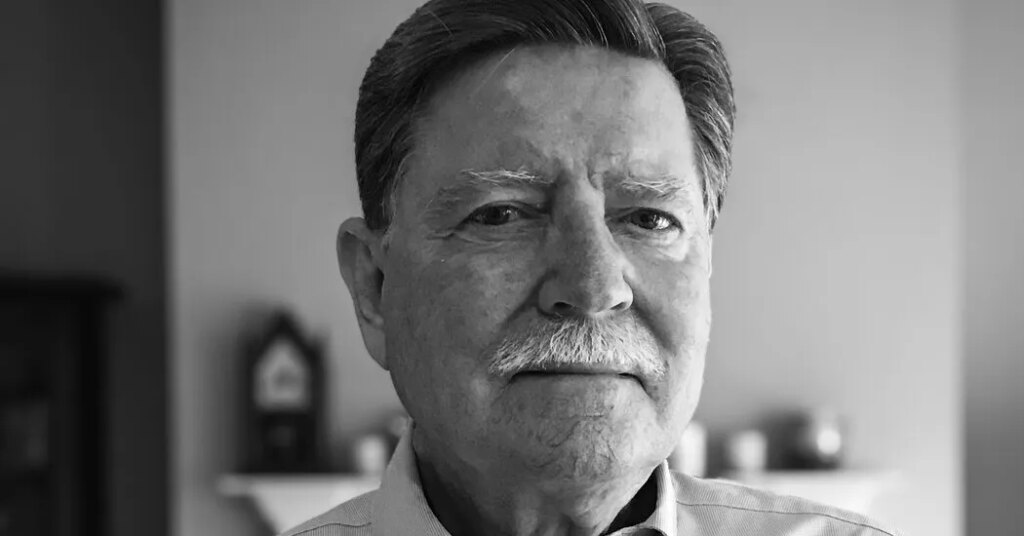
David Sanders, a Navy veteran who was among FedEx’s first pilots, was at the controls of a half-million-pound DC-10 loaded with fuel and packages when he heard a thud over his shoulder. As he turned to look, he saw a hammer taking aim at his head.
“What I saw was simply a face and his eyes and an object coming down on me,” Mr. Sanders later said.
The assailant, another FedEx employee who was hitching a ride on Mr. Sanders’s flight, had already attacked the flight engineer, tearing open the man’s temporal artery. He struck the co-pilot so hard that pieces of his skull lodged in his brain, leaving him stunned. Blood splattered across the cabin.
The attacker struck Mr. Sanders repeatedly, then retreated to the galley before returning seconds later with a spear gun.
The bloody attempted hijacking of Federal Express Flight 705, just minutes after it took off from Memphis International Airport on April 7, 1994, had only just begun.
Investigators would later piece together a horrific account. The attacker, Auburn Calloway, was a former Navy pilot, a Stanford graduate and a martial arts expert. But he had struggled to climb the ranks at FedEx. He said it was racism against him as a Black man. Colleagues said he was a substandard pilo
He was also under investigation for inaccurately logging flight hours, and was set to appear before a disciplinary board the next day. He was unlikely to face a severe punishment, but as he later told investigators, it was enough to push him over the edge. He concocted an elaborate plan for revenge.
In his flight bag, he carried an assortment of hammers, a spear gun and a knife — items that, if caught, he could explain away as hobby tools. In mid-flight he would use them to incapacitate the crew, then crash the plane. He had arrived at the plane before the crew and turned off the cockpit voice recorder.
It would all look like an accident, allowing his ex-wife and two children to collect $2.6 million in life insurance.
Mr. Calloway had flown into Memphis from San Jose, Calif., the night before. He had originally expected to be the flight engineer on the return, meaning he would have to take out only the pilot and co-pilot. But the crew had gone over its maximum flight hours by one minute, forcing FedEx to cobble together a new crew, which included Mr. Sanders.
Mr. Calloway now had to hitch a ride back, and he would have to take on three crew members, not two. And, though he didn’t know it, the flight engineer, Andrew Peterson, had turned the voice recorder back on.
Still, standing in the doorway of the flight deck with the spear gun in hand, it looked as if his plan might succeed.
“He said, ‘Get back in your seat,’” Mr. Sanders told an aviation conference in 2011. “‘This is a real gun and I will kill you!’”
Suddenly, Mr. Peterson, slouched against the control panels and still groggy, grabbed the spear gun and tried to wrestle it from Mr. Calloway’s hands. Mr. Sanders unbuckled his seatbelt and dived on Mr. Calloway.
The co-pilot, James M. Tucker Jr., who was still seated and bleeding profusely, saw his chance. A former Navy fighter pilot, he immediately put the plane into a 15-degree climb, throwing the other three back into the galley.
Over the next five minutes, while Mr. Sanders and Mr. Peterson tried to wrestle Mr. Calloway to the ground, Mr. Tucker executed a series of extreme maneuvers to keep Mr. Calloway disoriented — including a left roll that nearly put the plane upside down, followed by a steep dive.
The plane went sped up, reaching 530 miles per hour, far faster than a DC-10 is supposed to fly at low altitude. Mr. Tucker could feel the airframe begin to shake.
In the back, Mr. Calloway hit Mr. Sanders on the head again. Mr. Peterson was going into shock. For a second, it seemed as if the attacker had the upper hand.
”I was blacking out,” Mr. Sanders told the aviation conference. “I realized this guy was going to kill us. I grabbed a hammer and hit him in the head twice. He seemed to quiet down and be subdued.”
Mr. Peterson then used his weight to pin Mr. Calloway, while Mr. Sanders grabbed the spear gun and pointed it at their attacker.
Up front, Mr. Tucker radioed Memphis, asking for permission for an emergency landing back at the airport. He also requested an “armed intervention” — i.e., a SWAT team — and an ambulance. Then he went back to help his colleagues.
Now it was Mr. Sanders’s turn to fly. He was the most experienced pilot of the three men, and he was going to need all his skills to get the plane on the ground. It was coming in fast, still rattling, still loaded with 85,000 pounds of fuel, far above its maximum landing weight. Emergency alarms were pealing all around the cockpit.
He requested to land at one of the airport’s longer runways. He could feel the plane’s body straining under the pressure of the rapid approach. Blood from his head wound kept seeping into his eyes.
He communicated with air traffic control in measured tones — controllers later noted how, even in the heat of the moment, Mr. Sanders used “please” and “thank you” in his messages, according to David Hirschman, a reporter, in his book “Hijacked: The True Story of the Heroes of Flight 705” (1997).
Somehow, despite hitting the runway at 208 m.p.h. — more than 60 m.p.h. faster than the safe limit — the plane’s landing gear and tires held together.
As soon as the plane came to a rest, Mr. Sanders saw the emergency crews rushing toward it. He sank in his seat. In the back, Mr. Tucker was losing consciousness, and Mr. Peterson was still drifting in and out of a fog, even as Mr. Calloway seemed to be recovering strength.
“Get the crews over here now!” Mr. Sanders shouted over the radio. He pulled the emergency door release, setting off a loud bang.
Minutes later, police officers and paramedics swarmed the plane. The cockpit and galley were covered in blood, but all four men were alive.
Mr. Calloway was arrested and later sentenced to life in prison. He is incarcerated at Canaan, a Bureau of Prisons facility in northeastern Pennsylvania.
The three crew members recovered, but their injuries prevented them from being recertified to fly commercially. But the company kept them on the books as pilots until their mandatory retirement at 65.
Later in 1994, Mr. Sanders joined his fellow crew members in receiving the Gold Medal for Heroism from the Air Line Pilots Association, the highest honor given to civilian pilots.
Mr. Sanders died on Nov. 2. His wife, Susan Sanders, confirmed his death in an assisted living facility, from complications of dementia.
David Gilbert Sanders was born on Sept. 1, 1944, in Dallas. His father, Willis, was a skilled tradesman, and his mother, Julia (Wood) Sanders, worked in public schools.
Intending on becoming a teacher, he studied music at Abilene Christian College (now Abilene Christian University), and graduated in 1967. A chance encounter with a naval recruiter made him change his career goal, and after college he joined the Navy.
He spent six years as a naval pilot, mostly flying P-3 submarine hunters, which he chose because of their similarity to commercial planes.
After leaving the service, he turned down offers from major airlines to take a chance on FedEx, at the time a scrappy upstart delivery service. He began flying for the company in 1975.
He married Susan Haviland in 1977. Along with her, he is survived by their daughter, Lauren Pollard.
After retiring from FedEx, Mr. Sanders finished building the family’s dream home outside Memphis. They moved to Franklin, Tenn., in 2008.
“Quite honestly, we never saw ourselves as heroes,” he told The Commercial Appeal, a Memphis newspaper, in 2007, speaking about the crew on the FedEx flight. “It is our Navy training that allowed us to see what our limitations were in an airplane. It’s like a racecar driver knowing how close he can get to the wall.”
The post David Sanders Has Died. As a Pilot, He Fought Off a Hijacker’s Violent Attack. appeared first on New York Times.