The Trump administration’s crackdown on international students is deepening, as it moves to impose new rules and fees that higher education leaders say are likely to further cut enrollment from abroad, which has already dropped by 15 percent this fall.
The recent actions targeting the roughly 1.1 million international students in the United States would make it harder for them to work in the country and, critics say, discourage them from enrolling in American schools.
Universities have pushed back against a federal proposal last month to charge at least $70,000 for student visa holders to gain access to a popular program that lets them work temporarily in the United States after graduation. The administration would charge an extra $30,000 for STEM graduates to receive extensions in the program, known as Optional Practical Training.
The fees would be charged to colleges and universities, and if that cost is passed to students, many fewer could come to the United States.
“In the beginning of the administration, they were taking a hammer to everything and really shocking the system,” said Daniel Delgado, a former senior Department of Homeland Security official who now works at the Searchlight Institute, a centrist Democratic think tank. “Now we’re seeing them translate that into policy.”
The Trump administration has aggressively targeted international students as part of its broader campaign to restrict immigration, arguing that curbing their enrollment would prevent companies from sidelining Americans, especially amid layoffs in the tech industry.
But the recent actions have drawn sharp criticism from universities and business groups that say the loss of international students would make it harder for companies to hire top talent, hurting the country’s competitiveness. Tech leaders have long said that there are not enough U.S. workers for all of their specialized roles, and that international students help fill those gaps.
.
Dennis Galvan, the vice provost for global engagement at the University of Oregon, said the fee would likely have an “even bigger negative effect” on enrollment. The number of international students at the university had already dropped by about 14 percent compared with 2024, he said.
The Optional Practical Training program is “one of the biggest draws” for foreign students to come to the United States and study at the university, Mr. Galvan said. But the university probably would not be able to cover the program’s costs if the fee was imposed, he said.
Many international students rely on the program before seeking H-1B visas, a small number of which are granted to skilled foreign workers each year. Trump officials have also taken aim at the H-1B program, which they have accused of undercutting Americans.
In August, the administration proposed attaching a steep $103,265 fee for H-1B visas, echoing a move by the president last year that was blocked by the courts. This time, the administration is trying to formalize the fee by using a different legal process.
In September, federal officials proposed ending the 60-day grace period that H-1B and other visa holders have to remain in the country after losing their jobs, essentially making them subject to deportation immediately.
The administration’s efforts are expected to face legal challenges. Some of its policies have already been blocked. On Monday, a federal judge vacated a rule that sought to limit the period that students can remain in the country, an attempt to reverse a policy known as duration of status.
The Department of Homeland Security said the proposals would help protect U.S. workers and the country’s “national identity.”
“Our immigration system is being reformed to serve American citizens, American workers, American families, and preserve our national identity, not rapidly import foreigners who take American jobs, commit crimes, burden our welfare system and erode our cultural and social fabric,” the department said in a statement.
Arizona State University was among dozens of schools that criticized the new fee, saying it could “severely damage international enrollment.” That could even affect students from the United States, the university said, because international students often pay full tuition. Losing them, it added, would weaken its “financial base” and academic programs.
Some students worry that if schools pass on the costs of the new fee to them, they would be unable to pursue work in the United States.
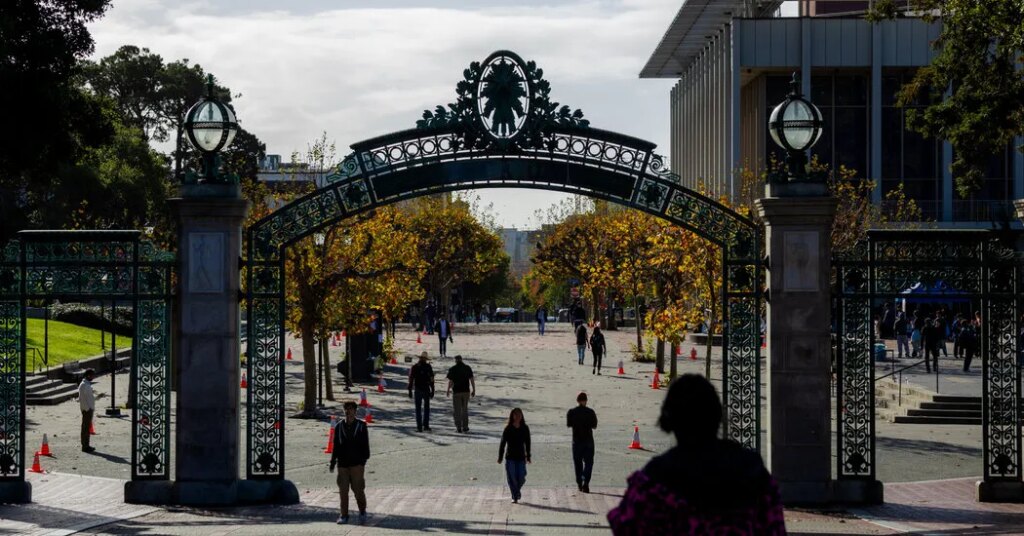
Sandra Ding, a senior at the University of California, Berkeley who came to the school from China, said she could not afford to pay at least $70,000 for work authorization.
“Affording an education here is already a huge burden on my family,” said Ms. Ding, who is studying psychology and cognitive science.
The attempts to overhaul work authorization programs are resurfacing tensions with business groups that have at times clashed with the administration over its immigration agenda. In public comments this month, the Chamber of Commerce and organizations representing tech companies, including Apple and Meta, said the new policies would hurt employers and their ability to recruit workers with critical skills.
Mr. Trump has at times scaled back his restrictive immigration policies after outcry from businesses, raising questions about the future of the latest proposals. But administration officials have also made clear that they will pursue what they say is fraud in visa programs.
Miriam Feldblum, the head of the Presidents’ Alliance on Higher Education and Immigration, a group of university leaders, said the administration had been “flooding the zone” with policies targeting international students.
Her group sued the administration over its dismantling of the duration of status policy. The alliance has also challenged the administration’s attempts to limit the Curricular Practical Training program, which authorizes international students to complete internships and other work experiences while enrolled in school. On Tuesday, a federal judge blocked the administration, for now, from carrying out the policy.
Critics of the efforts say the loss of international students would stifle U.S. economic growth and innovation. Economists have generally found that H-1B visa holders boost American productivity, even if it has long been a source of controversy that has garnered bipartisan calls for reform.
“It’s going to have ripple effects throughout the whole economy,” said Jeremy Neufeld, the director of immigration policy at the Institute for Progress, a think tank focused on innovation.
Lauren Bis, a White House spokeswoman, said in a statement that Mr. Trump would continue to focus on growing the U.S. economy, and that there was “no shortage of American minds and hands to grow our labor force.”
Proponents of the administration said they welcomed the Trump administration’s attempts to prioritize American workers.
“Absolutely it is a positive step, and I would even say long overdue,” said Mark Krikorian, the executive director of the Center for Immigration Studies, a think tank that favors lower immigration rates.
The post International Student Enrollment Plunged. Schools Are Bracing for More Losses. appeared first on New York Times.