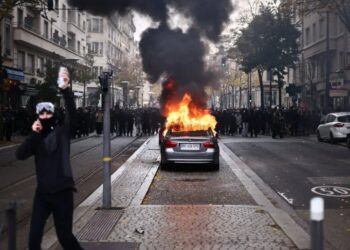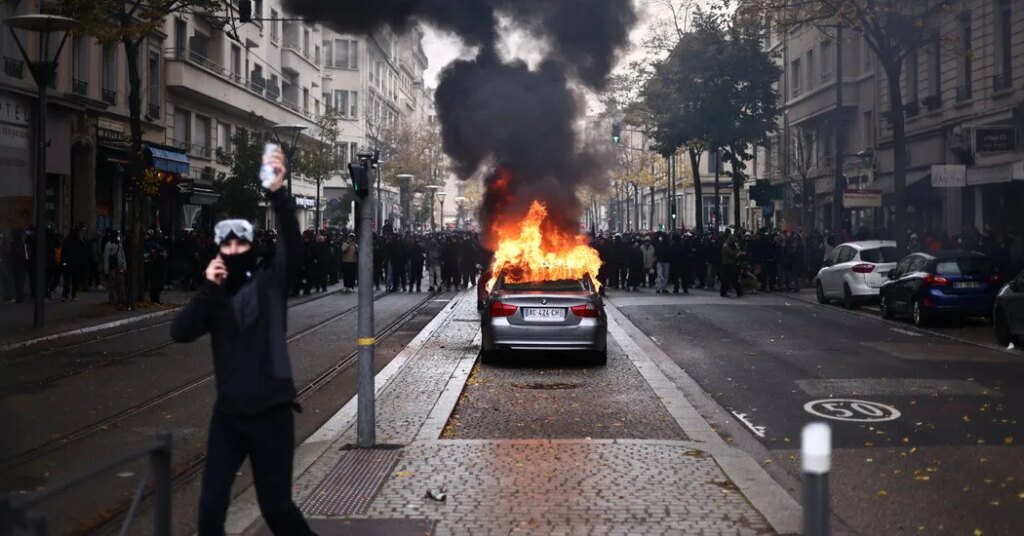
When France erupted in nationwide protests last month, the country’s 24-hour television news channels pulled out a well-worn playbook: dramatic footage of billowing tear gas, burning cars, shattered store windows and violent street clashes, amplified by sometimes strident on-air commentary.
Now, two of the main channels, CNews and BFM TV, are under fire themselves, accused of fueling France’s autumn of discontent.
More than a million people signed a petition demanding that the French government revoke the broadcasting license of CNews, citing what they called its right-wing propaganda and racist language, content that regulators have defined as incitement to racial hatred.
At BFM TV, 160 staff members rebelled against what they characterized as a rightward “drift of opinions” expressed on air, saying in a letter to the channel’s bosses that they were ashamed to work there.
A camera crew from BFM TV was attacked by a crowd this month while covering a protest in Lyon, weeks after another crew was accosted at a memorial service for a young Black man killed by a white gunman in a working-class suburb of Paris. The city’s mayor, Ali Rabeh, put the blame for the violence squarely on the news channels, saying that they have poisoned viewers and polarized the political debate.
“It’s what people watch all day long,” said Mr. Rabeh, a left-wing politician whose parents immigrated to France from Morocco in the 1960s and who says the attack traumatized his racially diverse town, Trappes.
Neither CNews nor BFM TV responded to multiple email requests and calls for comment, but both have previously rejected charges of fomenting racially motivated violence. CNews said in a public statement about the petition that “everyone is free to criticize CNews and to challenge its editorial choices,” but that “calling for the elimination of a channel raises a fundamental question regarding pluralism and freedom of the press.”
Speaking to the French paper Le Parisien, the director of BFM TV, Fabien Namias, said his channel offered a platform to people across the political spectrum. “Hatred, racism, exclusion and division are foreign to BFM TV,” he said.
On a recent Sunday, however, two guests on the channel erroneously asserted a direct link between immigration and delinquent behavior in the protests. Last week, a commentator on CNews described Paris as a victim of “migratory submersion,” citing a plan to convert a building into a temporary homeless shelter.
Mr. Rabeh accused the channels of normalizing anti-Muslim language by giving platforms to certain far-right politicians and commentators. He said he wanted to change French law to make it harder for billionaires to own media properties, and to bolster protections for journalists who object to the political tilt of their employers. Cable news channels in the United States, Mr. Rabeh said, offered a troubling precedent.
“There are things that have to change fundamentally,” he said, “to guarantee the freedom of our journalists, to avoid an American-style drift.”
The ratings for France’s news channels are modest relative to Fox News in the United States, to which CNews is often likened because of a similar approach to culture-war issues. While Fox sometimes beats the American broadcast networks in prime-time ratings, France’s news channels have a fraction of the ratings of the leading French commercial broadcaster, TF1.
Still, their viewership has risen over the two months of student-led protests, which they have covered wall to wall. BFM TV reached an aggregate audience of 50.9 million people in October, according to Médiamétrie, a market research company, while CNews reached 44.7 million people. France’s population is roughly 70 million.
With audiences like that, these channels are destined to play an influential — critics say, divisive — role in France’s presidential election next spring. The campaign to replace President Emmanuel Macron is unfolding against a combustible backdrop of social unrest, rising populism on the right and left, and fears of additional racially motivated attacks, as officials described the one in Trappes.
“The wind has shifted,” said Samuel Bouron, an expert in media at Paris Dauphine University. “It has put CNews and BFM on the defensive, and these networks are now being called upon to explain themselves, at least regarding how they shape public debates and how they regulate hate speech.”
CNews, which embraces its identity as a French Fox News, has been sanctioned or warned 20 times by France’s broadcast regulator since 2019, six times this year alone. Among the violations: airing statements that incite racial hatred, failing to offer a diversity of views and over-promoting the far right.
Still, France’s National Assembly declined to act on the petition to revoke the channel’s license, saying it was not the job of lawmakers to force a TV channel off the air. Instead, it has scheduled a debate on free speech. CNews noted that more than million signatures is far from a majority of French people.
For some critics, the challenge posed by these channels is as much about money as politics. CNews is owned by a French billionaire and media mogul, Vincent Bolloré; BFM TV, by a French-Lebanese shipping tycoon, Rodolphe Saadé. Critics said the concentration of media properties in the hands of such wealthy owners made them less accountable and more apt to reflect the politics of their proprietors.
Neither man describes himself as politically right-wing, though the output of all of Mr. Bolloré’s media holdings has a conservative angle. In testimony before the National Assembly in March, he described himself as a “Christian democrat,” without an ideological agenda.
Mr. Saadé, who is close to Mr. Macron, a centrist, told lawmakers in 2025 that he does not interfere in the editorial decisions of his holdings. That year, he visited President Trump at the White House, pledging to invest $20 billion in American ports.
BFM TV, which was spun out of an FM radio station, offers a more straight-news diet than the openly political CNews. But in August, BFM TV poached Sonia Mabrouk, a Tunisian-born French journalist, from CNews, where she had developed a reputation for interviewing far-right political figures. Ms. Mabrouk brought that specialty to BFM TV, to the chagrin of many of her new colleagues, who believed that such figures should not get that much airtime, according to two people who work there.
She did not reply to a request for comment.
Some analysts said the rightward creep of BFM TV reflected a recognition that Marine Le Pen, the candidate of the far-right party, National Rally, is riding high in the polls and has a plausible path to the presidency. (The party has never entirely disavowed its founder, Jean-Marie Le Pen, and many of its candidates in recent parliamentary elections made racist or antisemitic remarks.)
“It’s not because of ideology; it’s because of interests,” said Alexis Lévrier, a media historian at the University of Reims. “They are people who have finally come to terms with the idea of a probable victory for the National Rally and show signs of compatibility with the extreme right.”
People who work for BFM TV suggest another motive: costs. Fielding a panel of talking heads is cheaper than paying for reporting in the field. The problems begin when those panels feature far-right politicians or commentators whose statements can be both inflammatory and wrong.
Thomas Leonetti, a technician at BFM TV who signed the letter of protest to the channel’s management, said he and his colleagues recognized that they had “a societal responsibility. We work at this channel, but we are also citizens and we realize the impact that such words can have in the public debate.”
“Of course,” Mr. Leonetti added, “we feel shame and embarrassment to say that we work at BFM TV today.”
Giulia Imbert and Ségolène Le Stradic contributed reporting.
The post In France’s Angry Autumn, TV News Channels Are Accused of Stirring the Pot appeared first on New York Times.