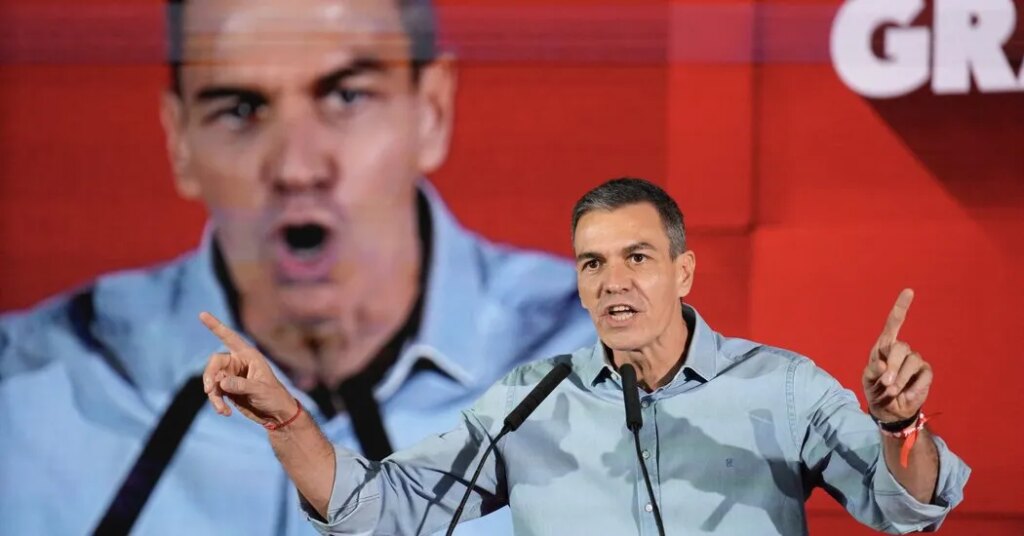
Pedro Sánchez knows what to do to keep his position.
“I always use elbows,” Mr. Sánchez, the prime minister of Spain, said with a laugh in the corner of a locker room as he used lessons learned from his time as a youth basketball player to describe his political game.
It was minutes before a Socialist Party rally in southeastern Spain — in a packed gym fitted with basketball hoops — and a dozen days before national elections on Nov. 29. Polls suggest Mr. Sánchez, Europe’s most prominent left-wing leader, will lose after eight years in charge.
But Mr. Sánchez, known as a political survivor, appeared to relish the idea of being written off once again by the conservatives who are favored. “That is good for me,” he said in a pre-rally interview, looking relaxed in a black mock turtleneck. “It’s a good tactic because at the end of the day, they underestimate me.”
Mr. Sánchez, 54, has beaten the odds in the past, but this time, they are stacked against him.
Outside Spain, he has become a hero to the global left by resisting President Trump, welcoming migrants and denouncing what his government called Israel’s genocide in Gaza, a term rejected by Israel. Under Mr. Sánchez’s leadership, Spain has become one of Europe’s fastest-growing economies and one of its most prolific users of renewable energy. He said that he had put Spain “more in the conversation.”
Yet within Spain, many have had it with him. He has become an increasingly polarizing figure after years of corruption scandals in his inner circle, a national electricity blackout in 2025 and a migration crisis this summer in Ceuta, a Spanish territory in North Africa.
He tried to capitalize on left-wing frustration over spiraling rents by calling for early elections and making the issue his own. But a horrific train crash stalled the momentum that polls showed he was building, shifted voters’ attention and raised unsettling questions about his maintenance of the country’s infrastructure.
Even the online chess matches he plays to relax between campaign events are not going his way. His score of 700 on chess.com — among “the lowest,” he conceded — means his king is often felled.
For most of his career, it has been a different story. Those spurned by Mr. Sánchez, a highly disciplined campaigner, say his chiseled features and abundant charm mask a ruthless political instinct.
He mostly shrugged off regular attacks from Mr. Trump, using them to bolster his left-wing support. He joked that despite the American president “saying all these mean things about me,” Mr. Trump talked to him only about golf when they met in private. “It was weird,” he said with a laugh. The White House declined to comment.
Even Mr. Sánchez’s enemies do not believe the polls. They are traumatized by his previous comebacks, including in 2023, when he managed to assemble a governing coalition despite his party not winning the most votes.
To hear Mr. Sánchez tell it, winning has never been more important. Polling suggests that the conservative Popular Party is likely to take office after the election, in a coalition for the first time with the far-right Vox party.
“The danger is that the last time that the far right was in office in my country was during the dictatorship,” Mr. Sánchez said, suggesting that a coalition of mainstream conservatives and far-right forces risked sending Spain back to the authoritarian rule of Francisco Franco, who died in 1975. Alluding to the Spanish Civil War that installed Franco, he added, “we had of course all these terrible situations in the past.”
For Mr. Sánchez’s enemies, this is a classic stunt by a prime minister whom they portray as the primary cause of Spanish social divisions. They see his use of civil war imagery — he recorded a political ad in front of Pablo Picasso’s “Guernica,” which depicts the horrors of the war — as inflammatory.
“Less civil war, less hatred among Spaniards, less garbage from a century ago,” Santiago Abascal, the leader of Vox, who has called Mr. Sánchez a “dictator,” “traitor” and worse, said at a rally in the Canary Islands on Tuesday.
Mr. Sánchez equates Vox — which is anti-immigrant, nationalist and has challenged Spain’s acceptance of L.G.B.T.Q. rights — with the mainstream conservative Popular Party.
“Today,” he said, “they are more or less the same.”
His intention is to use the possibility of a union between Vox and Popular Party to mobilize his left-wing base — and to attract supporters of far-left parties because they think he is their only shot of averting a right-wing government.
But Mr. Sánchez also needs to peel back Spain’s exasperated centrist voters by seeming more moderate.
“This is a real referendum in favor of good politics,” Mr. Sánchez said from the stump on Tuesday night in Albacete in southeastern Spain. “And against incivility.”
The event capped a busy couple of days during which I shadowed Mr. Sánchez on the campaign trail, including in the Palace of Moncloa, the seat of the Spanish prime minister.
I ate churros with his ministers at a weekly closed-door breakfast, and caught Mr. Sánchez joking with his aides about a right-wing media conspiracy that depicted him as possessing secret tapes to drop on the opposition before Election Day. During a visit from Brazil’s president, Luiz Inácio Lula da Silva, fresh off his own comeback election victory, I stood with Mr. Sánchez on Moncloa’s steps as we watched the Brazilian leader delay the departure of their motorcades so he could shoot a video under the branches of a 600-year-old olive tree.
Mr. Lula had come to energize Mr. Sánchez’s campaign. The two leaders drove into central Madrid to film a conversation that had the vibe of a mutual admiration society. The Sánchez campaign quickly chopped it up into social media clips to motivate left-wing supporters.
On the sidelines, André Janones, the architect of Mr. Lula’s come-from-behind victory, applauded as Mr. Lula signed Mr. Sánchez’s red “Power of the People” campaign T-shirts. “Now, it is Spain’s turn to keep this momentum going,” he told me. And since Europe is so barren of left-wing leaders, he said, a “much greater responsibility” fell on Mr. Sánchez.
The tougher assignment for Mr. Sánchez involves bringing moderates back into the fold.
To reach them, he has replaced his far-left deputy prime minister with a more moderate economist, and taken to waving Spanish flags, long a conservative symbol, at rallies. On Tuesday evening, he dropped by the studios of Telecinco, a popular television network seen as lukewarm to the Spanish left.
Before his interview, Mr. Sánchez oozed confidence, talking with one executive, Francisco Moreno, about how he used to play basketball in Converse sneakers.
But when the interview began, the reporter pushed hard on Mr. Sánchez’s political reversals — “Evolutions,” the prime minister called them — and asked tough questions about railway maintenance and Mr. Sánchez’s decision to take a vacation during a migration crisis. Mr. Sánchez bristled after the interviewer rushed his answers so they had more time to discuss corruption scandals involving the prime minister’s associates.
“You get to speak,” Mr. Sánchez snapped. “I have the right to speak, too.”
When Mr. Sánchez walked out, his lips tightened around a forced-seeming smile. He again shook hands with Mr. Moreno and left. “The way television interviews should be,” Mr. Moreno said as he stepped into an elevator.
The next morning in a Moncloa breakfast room adorned with abstract Spanish art, Mr. Sánchez’s ministers sipped coffee from gold-rimmed cups emblazoned with the Spanish coat of arms and said their boss acquitted himself well, considering the forum. Several picked up where Mr. Sánchez had left off.
“Europe needs a strong progressive voice that continues to believe in European values,” said José Manuel Albares, the foreign minister, between bites of a Spanish pastry. Other members of the government said that they felt a sense of momentum.
They were also trying to create it. Minutes later they joined Mr. Sánchez in a room across the hall where they increased the minimum wage and raised salaries for public servants.
Later that night in the locker room, Mr. Sánchez, again in a good mood, stuck with his basketball metaphors. He said “you have to deliver” in the short time one had the ball, something he suggested other left-wing leaders could learn.
Moments later it was time to deliver again. He entered the packed gym, as supporters waved Socialist, Spanish, European and Pride flags. They cheered his litany of accomplishments and hissed at the mention of his right-wing opponents.
“Sánchez won us all over,” Pedro Arnas, 68, said after the event. But out in the country, he said, “It’s going to be tough.”
Carlos Barragán contributed reporting.
The post On the Trail With Spain’s Prime Minister, as He Tries to Pull Out a Win appeared first on New York Times.