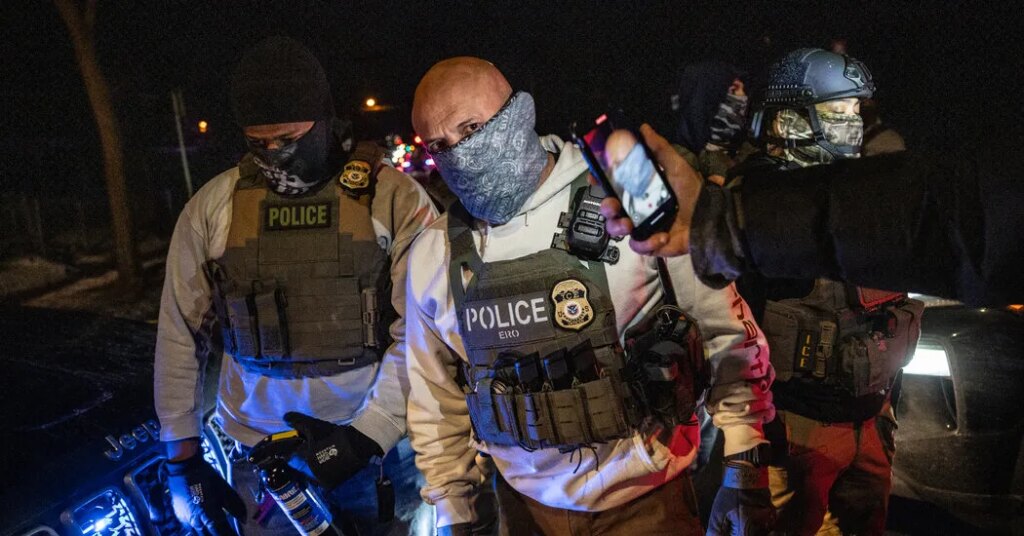
The Department of Homeland Security went too far last year in loosening training standards for thousands of immigration officers hired to support President Trump’s mass deportation push, an internal department watchdog has found.
The findings, in a 19-page draft report that has not been finalized or released, amount to a sweeping critique of the plan carried out under Kristi Noem, the homeland security secretary at the time, to rapidly hire and deploy 10,000 new officers with the help of tens of billions of dollars provided by Congress.
One recruit instructor quoted in the draft report, which was obtained by The New York Times, called the rollbacks in training standards a “catastrophic failure.”
Among the changes highlighted was a decision to allow more than 3,500 recruits with prior law enforcement experience to complete their basic training virtually. Previously, the training was done fully in person at a training center over the course of a month. Using the online option, some officers completed the training in less than a day.
The draft report also criticized the relaxing of a policy that had given the recruits only two chances to pass a training test. As the department staffed up, it allowed them to take the test an unlimited number of times. One officer took the training test 32 times before passing.
The draft noted that the current secretary, Markwayne Mullin, restored the more robust training standards in July. However, it said, “despite increasing training hours and days for future recruits, ICE has not fully addressed training gaps born of the reductions and revisions.”
The rush to hire officers and get them onto American streets came after months of pressure from the White House to increase deportations and arrests. While Immigration and Customs Enforcement has long said that the training was adequate, several shootings and other incidents have led to concerns that underqualified and improperly vetted people were being given ICE badges.
The draft report, from the Homeland Security Department’s Office of Inspector General, did not consider whether lax training had contributed to problems on the ground. But at least one officer involved in a recent incident is known to have joined ICE while lower standards were in place: David Brouillette, who was hired last December and fatally shot Johan Sebastián Durán Guerrero, a 25-year-old Colombian immigrant, in Maine this summer during a vehicle stop.
Representatives for Ms. Noem did not respond. Mr. Brouillette did not respond to a message to his personal email address.
In a statement, the Homeland Security Department said that Mr. Mullin had acted quickly upon taking office and that ICE officers were getting extra training.
“A significant portion of officers brought on during the hiring surge have law enforcement experience and have already successfully completed a law enforcement academy,” an ICE spokesperson said in a statement.
Asked at a hearing this week about training changes, Mr. Mullin told Congress that “there were some decisions that were made before I was secretary that we are having to undo.”
ICE officer training has come under scrutiny as viral videos documenting rough tactics have proliferated online, and the agency has been involved in a series of shootings of immigrants and a U.S. citizen. The agency has faced a downturn in public support and intensifying criticism from Democrats, including numerous candidates who won in the midterm elections promising reforms.
One whistle-blower previously reported that the agency had “improperly vetted” new recruits. Top ICE officials believed that the training changes were a mistake, according to a former senior official who spoke to The Times on the condition of anonymity to discuss the findings in the draft report.
The Homeland Security Department’s inspector general, Joseph V. Cuffari, is one of the few internal agency watchdogs Mr. Trump did not dismiss after retaking office. Mr. Cuffari, who was nominated by Mr. Trump during the president’s first term, has been aggressive in examining agency practices. His office is also scrutinizing contracting, ICE hiring and compensation.
“We strongly condemn the premature release of draft reports before the department has had the opportunity to complete its review and provide formal comments,” Mr. Cuffari’s office said in a statement. “Such disclosures undermine the integrity of the oversight process, risk presenting incomplete or misleading information, and compromise the fairness and accuracy essential to credible oversight.”
Truncated training for thousands of officers
In-person basic training historically has included firearms instruction, de-escalation techniques, use-of-force lessons, techniques for handcuffing and ways of identifying the immigration status of targets, among other topics. But from August 2025 to around July this year, nearly 6,000 officers went through a sharply curtailed training model, according to the draft.
Among those hires were many with law-enforcement backgrounds.
The more than 3,500 deportation officers with prior law enforcement were hired under the more lax training standards, the inspector general draft report found. That is equivalent to about 35 percent of the active force of deportation officers across the country. Deportation officers work in ICE’s Enforcement and Removal Operations, or ERO.
The draft report found the online training provided recruits a way to speed through the training. More than 80 percent of those completed the training within 10 days. Some went even quicker: More than 10 percent completed it within 24 hours. At least five recruits did it within two hours.
An ICE official who spoke with inspector general agents said it should have taken the recruits the same amount of time as before — about a month.
“Another graduate told us that some students clicked through the learning modules without absorbing content,” the draft report said. “An ERO official stated that the virtual training appeared ineffective for many recruits, and they would have preferred that those recruits (even with prior law-enforcement experience) take in-person training instead.”
ICE told the inspector general’s office that additional in-person trainings were offered to these officers.
ICE officials cut the training hours for recruits with no law enforcement experience from 543 hours to around 300 hours, and the number of days of training went down from 72 to 42 days. The cuts were made beginning in November 2025 until February 2026.
ICE officials cut training hours on “law enforcement handguns,” how to control detainees during deportation flights, driving maneuvers, and “arrests and determining citizenship.” More than 2,000 recruits — or more than 20 percent of its deportation officers — went through the condensed training, the document says.
The agency also withdrew from Federal Law Enforcement Training Accreditation, which vets federal training standards. The U.S. Secret Service and the Department of Veterans Affairs have been accredited by the organization.
ICE officials believed the changes to the training made them ineligible, according to the draft report. One official said that without the accreditation the training could “become a crisis.”
ICE has reapplied, but the process takes three years.
No explanation given to watchdog agents
The draft report said inspector general agents struggled to determine the rationale of department leaders in justifying the slimmed-down training because the leaders “did not leave behind any written explanation for their decision.”
The watchdog agents spoke with the former head of training, who told them he was ordered to make the changes. The official indicated “that course reductions were dictated to him by then ICE deputy director and strongly supported by former Secretary Kristi Noem and former senior adviser Corey Lewandowski.”
Mr. Lewandowski did not respond to a request for comment.
ICE instructors found the changes alarming.
“Several ERO instructors shared concerns that students were not adequately trained or tested on critical material,” the draft report said. “One instructor characterized the revised training as a ‘catastrophic failure.’ Another instructor noted that undertrained students could become liabilities.”
Earlier this year, Ryan Schwank, a former ICE lawyer who quit the agency in February, publicly detailed some of the changes to the courses for new recruits. ICE officials at the time said that on-the-job training would be a supplement.
In March, The Washington Post reported on documents it obtained backing the claims made by the whistle-blower.
“The training does not stop after graduation from the academy — recruits are put on a rigorous on-the-job training program that is tracked and monitored,” read an agency statement following Mr. Schwank’s disclosures.
But officials with inspector general’s office also found problems with the on-the-job training, in which ICE officers are supposed to build on academy knowledge with the help of coaches.
“ICE could not demonstrate that its field offices consistently implemented” on-the-job training “as intended,” the draft report found, “raising significant concerns about the completeness and effectiveness of employee training.”
Nearly 90 percent of ICE officials managing the program who filled out a questionnaire sent to them by the inspector general’s office said the on-the-job training was “not successful.”
In some places, like Dallas, the push for more arrests meant that the training became a secondary thought. A supervisor there said that the push to get “nearly every officer” out doing arrests and deportations made it impossible to do more advanced training.
In Baltimore, new recruits were assigned to follow more senior officers instead of getting a coach to train them formally. And in San Francisco, the draft report said, on-the-job training was more informal because there were not enough people to carry it out.
The inspector general officials had a stark warning to ICE leadership.
“It is imperative,” the draft report said, “that steps be taken to promptly ensure all new ICE hires are fully prepared to perform their law enforcement duties and responsibilities.”
The post A ‘Catastrophic Failure’: Watchdog Officials Find Cascade of Problems With ICE Training appeared first on New York Times.