Warby Parker is one of the clear winners of the 2010s-era direct-to-consumer (DTC) wave. It and other upstart digital-first brands like Allbirds shoes, Away luggage, and Casper mattresses used e-commerce savvy to cut out middlemen like wholesalers, upending their industries and selling straight to shoppers.
While many of its peers from that era have struggled or shut down, Warby Parker retains an empire of 360 stores; its revenue increased 10% to $245 million in its most recent quarter. Still, the eyewear company is grappling with soft growth in new active customers—only 3.4% last quarter—and a sluggish eyewear market overall.
In search of its next big growth engine, Warby Parker is planting its flag in the promising but still tiny market for smart glasses, teaming up with Google. The tech behemoth, along with partner Samsung, will provide the AI technology behind the glasses, including a high-resolution display tucked inside one lens that wearers can control with a wristband or watch.
For Warby Parker, whose own innovations have included a virtual try-on and features that enable customers to choose glasses from home, the partnership could bolster its tech-forward reputation, tapping its strengths in design and retail to win eyeglass buyers of the future.
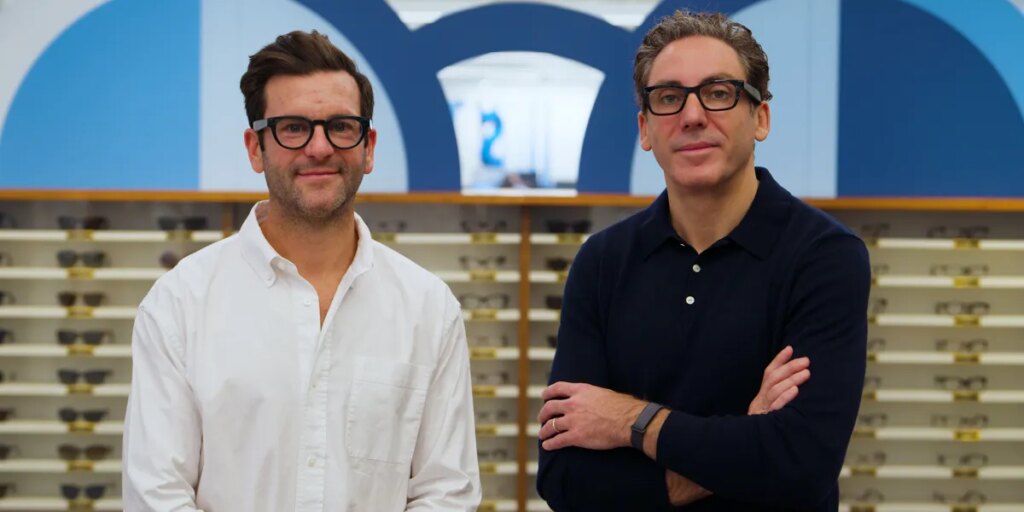
“Glasses are the original wearable, right?” says Warby Parker cofounder and co-CEO Neil Blumenthal on Fortune’s Behind the Business YouTube series. “The combination of form and function is something we can bring to this new category and create something that has a ton of technology in it.”
The Warby Parker glasses, at a starting price of $395, hit the market on Nov. 12 and are taking on an early market leader in Meta, whose Ray-Ban smart glasses are designed and made in partnership with EssilorLuxottica, the largest eyewear company in the world. Meta’s glasses represented about 69% of smart glasses so far this year. EssilorLuxottica has said it sold 7 million pairs of AI-supported glasses in 2025.
Google’s and Meta’s decisions to team up with established eyewear brands like Warby Parker and EssilorLuxottica demonstrate that they understand that so-called intelligent eyewear, as Warby Parker refers to it, must be aesthetically pleasing and less sci-fi-like to achieve mass appeal.
“We’ve always innovated in technology,” says Dave Gilboa, Warby Parker’s other co-CEO and cofounder. “But our North Star is that someone has to want to put this on their face.”
Indeed, the “smart” aspect of the Warby Parker glasses is subtle. The cameras on the front of the frame could pass for a screw. Wearers can start filming or take a photograph with the glasses by pressing a small button near the temple. Outward-facing lights illuminate when the user is recording, a feature that helps assuage concerns that wearers will use smart glasses to photograph or film surreptitiously.
Warby Parker commands just 1% of the U.S. eyewear market, but its history as a digital-first brand and its reputation for simple but appealing designs have made it a desirable partner for Big Tech, says Kate Winick, an analyst with Forrester Research.
“Warby Parker is a small player, but it’s the right player,” says Winick. “It has stores in these zip codes that tech companies desperately want to reach.”
That’s especially important for Google, which has a lot riding on these glasses. The company needs Warby Parker, Winick says, to help it move past Google Glass, its first attempt at smart glasses, which flopped after its 2013 debut. Glass was bulky, its battery died quickly, and at $1,500 it was hard to justify. Worse, it made people uneasy: Many bars, restaurants, and theaters banned it over fears of nonconsensual recording. It came to embody the era’s “tech bro” stereotype so completely that its wearers earned a nickname: “glassholes.”
Google is eager for its new version of smart glasses to prove that its technology can work at scale across other wearables. Forrester’s Winick expects tech giants to use the wearable tech featured in glasses in other devices, such as Meta’s Muse Charm, a pocket- and key-chain-size AI companion.
At Warby Parker’s recent quarterly check-in with Wall Street analysts, where smart glasses dominated the discussion, the company said smart glasses could contribute several percentage points to its fourth-quarter growth. (Google and Warby Parker have not disclosed the revenue sharing and intellectual property ownership details of their partnership.)
Blumenthal and Gilboa acknowledge the privacy concerns smart glasses raise, but they argue the devices could also fix a modern habit: constantly reaching for our phones. “For the first time, you can have this accessory that enables you to leave your phone in your pocket to keep your attention in the real world,” Gilboa says.
The post Warby Parker is betting its next chapter on smart glasses people actually want to wear appeared first on Fortune.