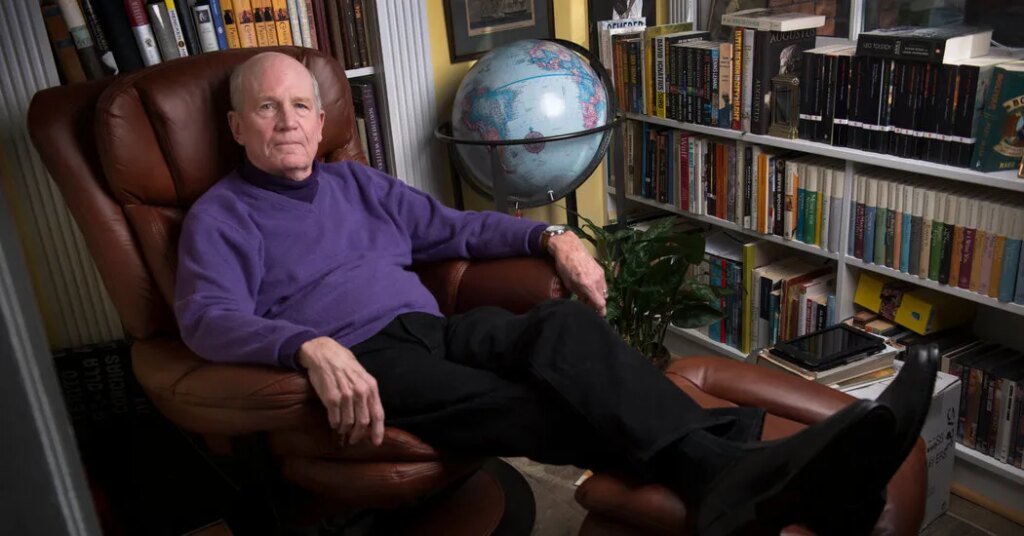
Jonathan Yardley, a Pulitzer Prize-winning bibliophile who wrote often scabrous book reviews for The Washington Post that challenged celebrated authors whose works he felt had been cursorily acclaimed, and who ran a popular column reacquainting his readers with neglected gems, died on Friday in Washington. He was 87.
His death, at an assisted-living residence, was confirmed by his son Jim.
Reviewing some 3,000 books for The Post over “33 years and four months — a third of a century almost to the minute,” as he put it, and “never missing a day’s work,” Mr. Yardley delivered blunt appraisals of established, best-selling writers, eschewing euphemisms in fulfilling what he considered his mission to spare readers a wasted investment of their precious time and money.
The writer Joe McGinniss, for instance, had risen to critical acclaim with his first book, in 1969, about the marketing of Richard Nixon during his 1968 presidential campaign. But Mr. Yardley had these words for Mr. McGinniss’s salacious 1993 biography of Ted Kennedy, “The Last Brother: The Rise and Fall of Teddy Kennedy”: “a textbook example of shoddy journalistic and publishing ethics.”
“It is also a genuinely, unrelievedly rotten book,” he added, “one without a single redeeming virtue, an embarrassment that should bring nothing except shame to everyone associated with it.”
In the same vein, Kathryn Harrison’s widely praised 1997 memoir, “The Kiss,” a brutal recounting of her sexual relationship with her estranged father, was dismissed by Mr. Yardley as “slimy, repellent, meretricious.”
“The temptation to go on and on about this book,” he wrote, “piling one abusive paragraph upon another, is extreme, but must be resisted. Space is short in this newspaper.”
Neither was the canon spared from his scrutiny.
John Steinbeck, in his view, was a “plodding, graceless prose stylist” who was not “a great, or even near-great, writer,” he wrote in 1994. Mr. Yardley remembered cherishing J.D. Salinger’s 1951 novel “The Catcher in the Rye” as a teenager, but he reread it decades later and described it as “almost literally a painful experience: The combination of Salinger’s execrable prose and Caulfield’s jejune narcissism produced effects comparable to mainlining castor oil.” Neither did he hold much regard for Ernest Hemingway’s 1952 novella “The Old Man and the Sea.”
Those works by Mr. Salinger and Mr. Hemingway, while “durable and beloved,” he concluded, were also “by any reasonable critical standard, two of the worst.”
He admitted, as a reviewer, to relishing the attack more than heaping praise. “The very vocabulary of attack is more varied and interesting,” he told Washingtonian magazine in 2007. “‘Wonderful,’ ‘extraordinary,’ ‘exceptional,’ ‘accomplished’ — blah, blah, blah. You get bored fast.”
For him, good literature was unpretentious and not of the navel-gazing variety, and instead cast a reflective eye out onto the world. Of those that undoubtedly qualified for him were the works of C.S. Forester, William Faulkner, Flannery O’Connor, Peter Taylor and Ralph Ellison, whose “Invisible Man” he said he had read multiple times.
When praise did come, Mr. Yardley could greatly lift the profile of new authors, and he had a hand in propelling the careers of John Kennedy Toole, John Berendt, William Boyd, Michael Chabon, Olga Grushin, Edward P. Jones and Anne Tyler.
Mr. Toole’s “A Confederacy of Dunces” first appeared in print in 1980 after a yearslong crusade by the mother of the young novelist, who had died by suicide following the unanimous rejection of his manuscript.
Writing in The Washington Star, the paper where Mr. Yardley worked before joining The Post in 1981, he noted: “There’s a temptation, in the circumstances, to regard the book as a freak — a novel more notable for its history than for its merits. Nearly a dozen New York publishers can’t be wrong, can they? Yes, they can; even the best of them make mistakes.”
“‘A Confederacy of Dunces’ is a marvelous book,” Mr. Yardley continued. “It may be a trifle shapeless and discursive, but that simply doesn’t matter. This is rich, outrageous, hilarious, moving stuff, alive with vivid characters and true-to-life settings.”
Mr. Toole’s novel won the Pulitzer in fiction in 1981. Mr. Yardley was also the chairman of the Pulitzer fiction jury that year, and his review of the book was one of the citations for his own Pulitzer win, for criticism, that same year.
Mr. Chabon, too, was a beneficiary of Mr. Yardley’s positive appraisal. “There’s no getting around it,” Mr. Yardley wrote in The Post 1995 of Mr. Chabon’s third book, “Wonder Boys.” “Chabon leaves no doubt that he is the young star of American letters.”
Mr. Chabon later recounted that Mr. Yardley’s gentle prodding, in the review, to “explore larger worlds,” pushed him to pursue what would become his Pulitzer-winning novel, “The Amazing Adventures of Kavalier & Clay.”
For seven years beginning in 2003, Mr. Yardley wrote a column every month or so called “Second Reading,” which reconsidered some of the notable but forgotten or neglected books — about 100 in all — that he retrieved from his bookshelves.
Among them was Edwin O’Connor’s 1964 novel of a vaudevillian, “I Was Dancing” (“I’d be hard-pressed to say that any book discussed therein is more undeservedly neglected than this one,” Mr. Yardley wrote), and Thornton Wilder’s “The Bridge of San Luis Rey.” “It is no exaggeration to say that on second reading,” he noted of Mr. Wilder Pulitzer-winning 1927 novel, “I was completely blown away, not so much by Wilder’s sensitive treatment of his central theme as by the richness and power of his prose.”
“I came to this task as a journalist, not a literateur, and I have remained one to this day,” he told readers of The Post in 2014 as he was retiring. “I have high literary standards and delight in the expression of strong opinion, literary and otherwise, but I also read a book as if I were a reporter: looking for what it is ‘about’ in the deepest sense of the word, determining what matters about it and what doesn’t, trying to give the reader a feel for what it is like as well as passing judgment on it.”
Sam Tanenhaus, a former editor of The New York Times Book Review, wrote in an email in 2024 that Mr. Yardley was “the rare reviewer who earned the designation ‘critic’ — which is to say he did not just tell you what he thought of a book, thumbs up or down, but what authors were trying to do.”
“He assumed readers looked for the same things he did, high literary ambition and developed artistry,” Mr. Tanenhaus added.
Jonathan Yardley was born in Pittsburgh on Oct. 27, 1939, and grew up in Chatham, a town in southern Virginia. His father, William Woolsey Yardley, was an educator who taught English and the classics and was the headmaster of Chatham Hall, a girls’ boarding school. His mother was Helen (Gregory) Yardley.
After graduating in 1957 from the Groton School in Massachusetts and in 1961 from the University of North Carolina at Chapel Hill, he was an intern for James Reston, a columnist and the Washington bureau chief of The Times.
While working as an editorial writer and book reviewer for The Greensboro Daily News in North Carolina from 1964 to 1974, he was a Nieman fellow at Harvard University, where he studied American literature and literary biography, and also contributed reviews to The Times.
Mr. Yardley served as book editor of The Miami Herald from 1974 to 1978, then moved to The Star, where he won the Pulitzer for criticism in 1981. After The Star folded in 1981, he joined The Post and announced his retirement at the end of 2014.
Mr. Yardley, a jazz enthusiast, also edited anthologies and wrote several books, including a biography of the sports columnist Ring Lardner and another of the fictional memoirist Frederick Exley.
His own chronicle of the white, Anglo-Saxon Protestant world of his parents, “Our Kind of People: The Story of an American Family” (1989), was praised by Elizabeth Janeway in The Times Book Review as reading “like a first-rate novel.”
In 1991, H.L. Mencken’s unfinished memoir was released from archives where it had been held for 35 years since his death, per the author’s instructions. Mr. Mencken’s publisher, Knopf, then commissioned Mr. Yardley to edit the sprawling 300,000 to 400,000 pages into what became “My Life as Author and Editor” (1993).
Terry Teachout, in a review in The Times, praised Mr. Yardley for transforming “a massive document of interest mainly to scholars into a rich, absorbing memoir.”
His marriages to Rosemary Roberts and Susan L. Hartt ended in divorce. In 1999, he married Marie Arana, an author and journalist who edited The Post’s Book World section.
In addition to his wife, he is survived by two sons from his first marriage, Jim and William Yardley; two stepchildren, Lalo Walsh and Adam Ward; two sisters, Jane and Sarah; a brother, Benjamin; and 11 grandchildren.
(Jonathan and Jim, who is currently an assistant managing editor at The Times, are among the few father-son Pulitzer recipients.)
When Mr. Yardley retired, he wrote in The Post that he looked forward to reading books simply for pleasure: “lots of P.G. Wodehouse and Peter Taylor first and foremost, of course, and Flannery O’Connor, and Ward Just, and Ellen Glasgow, and Raymond Chandler, and Anne Tyler, and John D. MacDonald, and doubtless ‘The Count of Monte Cristo’ for the umpteenth time.”
“I promise to make one last attempt to read ‘Ulysses,’” Mr. Yardley also wrote, “the gargantuan novel by James Joyce that was admitted to this country by my great-great uncle, federal Judge John Woolsey, whose famous opinion authorizing its admission” — after its ban for obscenity — “I regard as considerably more engaging, witty and intelligible than the novel itself.”
Mr. Yardley expressed optimism for the future of books to “survive and perhaps even thrive.”
“I am an old-fashioned man in a new-fashioned world,” he wrote, “which is reason enough to step aside, though, while doing so, to argue for the continuing value and pertinence of much that is old-fashioned, above all the carefully, scrupulously written word.”
The post Jonathan Yardley, Who Reviewed 3,000 Books and Pulled Zero Punches, Has Died appeared first on New York Times.