Los Angeles has long searched for ways to clean up MacArthur Park, to rid the space of the drug sales and homeless encampments that have made it a blight on the neighborhood and a target for the Trump administration as an example of failed Democratic leadership.
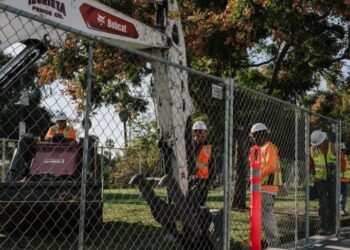
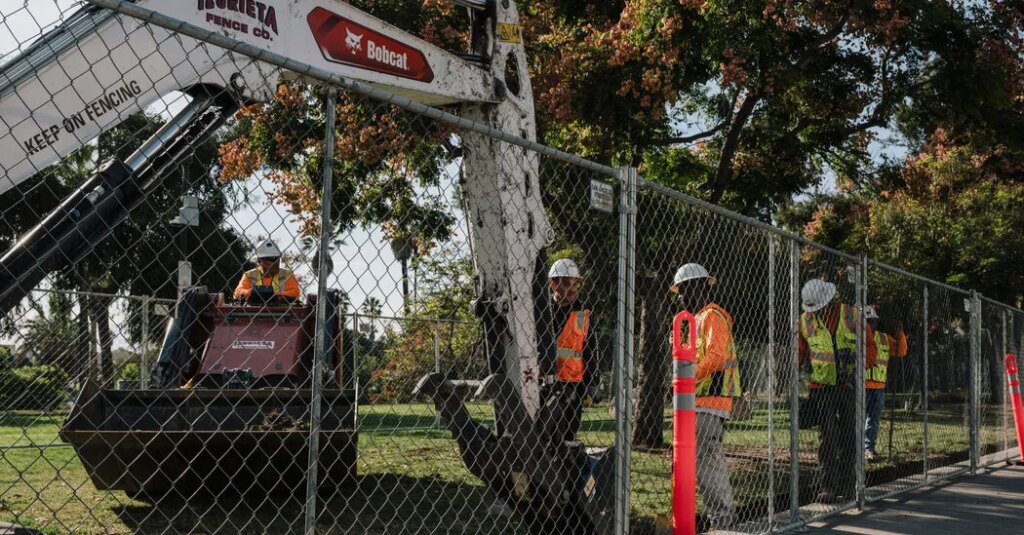
Now it is trying a new approach. The city has committed more than $2 million to erect a fence around the park that is meant to allow officials to exert more oversight over how the park is used.
Construction began on a temporary barrier on Tuesday, with a permanent fence scheduled to be completed next year. Some efforts to improve the park were already underway, including the installation of more lights around the vast 35-acre space, garbage cleanups and the deployment of more street medics and homeless service providers.
Los Angeles police and the Drug Enforcement Administration had already started to crack down on drug dealers who supply the park dwellers. In May, the agencies carried out a major raid that resulted in the arrest of 18 people who the police said were part of a network selling methamphetamine and fentanyl at the park.
Residents and merchants in the community just west of downtown Los Angeles say the recent law enforcement efforts have made a small but noticeable dent in addressing some of the problems, though they say the park remains relatively unsafe, especially at night.
The city’s plans call for the gates to be shut from 10 p.m. to 6 a.m. The police will patrol the park to try to clear it out before closing.
MacArthur Park, named for the World War II general, began its life as Westlake Park in the 1880s and was once the crown jewel of the Westlake neighborhood that was home to affluent residents in the early 20th century. Over time, the park deteriorated as the wealthy fled to other areas of the city and investment in the neighborhood declined.
In the 1980s, the neighborhood became a destination for refugees and immigrants fleeing civil wars in Central America.
Today, the community is largely working class and made up of immigrants from Central America. The space features a sports field, a small auditorium, playgrounds, a recreation center and a large lake that at night reflects the downtown skyline looking east.
The park attracted national attention last summer when the Trump administration sent heavily armed Border Patrol agents and members of the National Guard to conduct a military-style sweep. The operation was intended to be a show of force, led by the ousted Border Patrol leader Gregory Bovino, and led to a confrontation between the agents and Mayor Karen Bass, who said the government was just trying to “demonstrate to the nation their bravado.”
Conservatives have also criticized local nonprofit programs that aim to reduce disease and drug deaths by providing clean syringes to users.
The fence initiative, backed by Mayor Bass and Eunisses Hernandez, the councilwoman representing the area, was undertaken by the city’s recreation and parks commission, which approved the $2.3 million project last month. A chain-link fence is being erected now to seal off a construction area for a permanent fence, which will be green and have several pedestrian entry points. The park will remain open during construction.
The plan drew praise from many in the community eager to rid the neighborhood of illicit activity, and criticism from those opposed to closing off a public space.
The president of the city’s cultural heritage organization wrote in a letter to the parks commission that a permanent fence would detract from the park’s historic character.
The cultural commission suggested instead that the city enclose the park with a more temporary barrier as it had done at Echo Park, another enclave that has struggled with many of the same issues at MacArthur Park. That barrier — a chain-link fence — was taken down after two years.
Though the fence around MacArthur Park is built to be permanent, the city plans to review its effectiveness at improving safety after three years.
On Wednesday, men in orange vests and white hard hats were erecting chain-link fencing.
Donnell Edwards, 31, one of the installers, said many of the local residents were happy to see him and his fellow workers. “They’ve been recording,” he said, adding that some had come up to thank him.
Hugo Lopez, 36, who was walking around the park with his wife and 2-year-old son on Wednesday morning, recounted getting mugged at the park one time. He said he was happy to see what he considered decisive action by the authorities.
“You can’t be here at night because people there are people who are really drugged up who can harm you,” Mr. Lopez said.
But others in the area felt the fence would be yet another eyesore, and a futile attempt at solving an intractable social problem.
“Sometimes these things make you laugh,” said Mateo Antonio, 48, as he wrapped up his morning stretch at the soccer field in the park while listening to salsa music. “This problem has nothing to do with a fence.”
People wanting to get in the park during closed hours, he said, would find a way to get in.
Deisy de Leyva, 50, was worried that homeless people who are moved out of the park would wind up outside her beauty salon across the street.
Business, she said, was already slow because of the economy, and the fear of immigration agents was already keeping many of her customers home.
Near the another section of the park, Norm Langer, 81, the owner of Langer’s Delicatessen, is perhaps the most vocal business owner on matters concerning the park. His highly popular eatery has been around since 1947 and is considered a Los Angeles institution.
“I think the fence will do wonders, but the problem still is going to exist,” Mr. Langer said, sharing Ms. de Leyva’s concern that people who need help would simply be displaced.
The hope, he said, was to see the city ensure they went somewhere to get treatment.
The post L.A. Wants to Clean Up MacArthur Park. Will Fencing It Off Work? appeared first on New York Times.