Janatan Sayeh is an Iran analyst at the Foundation for Defense of Democracies.
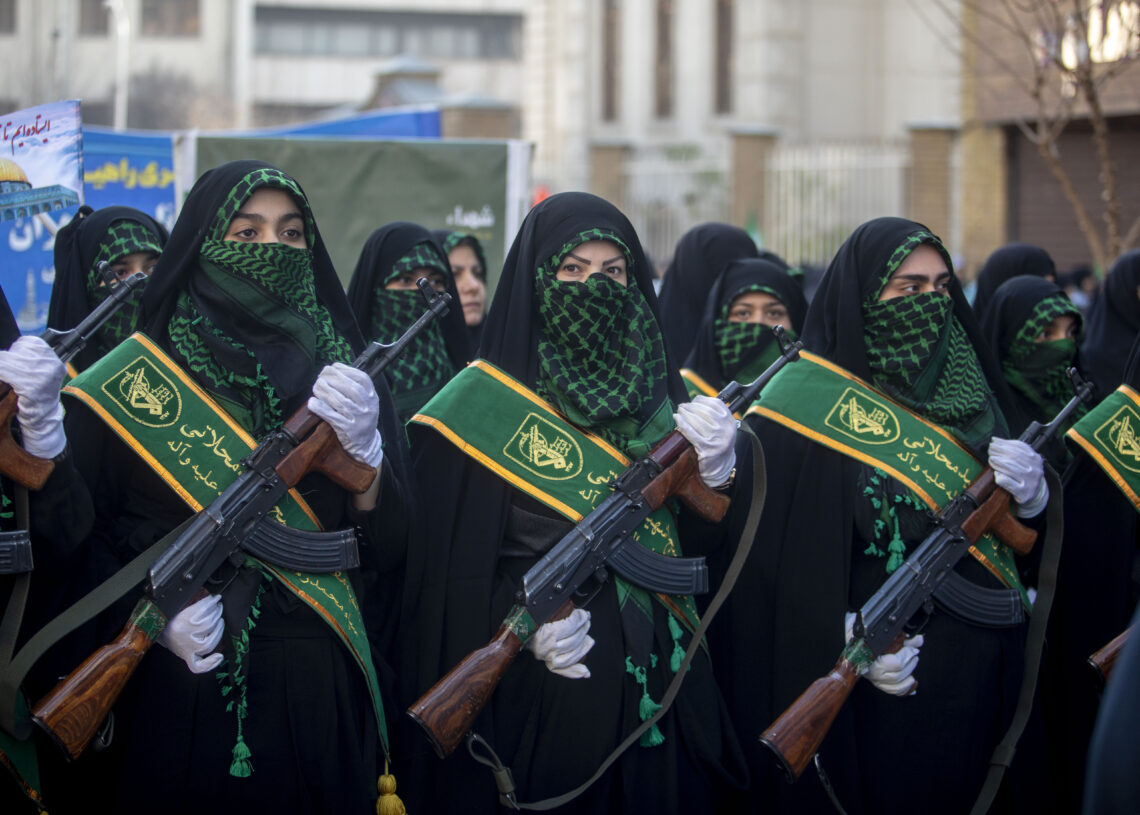
Enveloped in black and armed with rifles, chador-clad women marched through Iran’s streets in September as they trained for warfare. Exercises have offered a spectacle of military preparedness, with women operating air-defense systems and brandishing machine guns. Yet the Islamic republic might have a more immediate use for these trainees: fighting enemies at home.
As Tehran remains stuck in neither-war-nor-peace limbo, it is trying to mobilize the revolutionary faithful — especially women — to prevent Iran’s economic crisis from devolving into nationwide unrest.
The irony of women’s formal military integration becomes apparent when set against the words of Ayatollah Ruhollah Khomeini, the leader of the Islamic Revolution. In 1963, he attacked the ruling shah’s proposed “equality of rights” for men and women by likening compulsory military service for 18-year-old women to sending “chaste girls to the centers of prostitution.”
But the Islamic republic’s ideological boundaries hold firm only until they collide with its survival. The regime never entirely excluded women from its revolutionary project. During the 1979 takeover of the U.S. Embassy in Tehran, which led to the Iranian hostage crisis, a woman, Masoumeh Ebtekar, spoke for the revolutionaries. During the Iran-Iraq War in the 1980s, Khomeini praised women for supporting the war effort by educating children and sending them “to the warfronts.”
One propaganda poster from that time depicts an armed soldier and a cleric beside a woman holding an infant and a tulip associated with martyrdom. Other portrayals showed a mother in hijab physically shielding her child from bombs. Another placed a mother with her dead soldier son amid imagery of new fighters emerging to replace the fallen.
However, postrevolutionary laws relegated women to auxiliary roles. The regime converted women already serving in the military into civilian employees, limited new female recruits to medical and healthcare roles and sequestered those in the police to gender-segregated roles. Highly publicized paramilitary drills involving women in the mid-2000s remained largely symbolic, with female participants citing limited training and responsibilities. Women’s units in the Basij — one of the branches of the Islamic Revolutionary Guard Corps — remained focused on cultural and social work.
But the 2022 women’s rights protests showed Iranian leadership how a movement to fight oppression of women could converge with broader grievances and demands for regime change. Four years later, soaring prices and a collapsing currency brought years of accumulated anger to a boiling point, drawing millions into the January uprising demanding an end to theocratic rule. The unprecedented scale of the activism exposed the existential threat that domestic revolt poses to Tehran, making women too politically consequential for the Islamic republic to leave outside its mobilization strategy.
These efforts are part of the larger “Life Sacrifice” campaign, which has plastered cities with billboards encouraging firearms training, sent mass military recruitment texts and set up public weapons training booths. As part of a broader wartime militarization of civil society, the regime is trying to turn its supporters into the first line of defense against the enemy within.
Unlike during the Iran-Iraq War, when internal enemies were ethnic separatists or fringe ideological movements with narrow constituencies, anti-regime sentiment now spans broad swaths of society. Iranian citizens cheered U.S.-Israeli attacks and provided intelligence for Israeli strikes, validating the regime’s long-held view that internal enemies can serve as the “arm of more distant adversaries.”
Since May, authorities have increasingly held female-focused firearms training sessions and neighborhood defense meetings in smaller cities nationwide. Iranian leadership is drawing from the religious base that includes women who report other women for their attire and those who have asked for stricter hijab enforcement.
These loyalists are mobilized to defend the regime while their fellow Iranian women receive death sentences for protesting and lashes for defying compulsory hijab. Women’s units have also been piloting drones for the same regime that uses drones to enforce compulsory hijab.
At the height of the conflict with the United States, IRGC media quoted a person declaring that “today’s front is the street,” while celebrating the “feminine face of resistance.” Subsequent regime rallies featured pink military-style vehicles and other displays, with state media portraying a pink missile as an intersection of the “harshest aspect of war” and “the most delicate feminine symbol.”
As the regime’s desperation knocks down old barriers, the Basij’s deputy for education and training revealed on Oct. 3 that women had “recently entered units of the IRGC’s Ground Force,” expanding their participation beyond the Basij formations that had historically comprised most female military participation.
If successful, integrating women into the repression apparatus would make the regime harder to destabilize at home and raise Tehran’s willingness to absorb external pressure. Doing so requires the regime to compromise its founding ideals while persuading loyalist women to defend the very ideology that subordinates them — a contradiction both are willing to overlook for survival.
The post To survive, Iran is rewriting its rules for women appeared first on Washington Post.