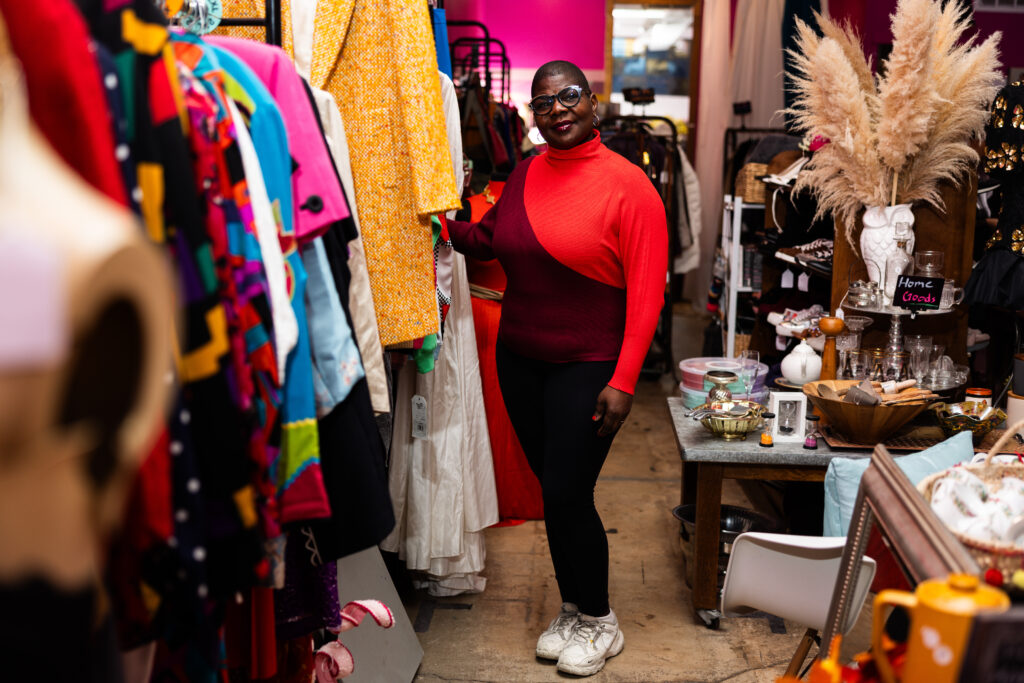
Safisha “Fia” Thomas grew up going to thrift stores and flea markets. Her parents would buy abandoned storage units and sell the contents secondhand.
“That was how we made a meaningful amount of money in our family,” Thomas said.
At first her parents were dragging her along, but eventually she learned to enjoy the process of sifting through other people’s old stuff in search of treasure.
“I really do love the hunt,” Thomas said.
As an adult, she grew that passion into her business: a thrift store in Washington, D.C., called Fia’s Fabulous Finds. Thomas still goes to yard sales and estate sales almost every weekend, but now she’s usually shopping for her customers rather than herself.
She’s noticed a growing clientele at these sales and her own store: younger people.
“We have hosted three teen birthday parties this year in the store,” Thomas said, explaining that the parties involve a scavenger hunt and a deeply discounted sale rack. “That’s when I realized, wow, this is something that really is trending.”
Why people are thrifting more than ever
Thrift stores as we know them date back to the Salvation Army’s shop that opened in 1897, followed by Goodwill soon after.
There was a stigma associated with thrift stores, as they were mostly for people who couldn’t afford to buy new things, said Jennifer Le Zotte, a historian at the University of North Carolina at Wilmington who studies alternative economies.
But that negative association has fallen away through the decades, especially in recent years, as the prices of everyday goods have risen and people have become more interested in pushing back against mass produced clothes.
“There’s definitely been a noticeable cultural shift,” said June Park, an associate professor of design and merchandising at Oklahoma State University. “Now secondhand clothing is a source of pride and creativity. Like, ‘Hey, I have this capability to hunt for treasure and style these unique items.’”
Americans sent 11.3 million tons of textile waste to landfills in 2018, about 70 pounds per person in the United States. Clothes are now being produced faster than ever and then being thrown away when they inevitably fall apart or go out of style.
But people are also pushing back against the trend. The resale market is growing. According to a recent report from the online marketplace ThredUp, the U.S. secondhand apparel market is expected to grow more than 7 percent annually to reach $78.8 billion by 2030. That’s largely driven by younger people and online platforms like Poshmark and Depop, according to the Bureau of Labor Statistics. Major retailers like Patagonia, Eileen Fisher and Madewell are also jumping in on the trend by offering resale sections on their websites.
“Thrift shopping is really the mainstream shopping behavior,” Park said. “Resale has become a really established part of fashion retailing.”
The thrill of the hunt
Research has shown that the “feel good” hormone dopamine is released in our brains when we are anticipating a reward.
“We love surprises,” said Susan Weinschenk, CEO of The Team W, a consulting firm focused on behavioral science. She said this is part of the joy of thrifting.
“You don’t know if you’re going to find anything,” she said. “So when you do, you get that kick of dopamine.”
And that motivates you to keep going. With activities like gambling and scrolling on social media, this can be a problem. In the context of thrifting, Weinschenk said she is less worried about people doing it compulsively.
“If you think about gambling, when you win, you’ve beaten the house. You’ve pulled one over on them,” Weinschenk said. There can be a similar feeling with thrifting, she said. “It’s like, ‘Oh, I found this thing, it’s really worth $100, and I’m getting it for $2.75.’”
Maria Esposito, a self-proclaimed thrifting devotee who lives in Baltimore, said this is why she loves it.
“I view it as a form of safe dopamine, instead of scrolling,” Esposito said.
Swap don’t shop?
If you peruse your closet, chances are there is at least one object that you love in theory but never wear.
Enter the clothing swap.
On a recent Tuesday evening in Baltimore, a group of mostly women gathered for an event called Pass the Pants. The rules are simple: Bring anything from your closet without rips or stains that you’re ready to let go of. Leave with clothes that someone else brought. You get a wardrobe refresh without any money changing hands.
“I do have a preference for swaps over thrift stores, because, number one, it’s free, but number two, I’ve made so many friends,” said Zhanna Thompson. “There’s a community behind these clothing swaps. It’s good energy.”
There’s also the satisfaction of seeing your clothes go to a good home.
“I love being able to see other people say, ‘Oh my God, this is so cute,’” Thompson said.
Usually Thompson takes home whatever she likes to try it on and then brings whatever doesn’t work to the next swap. Anything leftover at the end is donated to Paul’s Place or another local charity in Baltimore.
How to thrift better
Whether you’re a regular thrifter or a secondhand newbie, the experts have some tips.
Go in with a plan. Low prices can be hard to resist, but experts say even secondhand shoppers should be wary of overconsumption.
In her research, Meital Peleg Mizrachi, an academic fellow at Stanford University, found that people who bought more at thrift stores also bought more new clothing, too — often perpetuating the problems of fast fashion.
“Their total consumption is higher than other consumers,” said Peleg Mizrachi.
“Go in with an idea of what you want to buy,” Peleg Mizrachi said. Whether you’re looking for winter shoes or a new coat, she said, try to stay focused on that goal. “You’ll either find it or you won’t, but you won’t buy something that otherwise you wouldn’t have.”
Even if you’re just going for fun, give yourself a budget. When Thomas hits estate sales or thrift stores, she brings $100 in cash.
“Once it’s gone, it’s gone,” Thomas said. “Don’t spend a lot.”
The other key to saving money, she said, is to give yourself enough time to really consider objects.
“The thing I always tell people is don’t rush,” Thomas said. “I make sure that I really have time to look.”
Ask questions before you buy. Peleg Mizrachi suggests pausing before the checkout to ask yourself:
“Am I going to wear it in five years? Am I buying it only because it’s cheap, or if it cost five times more, would I still want to buy it? Do I have something similar in my closet?” she said.
Le Zotte also suggests thinking about your wardrobe collectively: If you’re buying a skirt, what top will you wear it with?
Read labels. Look for 100 percent cotton and 100 percent wool, said sustainable stylist Stephanie Hernandez, who works with clients who want a new wardrobe but want it secondhand.
“I’m looking at the tags and materials,” Hernandez said.
Don’t be afraid to give clothes a good whiff either. And if there is a smell, there are proven methods to get it out.
Try borrowing. If you need something for a special event, try reaching out to your friends and neighbors before shopping, or going through Free Cycleor a Buy Nothing group.
Shop your own closet. When Hernandez works with clients, the first thing she does is goes through their closet with them.
“The most sustainable thing is the thing you already have,” Hernandez said. “I help them shop their own closet to figure out what outfits they could be creating with the things they already own.”
Organize a clothing swap. When Stacy Villegas was in her early 20s, she said she had a problematic online shopping habit. Then she learned how fast fashion was harmful to the environment, and she changed course, starting to organize swaps with her friends and eventually founding Swap Season, a bimonthly clothing swap in D.C.
“I’m trying to consume more conscientiously,” Villegas said.
Sign up for The Optimist newsletter
Get inspiring stories delivered to your inbox every Sunday.
The post Here’s why thrifting and clothing swaps are so incredibly satisfying appeared first on Washington Post.