In today’s edition … How the midterms delayed some 2028 plans … We ask you about holiday sports … but first …
Many Americans either don’t know or don’t like Congress’s new leaders
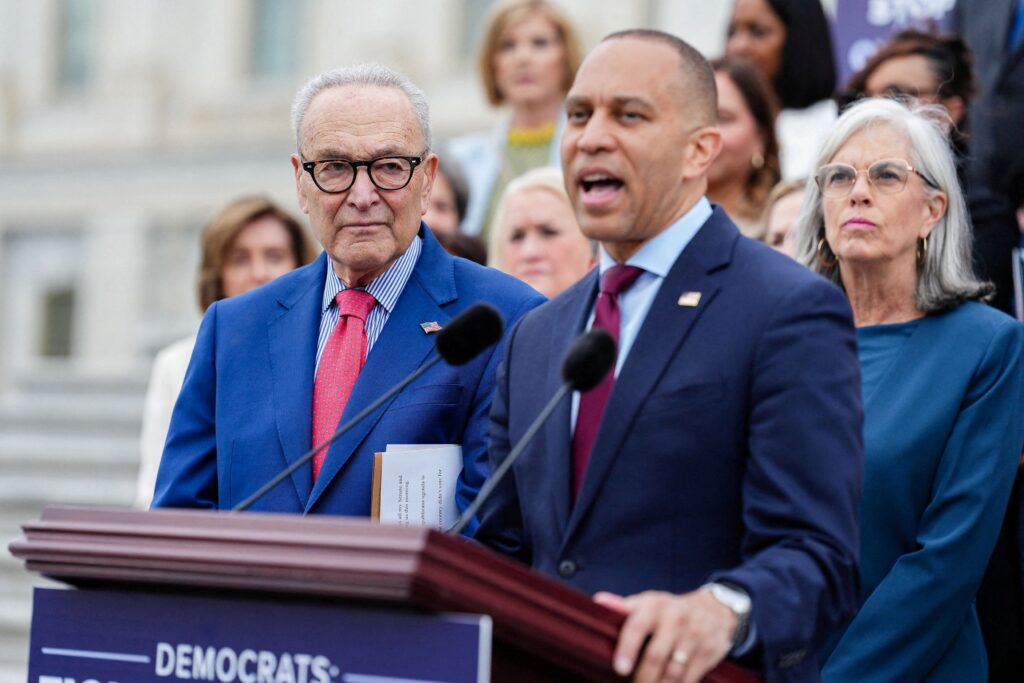
Americans voted overwhelmingly for Democratic candidates in the midterm elections. But American voters are not so hot about the Democratic leaders likely to be elevated as a result.
Two recent polls found Americans have net negative views of Rep. Hakeem Jeffries (D-New York), whom House Democrats nominated to be the next House speaker on Wednesday, and Sen. Chuck Schumer (D-New York), the top candidate to lead the Democrats in their new Senate majority.
Forty-one percent of U.S. citizens have negative views of Jeffries and 50 percent have negative views of Schumer, according to a YouGov/Economist poll fielded Nov. 13-16.
Meanwhile, a Reuters/Ipsos poll conducted during the same time frame found similar results, with 40 percent of Americans saying they view Jeffries unfavorably, and 21 percent saying they view him favorably. Schumer was found to be viewed unfavorably by 51 percent of Americans, and favorably by 19 percent.
“Many of the folks who voted for us yesterday, of course, are still skeptical,” Schumer acknowledged at a news conference the day after the election. “That’s okay. These voters did not give us the majority so we can do whatever we want.”
Schumer and Jeffries’s unpopularity isn’t unique to them.
“Both parties have been unpopular for most of the last decade and Congress is exceptionally unpopular, with a 14 percent approval rating last month and generally standing in the teens and 20s since Obama’s first term,” Scott Clement, polling director for The Washington Post, told me.
When YouGov and the Economist polled registered voters for their thoughts on House Speaker Mike Johnson (R-Louisiana) and Senate Majority Leader John Thune (R-South Dakota) at the end of October, they found comparable numbers: 45 percent disapproved of Johnson and 46 disapproved of Thune.
The good news for the incoming congressional leaders is that lots of Americans are still undecided about them, suggesting they may have a chance to improve their images. YouGov and the Economist’s most recent poll found 35 percent of registered voters don’t have an opinion of Jeffries and 28 percent don’t have an opinion on Schumer.
But some Democrats worry the leaders’ unpopularity represents deeper issues with their leadership styles.
Jeffries has taken flak of late, particularly from the left, with critics accusing him of being too pro-Israel, too close to big business, and too soft in his support for healthcare reform. He also faces questions about whether his style, which favors delegation and building consensus, is the right fit for an ambitious, now-sprawling caucus.
Despite those concerns, Jeffries escaped Wednesday’s nomination vote without difficulty, winning all but 11 members of his caucus.
Schumer has also faced some questions over his leadership. Though he’s won praise for Democrats’ surprisingly strong showing in tough Senate races this year, he too has faced criticism from the left over his position on Israel, and was roundly critiqued for his strategy around a contentious shutdown battle last year.
Now, he has some competition in the Dec. 1 secret ballot vote to decide who will be the next Senate majority leader, with Sen. Chris Van Hollen (D-Maryland) running against Schumer from the left.
Van Hollen had a slight net positive approval rating of 2 percentage points in the YouGov/Economist poll, but that’s largely due to his lower public profile compared with someone like Schumer, who has been in the news as the Democrats’ leader in the upper chamber for about a decade now. Sixty-four percent of respondents told YouGov and the Economist that they have no opinion about Van Hollen.
“That means he has more space to define himself,” said Leah Greenberg, founder of the progressive nonprofit Indivisible, which endorsed Van Hollen to be Senate majority leader.
Of course, how trusted a candidate is among the 56 Democratic senators is more important for the Dec. 1 vote than how well known they are among the general public. But Van Hollen’s numbers suggest he may be able to build support for his candidacy among the base.
Still, Schumer has said that he is confident he’ll win the election, with more than a dozen current and newly elected Democratic senators already saying they’ll back him. Four Democrats have expressed support for Van Hollen, who says more than a dozen others have privately signaled their support for him. Four Democrats have said publicly that they are opposed to Schumer but have not endorsed Van Hollen.
Most Democratic senators have not publicly weighed in, and the secret ballot votes can always differ from public remarks.
Recognizing how much the midterms were a rejection of President Donald Trump, Democrats are entering 2027 with an eye toward proving themselves to the American public. The leaders’ approval ratings at the start may not be good, but they haven’t wielded power in some time — or in Jeffries’s case, at all. And that means there’s plenty of room for their approval ratings to shift, in both directions, once the majority is actually in place.
Want this in your inbox?
Start your day with The Washington Post’s flagship political newsletter. Sign up here.
From across the newsroom
- Senate rejects resolution to block Trump from striking Iran, from Theodoric Meyer and Noah Robertson.
- Bigfoot believers get a boost from an unlikely ally: the U.S. Forest Service, from Annie Gowen.
- Iowans say that warning Army is going to blow up degraded lead came too late, from Sarah Kaplan.
- 10 years on, Britain reopens the Brexit fight — this time embracing the E.U., from Steve Hendrix.
- Arts panel asks Trump administration to rethink East Potomac golf course’s scope, from Rick Maese.
- U.S. sells first-ever leases to mine the deep sea, from Jake Spring.
What I’m watching
A few months ago, the popular thinking was that the 2026 midterms would happen and the 2028 presidential primary would start almost immediately.
That hasn’t really happened — and the reason is the size of the Democratic wins in Congress.
This is the basis of a new piece I published this morning with Praveena Somasundaram and Liz Goodwin about how the big Democratic wins in Congress have temporarily eclipsed the party’s forthcoming presidential fight and, according to multiple Democratic operatives, delayed planned announcements from prospective candidates who understand the party’s political story right now is in Congress.
This was captured by California Gov. Gavin Newsom’s visit to Washington, D.C., this week, a trip overshadowed by Democrats’ unexpectedly large incoming crop of congressional leaders.
“The class of 2026 is the most exciting group of Democrats we’ve seen in a generation,” said Rebecca Katz, a Democratic operative. “They deserve the spotlight and may take it up for a lot longer than some of the 2028 candidates have planned.”
The 2028 race will eventually start. Newsom, should he run, will be a top candidate and has proven he can get attention. But an interesting dynamic is playing out in Democratic politics right now: Some figures seen as prominent 2028 candidates have lost a little of their sheen now that the party is back in control of Congress.
Some Democrats argue Newsom is one such figure, even though he played a central role in the midterms with his successful gerrymandering of California in response to Texas’s partisan gerrymandering in 2025.
The move netted Democrats a handful of seats, helping the party reach a sizable majority in the House and making Newsom the Democrat credited with helping the party bounce back after Trump’s win in 2024.
“Gavin gets a lot of credit for taking the big swing in 2025 when Democrats were on their back heels,” said Jesse Lehrich, a Democratic operative who is tracking the 2028 primary. “It was a big swing.”
But Lehrich said Newsom has since “faded,” with voters’ attention turning to candidates who were on the ballot in 2026.
“He won the 2025 season of the 2028 primary,” Lehrich said. “But that is not the season you want to win.”
You can read more about this here.
In your local paper
Michigan Advance: A Michigan Court of Appeals ruled this week that “limitations on abortion procedures within Michigan’s public health code are unconstitutional,” a win for reproductive rights activists.
Virginia Mercury: Democrats plan to prioritize screen time limits in school during their 2027 legislative session.
Nevada Current: Should real estate agents be allowed to keep certain listings private and only offer them to certain buyers? Critics argue the practice hurts affordability and could allow agents to racially discriminate.
From you
We asked what Trump should, and will, do in the second half of his term, and we got a range of thoughts.
“As indicated by the midterm elections, Americans want Trump to focus on inflation, corruption, and the economy, not to carve out ways to make more money through underhanded deals with other shady leaders,” wrote Jackie Floyd. “He shouldn’t be allowed to work on any other foreign policy until he has ended the war with Iran.”
“As long as [Stephen] Miller is in charge and in the news, I will never believe anything they say or do,” wrote Karen Norval, advocating for Trump firing his new chief of staff. “Make peace and not with dictators, but real people struggling and in the midst of war.”
“My best guess is that President Trump will spend the next two years on vanity projects. The war in Ukraine and the war with Iran don’t interest him. Unless he can monetize a peace deal somehow. I wish it weren’t true, but we are dealing with Donald Trump here,” added John Troberg.
And Mary Reynolds offered this: “At least he’s dialed down notions of breaking the Constitution and trying for a third term… so far.”
Send a reply
Do you like the ways sports are synonymous with our major holidays?
It’s something we have thought about — the NFL already dominates Thanksgiving, and my colleague Will Leitch writes that they are coming for Christmas and New Year’s Eve, too. Add the NBA’s presence on Christmas and college football around the New Year, and sports truly dominate our major holidays.
Is that a good thing? Do you like watching sports on these holidays? What are the downsides? Let us and your fellow Early Brief readers know at [email protected].
Thanks for reading. You can follow me on X at @merica.
The post Americans voted for Democratic leaders — that doesn’t mean they like them appeared first on Washington Post.