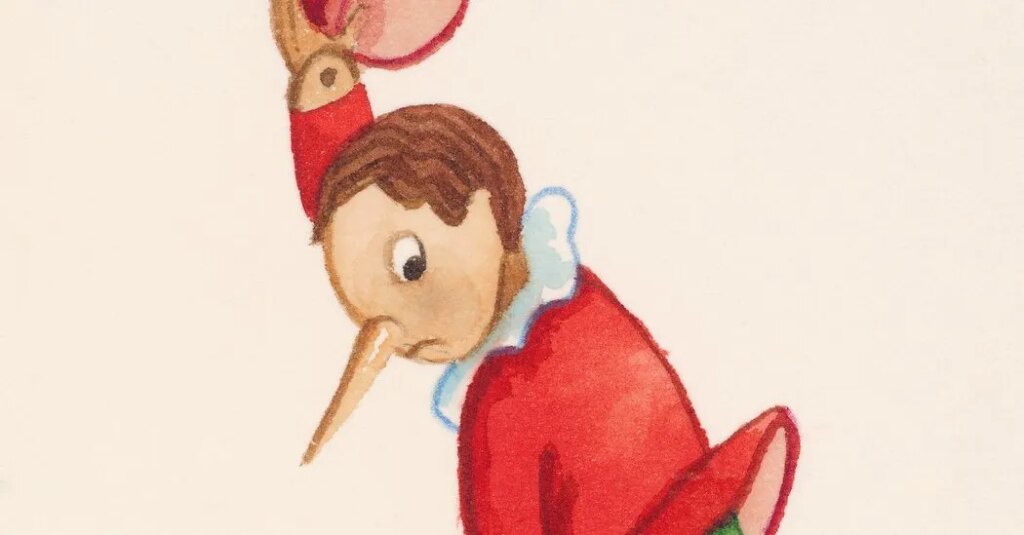
When my mother first read “Pinocchio” aloud to me, I was far too young, and it horrified me. While written for children, “The Story of a Puppet” is a 19th-century morality tale, and a particularly distressing one, that leaves the reader — of any age — more exhausted into submission than inspired. Even in its relatively sanitized form (the original serial, in a children’s newspaper, saw Pinocchio killed), the litany of Pinocchio’s calumnies felt Job-like, cruel and — particularly salient to the modern child-mind — unfair. I cried and cried. Then, according to my mother, I demanded, “Read it again.”
Carlo Collodi (real name, Carlo Lorenzini) was a satirist and a committed Italian nationalist, and “Pinocchio” is a Swiftian work that takes unsparing aim at the nation’s inequalities, and ultimately does not endorse anything but the value of school and acquired learning. (A foundation in Collodi’s name exists to promote state education.)
“Pinocchio” is, explicitly, not a Christian parable: Collodi was heavily involved with the anticlerical Risorgimento movement, and the puppet’s tribulations are gratified not by eternal life but by the dubious rewards of mortality. Yet it is still very much a book of its time, and uses the picaresque of suffering to make its ultimate point.
When I first heard the story, I knew nothing of Italian Unification — I hardly knew from nursery school — but, presumably as intended, the book’s terrifying nihilism worked on me without subtext. The beautiful 1940 Disney animation has been called saccharine by students of the original, but (truthfully) even the cartoon is an ordeal: After the humiliation of the stool-pigeon nose, we are greeted with Pinocchio’s imprisonment; his forced dancing; his stint on the dissipated Pleasure Island, where bad boys turn into donkeys; a terrifying storm; a Jonah-esque turn inside Monstro; and a near-death experience. There is little relief for the anxious child mind. Jiminy Cricket is hardly a palliative, and it is disorienting to lose our familiar protagonist in the last moments to his unfamiliar new form (an experience also true of “The Land of Oz” and “Beauty and the Beast”).
In the book, wishing is no substitute for education and hard work, the only defenses against a harshly arbitrary world racked with poverty, starvation and animal cruelty. In Chapter 23 of the first English edition, translated by Mary Alice Murray (which begins, “As soon as Pinocchio was released from the heavy and humiliating weight of the dog-collar …”), we find this heartbreaking scene, in which the puppet stumbles upon a tombstone: “Here lies the child with the blue hair who died from sorrow because she was abandoned by her little brother Pinocchio.” And “in his despair,” we learn, “he tried to tear his hair; but his hair being made of wood, he could not even have the satisfaction of sticking his fingers into it.”
I doubt many children read the book today; I had not reread it since childhood and it may have been on the “Bambi” list even then. If anything, it has gone the way of the mime, the clown, the doll — more a vestigial cultural shorthand than an active source of fear, probably as readily associated with The Washington Post’s whopper-detector as any feat of Garibaldi’s.
In 2019, John Hooper and Anna Kraczyna wrote in these pages that the puppet “would seem a ready-made icon for an age of fake news and bots, of alternative facts and internet trolls, of doubts about the reliability of conventional media.” At the time, we were entering into what has been termed the post-truth era.
I write this today, on the occasion of the 200th anniversary of Collodi’s birth, in the post-real-boy era, when arguably the source text has moved still farther into the rearview. (Other anachronisms include wooden toys, live theater, a healthy whale population, amusement parks, cigars and visible stars.)
And yet the text — the actual text — is eternal. Not because puppet noses might happen to be memes but because the epic ordeal is our most effective form of storytelling. It allows us one of the few reliable pleasures in life: relief, however short-lived, and the luxury of perspective — of despising a younger version of yourself, even if that version is only five minutes younger.
Consider the novel’s ending: Pinocchio, having been beaten, robbed, exploited, abused and nearly killed, wakes up “a bright, intelligent boy with chestnut hair” and blue eyes, and sees his old wooden body, inanimate, leaning against a chair.
“Pinocchio turned and looked at it; and after he had looked at it for a short time, he said to himself with great complacency: ‘How ridiculous I was when I was a puppet! And how glad I am that I have become a well-behaved little boy.’”
Read it again.
The post Reading ‘Pinocchio’ in the Post-Real-Boy Era appeared first on New York Times.