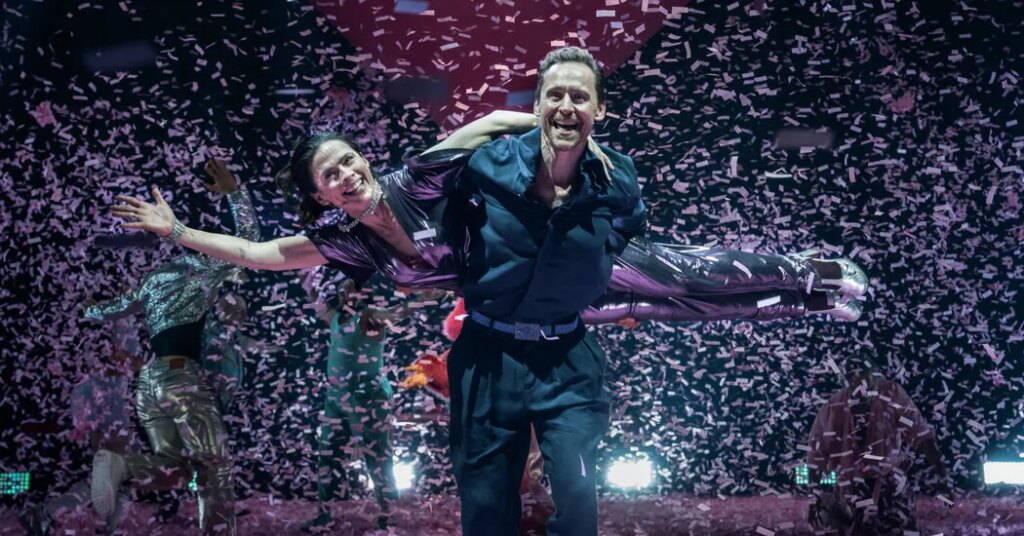
Love makes fools of us all. It embarrasses us. It exposes us. Sometimes it makes us jump up and down in the aisles of the Winter Garden Theater, yelling at a crowd to get excited.
Or perhaps that’s just the ushers at “Much Ado About Nothing,” the director Jamie Lloyd’s rave-lite version of Shakespeare’s most buoyantly romantic comedy. Even before the curtain rises on this Broadway production, which opened on Thursday, the show deploys a hype team into the audience — young, mostly female cheerleaders who rally us to go whoo! or do the wave. Music pulses oontz oontz oontz; pink lights throb. The actor Mason Alexander Park whips out a bedazzled microphone and sings a gorgeous, throaty cover of Taylor Dayne’s “Tell It to My Heart.”
The hyping, in this case, does not seem strictly necessary. News of the show’s transfer from London’s West End already ratcheted expectations to a high degree, and anyone walking through the theater district has been reminded of the real source of our anticipation — the actors Tom Hiddleston and Hayley Atwell. For months, their faces have stared yearningly across Broadway from a huge billboard over the Winter Garden marquee.
By the time these stars come boogying downstage, emerging through smoke like quarterbacks running out of a players’ tunnel, each sly wink or hip bump sends the crowd into raptures. The comedy itself then sails along on the momentum, gliding easily from one height to the next.
The euphoria might come as a surprise to those who know Lloyd as a lord of theatrical darkness. He and Soutra Gilmour, the Jamie Lloyd Company’s set and costume designer, tend to place shows in terrifying voids. At the end of their stripped-down “Sunset Blvd.” in 2024, they drenched Nicole Scherzinger in blood; in 2023, they put Jessica Chastain in a sad chair on a turntable for “A Doll’s House” and sent her orbiting in lonely circles through space.
Here, again, the vast maw of the theater — one of the widest on Broadway — contains only a few items to break up its shadowy volume: some chairs; a huge, inflated red heart that presides like a giant emoji-god; and a storm of fluttering pink confetti. This falls for hours as a constant, soft, battering hail, making the air twinkle pink in Jon Clark’s supersaturated lighting design. Perhaps the confetti is a nod to the foam at a warehouse party? In the show’s primary bravura scene, Hiddleston tries to hide inside its accumulated drifts, diving into the piles again and again, like a golden retriever leaping into autumn leaves.
This time Lloyd’s empty space is a playground. And once the kids are at recess, they seem reluctant to leave. Hiddleston, in a navy shirt as blue as the night sky over Ibiza, and Atwell, gleaming in magenta lamé, often appear in the background of other people’s scenes. They’ll just be there, dancing — Atwell’s go-to move is the twerk; Hiddleston enjoys a shimmy with the caboose out — or they’re laughing in delight. The propulsive music provided by sound designers Ben and Max Ringham never seems to stop. Giddiness is a difficult mood to maintain, but Lloyd’s production manages to keep itself aloft for ages.
We’re at a club, but we’re also, somehow, in Shakespeare’s Messina, where a group of merry aristocrats, led by Don Pedro (the hilariously louche Gerald Kyd), spends an eventful holiday with the wealthy lord Leonato (Forbes Masson). Don Pedro has the slicked-back gray hair and silky blouse of a man without cares, so there’s nothing for the bros to do but drink and party — and use their leisure time to pay court to various ladies. The ringleaders of each social circle have sworn off love, though: The mocking Benedick (Hiddleston) sneers at the emotion entirely, and his witty, bitter ex, Beatrice (Atwell), returns the favor.
The youngest and callowest of the men, Claudio (James Phoon), falls hard for Leonato’s daughter, Hero (Mara Huf), who falls right back. To kill the brief time between the young couple’s engagement and their marriage, the friends decide to trick Benedick and Beatrice into a relationship. This turns out to be about as difficult as tricking water into flowing downhill. Both are eager, primed, ready and willing.
Hiddleston’s Benedick, in particular, has been flirting with anyone and everything from the start of the show, including audience members in the front row and someone he points at in the balcony. He’s a megaton charisma bomb, and he radiates romance. “Love me? It must be requited!” he shouts, the instant he overhears Beatrice’s friends say she likes him. He is so thrilled, he sort of levitates up into love. Atwell’s Beatrice, on the other hand, seems exhausted by her own beautifully perfect posture, so her love is a relaxation, a tumbling at last into her old foe’s arms.
Every enemies-to-lovers romantic comedy seems to take its inspiration from “Much Ado”; it gave us the conniving friends, the hint of an affair gone wrong in the past, the overheard insult at a party. Beatrice and Benedick set the pattern for a thousand stories after them, and here, with such a magnetic pair in the roles, they make us swoon for the cliché all over again.
Not every moment can be so gorgeous. Lloyd’s tendency to place microphones very close to his actors’ mouths means that those who shriek (Hero in particular) become difficult to hear. And the club kids turn out to be kind of shallow and mean to one another. Phoon must sustain the plot’s cruelest turn — his Claudio gets conned by the wicked Don John (Tim Steed) into rejecting Hero at the altar — but the actor plays his hand cleverly by playing Claudio as a dolt. His himbo barely has the sense to push his hair out of his eyes, much less interrogate his sources. (Steed, making his character a perfect comic miniature, gives a faint and adorable “mwa ha ha” when he decides, self-affirmingly, that Don John shall be the villain.)
Lloyd’s overamplified interventions can grow a little confusing. He nods to his stars’ Hollywood roles in Marvel movies by sending out cardboard standees of their characters as sight gags, but we don’t need to look at Hiddleston’s Loki to laugh — Cupid is the relevant god of mischief here. And the liquid, down-and-dirty, anything-goes sexuality of the choreography by Fabian Aloise contrasts strangely with the prudish morality of parts of Shakespeare’s plot; certain resolutions are conveniently lost inside a crescendoing dance-floor beat.
Lloyd has removed a few secondary comic characters — the “no cops in the club” rule apparently extends to Shakespeare’s silly beadle, Dogberry — but he has kept in a long rant by the increasingly nasty Leonato, which does turn the vibe rather harsh. When the hyping returns during the show’s intermission, it begins to take on the desperate mania of a D.J. at a middle school dance, where everyone’s slightly the wrong age to get the party started. Whoo! the cheerleaders scream. Whoo, I thought.
But as another play once noted in its title, all’s well that ends well. And Lloyd and his company end in communal, rambunctious dancing. The mood in the room becomes almost too ecstatic to bear.
Over the course of the show, we have come to understand that the confetti is — metaphorically — love. It has been showering quietly down like grace, alighting on the heads and shoulders of people who scarcely register it. The paper rain does stop once, in the show’s ugliest moment of hateful rejection, but it soon starts falling again. At the Winter Garden, love is literally in the air. When you get home afterward, you’ll pluck a piece of it out of your collar.
Much Ado About Nothing Through Jan. 10 at the Winter Garden Theater, Manhattan; muchadobroadway.com. Running time: 2 hours 30 minutes.
The post In ‘Much Ado,’ Tom Hiddleston and Hayley Atwell Will Make You Swoon appeared first on New York Times.