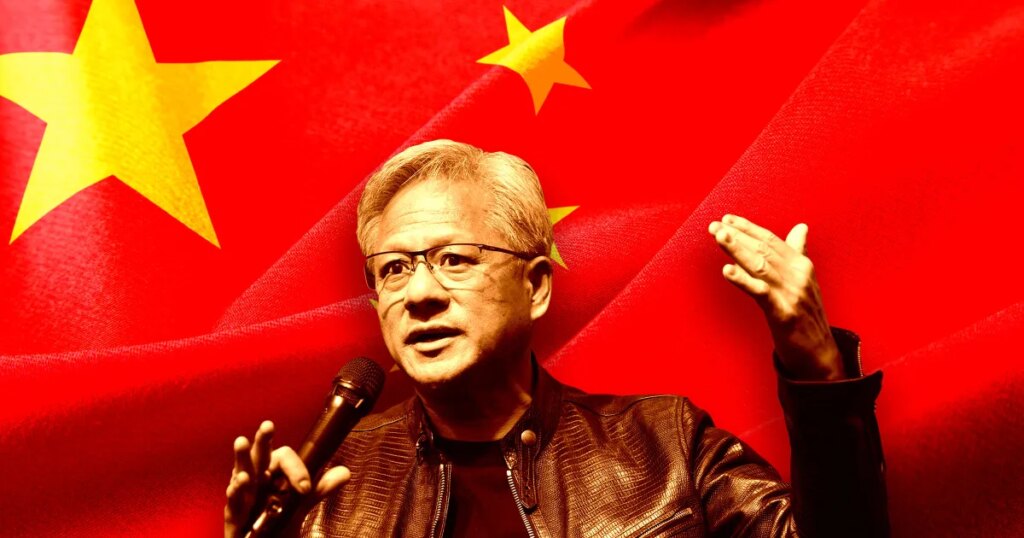
From the most conservative China hawks like Brett Guthrie to progressive stalwarts like Ro Khanna, pretty much every US lawmaker agrees: it’s bad to sell AI chips to Chinese companies.
This posture, often treated like a foregone conclusion, is arguably one of the very few positions currently uniting Democrats and Republicans. But why, if an American company is willing to sell chips to a Chinese one, would it actually be bad to do so?
The typical answer, dating back to the first advanced chip restrictions levied by the Biden administration in 2022, cites the federal government’s “ongoing efforts to protect US national security and foreign policy interests.”
That fuzzy logic continues four years on, with lawmakers like left-leaning Massachusetts senator Elizabeth Warren fretting that “it’s clear the American people can’t rely on Big Tech billionaire CEOs to put our national security above their bottom line.”
“Congress needs to pass legislation now to keep advanced AI technology out of China’s hands,” Warren continued, alluding to the sensational scandal surrounding former Nvidia CEO Jensen Huang’s relationship with an alleged Chinese spy. What she doesn’t address is why the US government feels the burning need to interfere with private enterprise. What does global market competition have to do with national security?
The most direct explanation — and the one lawmakers obscure behind vague terms like “national security” — is that the US government needs to intervene to protect its own economic world order from competition by one led by China and other rising players in the global south. At first glance, this might seem like a geopolitical issue that has little to do with AI. But as US leaders see it, AI models and the hardware undergirding them have become a linchpin in the global struggle over economic sovereignty.
Since the collapse of the Soviet Union in 1991, the United States has stood as the lone world superpower, able to impose its economic will across the globe with little resistance from rival countries. We see this in how the US dollar has become the world’s primary reserve and trade currency, and the way financial institutions like the International Monetary Fund impose austerity measures on countries that don’t subscribe to Washington’s preferred economic model.
Rising competition from China — exemplified by cutting-edge technology like AI — threatens to dethrone the US from this cozy perch atop the world stage, which is why Washington and its think tanks have increasingly framed market moves like AI chip sales as national security threats.
One 2025 congressional report on semiconductor export controls didn’t mince words. “Since 2018,” the report’s summary argues, the US government has “sought to sustain US leadership in advanced chips, related parts of the semiconductor supply chain, and computing and AI applications, while slowing China’s development of competitive capabilities.”
“US actions,” it continues, “have been grounded in concerns about [China’s] efforts to build an indigenous, self-sufficient, and secure and controllable semiconductor ecosystem.”
And as incoming Democratic senate-majority leader Chuck Schumer remarked on the legislative floor in September, the “best tool we have to outcompete China and curb the CPC’s AI ambitions is by prohibiting their access to the most advanced AI chips and manufacturing equipment.”
Schumer continues, saying that we “have to make sure China doesn’t get ahead of us and beat us in this competition over what to do with AI.”
That final phrase is instructive. China’s approach to AI, like most of its industries, is to create “shared prosperity,” namely by making cheap AI models widely available, with a heavy emphasis on developing practical infrastructure.
Schumer’s vision — typical in the American AI industry, at least as of now — is of AI developed for the benefit of a few powerful tech corporations chasing short-term financial gain. Though this approach is causing immeasurable harm to people across the world, AI has nonetheless become the key engine pushing the US economy forward. Any upset of this new status quo will slow economic growth to a crawl, which is bad news for a country which maintains the profit motive as its north star, and which attempts to impose that same condition on the rest of the world.
As China’s deputy foreign minister Ma Zhaoxu remarked in 2025, “AI is a common asset of mankind, not a game reserved for the wealthy nations or the rich people.”
Put together, the global chip struggle exposes the shared fears of every US lawmaker: a rising country which threatens to break the American vice grip on a key piece of technology, and in doing so, challenges US economic hegemony around the world.
More on China: Chinese Government Dismisses Tech Billionaire Calls for an AI Slowdown as “Fear-Mongering”
The post Wait, Why Exactly Is It So Bad to Sell AI Chips to China? appeared first on Futurism.