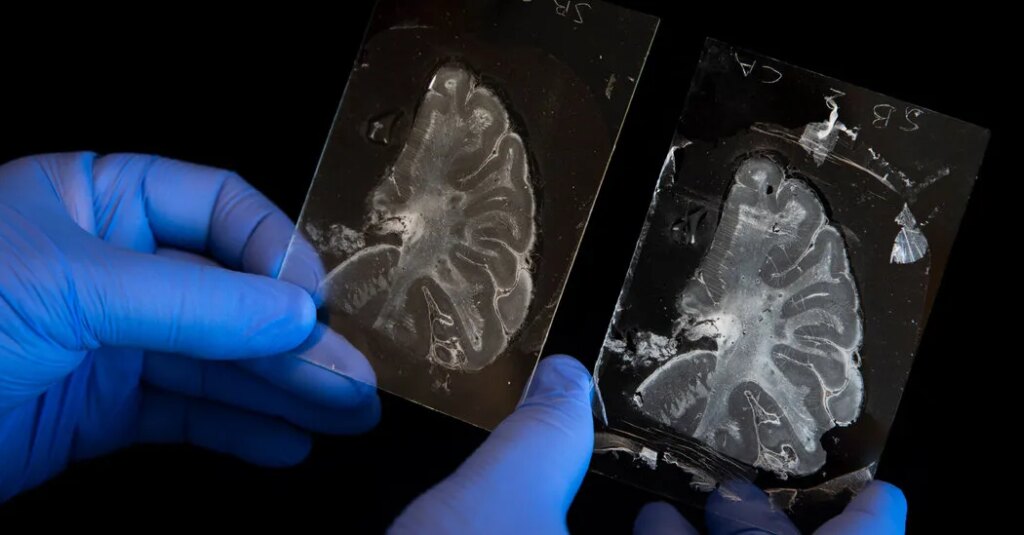
In the century since a devastating neurodegenerative brain disease was first identified in aging boxers, doctors have struggled to understand what has come to be known as C.T.E., or chronic traumatic encephalopathy, a progressive and incurable illness that causes memory loss, dementia and troubling changes in behavior.
The disease, associated with repeated blows to the head, stalks athletes who played football, rugby and other contact sports, as well as military personnel and victims of domestic violence.
Medical experts have long been stymied by an inability to diagnose the condition in living patients. For now, only a brain autopsy at death can confirm whether a patient had C.T.E.
But a pair of recent studies that identified a possible blood-based biomarker for the disease have created a stir among researchers, doctors and patients, raising hopes that a simple blood test could one day help diagnose C.T.E. in the living and pave the way for potential treatments.
The studies, published in the medical journal JAMA over the past week, describe two related markers that are associated with abnormal collections of tau, the protein that helps keep nerve cells functioning properly. In patients with C.T.E., those proteins form brown clumps deep within the folds of the brain, leading to neuron death and brain atrophy.
The first study, published last Friday, identified a protein associated with C.T.E. that is also found in patients with Alzheimer’s disease.
The second study, released on Thursday, found elevated levels of a related protein in samples from nearly two dozen former football players who had donated blood before their death. Patients with more advanced C.T.E., the study found, had higher levels of the protein.
Both studies were based on a small number of patients, and researchers said the results would need to be verified in larger samples. But the authors described the results as significant and said they were likely to withstand further scrutiny.
The study authors hope that their findings will lead to a commercially available blood test within the next five years. The optimism, they said, was informed by successful development of a blood test for Alzheimer’s, which the Food and Drug Administration approved last year.
“The studies have significant limitations, and there are still questions that need to be answered, including how to distinguish C.T.E. from those who also might have Alzheimer’s, but I applaud the researchers for their work,” said Dr. Julian Bailes, a brain injury specialist who was not involved in either study. “The blood biomarker they implemented could become important for identifying those with high-stage C.T.E.”
Marc Weisskopf, director of epidemiological studies at the Football Players Health Study at Harvard, also commended the study but cautioned against excessive optimism.
“It’s very important that people who think they might be at risk of C.T.E. understand that these are still early days, and this is still currently at best a research tool — albeit one that could hopefully help us better understand, in future work, C.T.E. and its effects on the brain and any resulting symptoms,” he said in an email.
Once an obscure and mysterious disease, C.T.E. has drawn outsize attention in recent months, much of it driven by new research suggesting that the disorder is far more prevalent among football players than previously thought.
A study published last month estimated that three of four former N.F.L. players who died between 2008 and 2023 most likely had C.T.E. at the time of their death.
Those findings expanded on a groundbreaking study, published last summer, that suggested at least one in four N.F.L. players who died between 2016 and 2021 had C.T.E.
The studies have fueled growing unease among professional players, retirees and the parents of budding middle school athletes. Others who are at risk for C.T.E. include members of the Navy’s elite speedboat crews whose brains are jostled by repeated wave-slamming while at sea.
In the general population, the disease is almost nonexistent.
The first study, led by a team of researchers at Washington University School of Medicine, found that fragments of an abnormal tau protein associated with Alzheimer’s and other forms of dementia were also present in patients with C.T.E. who had donated plasma or spinal fluid to research centers in the United States and Britain.
Discovery of that protein fragment, given the unwieldy name eMTBR-tau243, led to the creation of the test currently used to identify tau tangles in those living with Alzheimer’s.
Dr. Chihiro Sato, a lead author of the paper, said the team’s discovery had come about by chance, when researchers were testing more than 200 samples from a mix of healthy patients and those with a diagnosed brain disease. One of the samples stood out.
The patient, it turned out, did not have Alzheimer’s. But when they examined his autopsy records, researchers discovered he had developed advanced C.T.E.
The result prompted the researchers to widen their investigation. In a collaboration with the University of California, San Francisco, they tested blood samples from 11 other people whose C.T.E. had been confirmed after death. The findings showed that eMTBR-tau243 levels were higher among those whose disease was more advanced.
“It was just a matter of serendipity,” said Dr. Sato, an assistant professor of neurology who focuses on Alzheimer’s. More work needs to be done, but she said the discovery was nonetheless promising.
“This wouldn’t be a stand-alone biomarker,” she said, “but if someone has a history of repeated head injuries, tests negative for Alzheimer’s, and this biomarker comes up, it might be C.T.E.”
The second study, led by the CTE Research Center at Boston University and Banner Health, involved more than two dozen researchers around the country.
The team focused on 21 former football players who had donated their brains and blood samples to the CTE Research Center before their death. Of those, 18 had been diagnosed with C.T.E.
The larger group included 12 men who had played professionally, seven who had played at the college level and two who had played only in high school. The results: Those with the highest levels of the toxic tau in their blood plasma had more advanced C.T.E. upon death. The protein was absent or found at low levels among those with low-stage C.T.E.
Although the sample size was small, the effect was striking, said Dr. Michael Alosco, a senior author of the paper who is a co-director of the CTE Research Center. “When we looked at the data, we saw that there was a very clear separation with almost no overlap in the data points between those with high-stage C.T.E. and everyone else,” he said.
Even with new technology that can detect protein fragments less than a trillionth of a gram in concentration, identifying eMTBR-tau in the blood was exceptionally challenging, said Dr. Nicholas Ashton, senior director of the Fluid Biomarker Program at Banner Health and another author of the study.
“Imagine taking a sugar cube, breaking it into 200 pieces, throwing one of those pieces into an Olympic-sized swimming pool and then finding it in 15 minutes,” he said. “There are a lot of failures until you get one right.”
Dr. Gil Rabinovici, another study author who is a behavioral neurologist at U.C.S.F., said that developing a diagnostic test for C.T.E. was an essential first step for drawing the interest of drug developers.
A 20-year veteran of the quest to find diagnostics and treatments for Alzheimer’s, he pointed to the small but growing number of F.D.A.-approved drugs that can slow the progression of early-stage Alzheimer’s or help manage its symptoms.
“I have seen this cycle before with Alzheimer’s,” Dr. Rabinovici said.
Even if effective treatments for C.T.E. remain a distant promise, having a reliable test would make a world of difference to patients and their families, who often live with an agonizing uncertainty. It would also allow doctors to rule out C.T.E.
“The results are still preliminary,” he said, “but I couldn’t be more excited about doing the important work of further validating them and hopefully bring some hope to to people concerned about this devastating illness.”
The post Scientists Discover a Possible Marker in the Blood of C.T.E. Patients appeared first on New York Times.