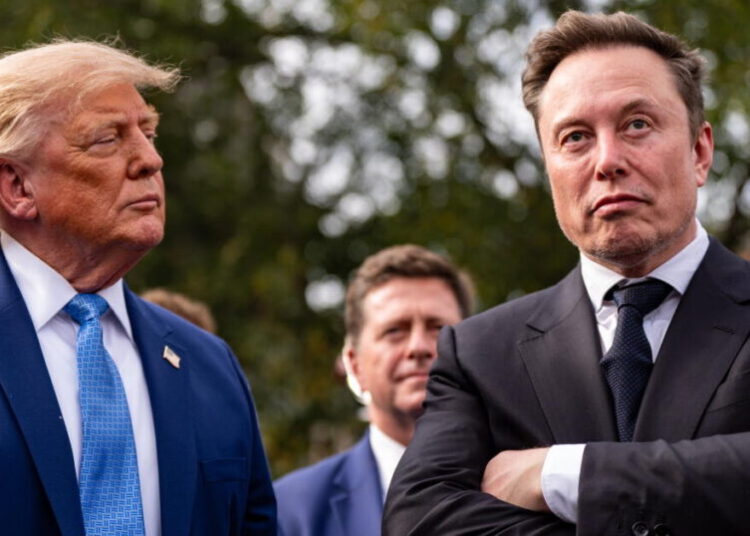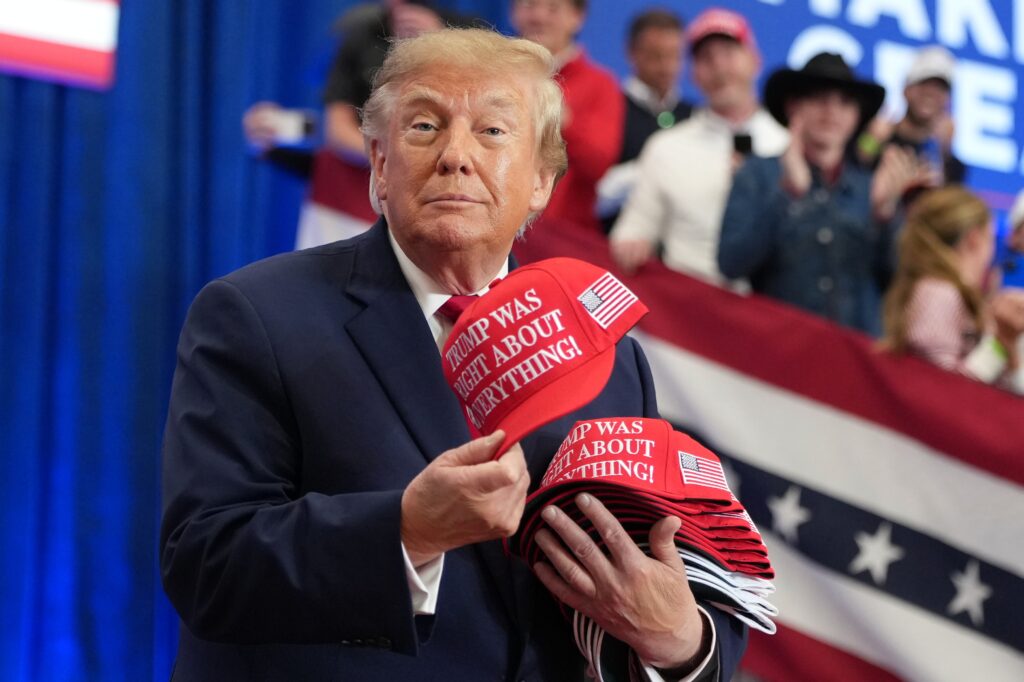
President Donald Trump’s strong support among Republican voters fueled his outsider presidential campaign in 2016, helped him avoid conviction after being impeached in 2021 and eased his comeback campaign in 2024. Before this year’s midterm elections, Trump was in a position to handpick the party’s 2028 presidential candidate.
Then came this month’s midterm elections, in which Trump faced the worst midterm approval ratings since Harry S. Truman and Republicans lost the popular vote for Congress by 14 percentage points, the biggest margin since 1976.
Could this shellacking shake Trump’s influence with Republican voters? The first polls suggest opinions are in flux after the midterms.
Want this in your inbox?
Sign up for The Pollwatcher newsletter here.
An Economist-YouGov poll this week finds about 8 in 10 Republican registered voters approve of Trump, but 40 percent “strongly approve,” down from 48 percent who said this one week before the election. (YouGov and the Economist published results among U.S. citizens but kindly shared a breakdown among registered voters with me.) Reuters-Ipsos polls showed a smaller drop-off, with 32 percent of Republicans strongly approving of Trump in two post-election polls, compared with the 34 to 39 percent range in the final month before Election Day.
Zooming out, Republicans have grown much less enthusiastic about Trump since he returned to the White House. In February 2025, 63 percent of Republicans strongly approved of Trump’s performance in a Washington Post-Ipsos poll, but that fell to 51 percent after his first 100 days, 48 percent in early 2026 and 39 percent last month.
Do Republicans really want to move away from Trump?
A Reuters-Ipsos poll highlighted in last week’s newsletter found the party was divided on this question, with 52 percent of Republicans and Republican-leaning independents wanting “a different approach to governing” than Trump, while 46 percent wanted “a similar approach.” Those results contrast with a Post-ABC-Ipsos poll before the election asking a similar question: 61 percent said Republican leaders should follow Trump’s leadership, while 37 percent said they should lead the party in a different direction.
The Reuters-Ipsos poll also revealed a schism between self-identified Republicans — 53 percent of whom want a Trump-like candidate — and independents who lean toward the Republican Party, 65 percent of whom want a different approach to governing. This pattern should be familiar to Pollwatcher readers, as we recently highlighted research finding that people who are dissatisfied with their party’s leaders are more likely to identify as independents.
Republicans say they are more interested in parting with Trump’s style than his policies. A large NORC poll fielded just before the election found almost half of Republican registered voters (47 percent) said they would like a president who “follows the policies of Trump, but not his style,” while only 11 percent wanted a Trump-style candidate who doesn’t follow Trump’s policies. Another 24 percent wanted a candidate with both Trump’s policies and style, while 17 percent wanted someone who differed from Trump on both counts.
But it’s also clear that many Republicans are dissatisfied with Trump’s handling of major issues, according to Reuters-Ipsos data. About half of Republicans disapprove of his handling of inflation and rising prices while roughly 3 in 10 disapprove of his handling of Iran, corruption and artificial intelligence. By contrast, fewer than 2 in 10 Republicans disapprove of Trump’s handling of immigration.
Trump’s influence on 2028 will also depend on how much Republican leaders and presidential candidates criticize him going forward or blame Trump for Republican losses in 2026. Vice President JD Vance’s post-election statement that “the reason we lost is the war” — without criticizing Trump for starting the war — showcased the indirect criticism of Trump that Republican candidates may embrace.
Reader questions!
Jeff asks: With many people no longer having landlines, and with the prevalence of caller ID, how is it that polling takes place?
Great question! You’re absolutely right about landlines: Only 20 percent of households are still reachable on a landline phone, according to the Centers for Disease Control, which has tracked phone access to help improve federal surveys. Response rates to all types of surveys have plummeted in recent decades.
As a result, polls have dramatically changed the way they reach people in the past two decades, as shown in the great Pew Research Center chart below. In the early 2000s, the vast majority of national polls relied on live phone interviews, but most now use online “panels” of survey takers recruited using various methods. For instance, the Reuters-Ipsos polls cited above were conducted using the KnowledgePanel, which invites randomly selected households by mail to take surveys online. YouGov surveys use opt-in online panels, which are recruited through online ads inviting people to take surveys for rewards.
Many state-level election polls (including The Post’s) still use live phone calls, primarily to cellphones, as that remains one of the most effective ways to conduct surveys using official registered voter lists. Many polls use multiple contact methods to reach a more representative sample, such as a recent Washington Post-Schar School poll of Arab Americans that combined a probability-based online panel, postcards, emails, text messages and live phone calls.
Worth your attention
How AI is changing day-to-day work — About 1 in 3 workers now say they use artificial intelligence at least a few times a week, but how is it changing what they spend time on? A Gallup poll of more than 21,000 U.S. workers found 52 percent of frequent AI users said they spend less time searching for information, 47 percent spend less time writing and drafting and 38 percent spend less time analyzing data. But perhaps surprisingly, 29 percent say AI has led them to spend less time doing “creative or idea-generation work,” while 58 percent say their creative time hasn’t changed and 13 percent say it has increased.
Likely voter models moved polls the wrong way — G. Elliott Morris at the Strength in Numbers newsletter took a deeper look at why polls underestimated Democrats in the midterm elections. He highlights that polls’ “registered voter” results were more accurate than “likely voter” results late in the cycle, suggesting that polls got the right mix of voters but misidentified which ones would vote. Indicators of past turnout seemed to hold pollsters back, while voters’ self-reported certainty to vote proved more reliable.
What do you want to know?
Send your questions, comments and ideas to [email protected].
The post Are Republican voters still loyal to Trump? What new polls say. appeared first on Washington Post.