For Jolene Gosha, the sudden reappearance of a 71-year-old solo trekker weeks after he was feared killed in the catastrophic flood this summer on the Nepal-China border brought hope, dread — and resolve.
The waters unleashed by the collapse of a Himalayan glacier on Aug. 26 swept away thousands of people in Nepal and China. The bodies of more than 1,500 have been recovered. At least 5,600 remain missing.
Gosha’s friend Venus Patel is one of them. Like many who were caught in the floods, Patel, a 45-year-old software engineer from Ohio, had traveled to Nepal to make a spiritual pilgrimage to Mount Kailash in Chinese-occupied Tibet. He has not been heard from since.
The solo trekker, a Malaysian man, was higher in the Himalayas when the catastrophe stuck. On descending, authorities say, he found shelter with local villagers.
With communications systems down and roads washed away, it took the man 37 days to make it to Kathmandu, the Nepali capital, some 40 miles away. By then, authorities were winding down search-and-rescue operations.
Among those still looking for loved ones, Gosha said, the man’s unexpected survival “sparked a lot of conversations. What if there’s a possibility that our people may have run for shelter as well?”
That’s when she made her decision. They would hire their own team to search.
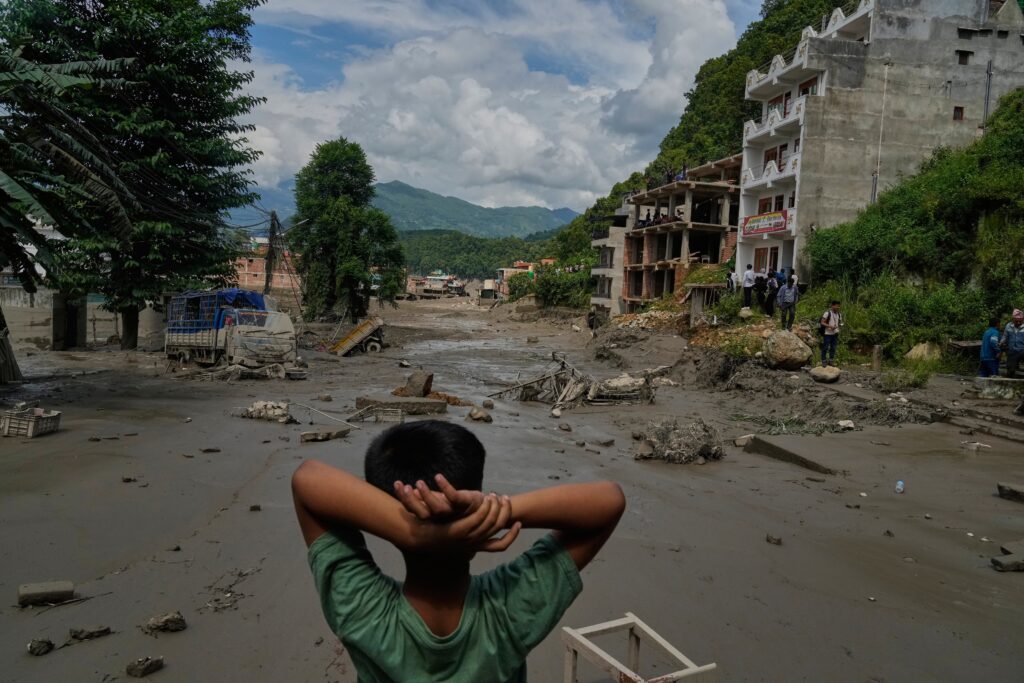
It’s been nearly three months since a glacier cleaved off a Himalayan peak and crashed into a valley below, triggering devastating flash floods. Survivors have described a 300-foot wall of water raging through the Trishuli River Valley at 110 mph. For more than 60 miles, it destroyed nearly everything in its path — more than 100 bridges, thousands of buildings, at least a dozen hydroelectric dams — leaving a mudscape of debris.
So powerful was the deluge that it carried some bodies more than 200 miles into India.
The missing include at least 70 Americans, according to the State Department. Many had traveled to the region with private tour operators for the grueling pilgrimage to Mount Kailash, a peak sacred to Hindus, Buddhists and Jains.
With the official search now over, some friends and relatives of the thousands still missing are continuing to look for their loved ones.
In the days after the disaster, details of the official response were agonizingly scant. Patel’s family resolved to send a representative to Nepal. Jay Kamdar, his closest friend, booked a one-way ticket from Cincinnati to Kathmandu, in part to spare Patel’s elderly parents from traveling.
“I couldn’t sit around, do nothing,” Kamdar said. “We were ready to hire choppers; we were ready to hire private rescue teams.”
When he landed, the flooded area was still inaccessible and at high risk of more inundation. So he stayed in Kathmandu to scour hospitals, post missing-person fliers and plead with any official he could reach: Which areas had been searched and how? Could the United States send in special teams? Had they used drones to scan forested areas?
After five days, Kamdar returned to the United States, somewhat deflated but hopeful that clarity would come soon. More than two months later, Patel is still missing, and almost all the family’s questions remain unanswered.
The State Department says it has provided consular assistance to families of the missing. Washington has sent nearly $4 million in emergency aid to Nepal and plans to give an additional $31 million for rebuilding and recovery. FBI forensics specialists have worked with Nepali police to help identify victims.
“The Trump Administration has no higher priority than the safety and security of Americans,” a department spokesperson said in a statement. “The Department has coordinated with the governments of Nepal and China on search and rescue efforts and liaised with the family members of missing Americans.”
Many families have expressed frustration that the U.S. government did not do more to search for their loved ones or recover their remains.
On the morning of Aug. 26, Anil Goel, a 67-year-old recent retiree from Centreville, Virginia, sent his family a picture of his tour group at an immigration processing facility on the Nepal side of the border. It was the last his family heard from him.
On learning of the flood, his son urged U.S. law enforcement officials to file emergency disclosure requests with tech companies. They could, he hoped, locate his father’s phone. He was told that they did not have jurisdiction.
“We had to play out all the series of events in our own minds and come to our own conclusion that his chances of survival were very slim,” Anurag Goel said.
The family celebrated Anil Goel’s life last month. His son says he has accepted that they might never have evidence of his death.
“It’s been such a big unknown as to whether there’s any hope to recover remains from that site,” Anurag Goel said. “Personally, I am at peace knowing my father is embodied in that land in a region of the world that he loved deeply. [But] there’s other people out there that maybe want those remains and want more tangible evidence of their loved one being no longer with us. And I feel for them, too.”
On Oct. 5, 40 days after the flood, Nepal announced the end of search-and-rescue operations. Going forward, authorities said, any human remains that were discovered would be preserved, but officials would no longer be actively looking for survivors or bodies.
They have asked family members to submit DNA samples to help identify the dead but have warned that it could take months to get through the backlog of remains. With more than 1,400 bodies and more than 2,000 DNA samples from relatives, they have made 112 matches. None were of missing Americans.
Without some kind of closure, Gosha says, she has been unable to move on.
“There’s so many what-ifs,” she said. “And until we have answers and transparency on what happened, I feel like we have to follow every what-if because what if our loved ones are out there?”
The search has consumed Gosha’s life. She estimates she has spent hundreds of hours investigating leads, scouring reports and databases, and building a network through Facebook and WhatsApp of other people who are looking for loved ones.
She has connected with people from around the world whose lives have been similarly thrown into limbo. In South Africa, Linda Govender prays daily to again hear the voice of her 33-year-old daughter, Terricia. In Malaysia, Manivannan Rethinam has taken his search for his sister Komathi and 53 other missing Malaysian citizens all the way to the country’s prime minister. In India, Sumeet Gupta awaits word of his brother Suhail, who was probably in a caravan of buses near the border, one of which managed to escape.
Gosha has also met others who have volunteered to help despite having no connections to anyone missing. Monika Alea Patterson, a former forensic sketch artist based in California, has been using artificial intelligence to turn images of the unidentified dead from a Nepali police database into pictures showing how they might have looked when they were alive.
Patterson says she is hoping to spare families the trauma of searching the macabre gallery of bodies and body parts for their loved ones. She’s doing the work free of charge but is herself paying a cost: According to her husband, she has begun to recite case numbers in her sleep.
Flashes of hope have buoyed families in their search. Nine days after the flood, two workers were rescued from a hydroelectric power tunnel in Upper Trishuli. The next day, a Chinese worker was rescued from another tunnel. Also that day, a 64-year-old woman was pulled alive from the wreckage of her four-story house. Her family had already begun funeral rites.
But for each miracle there have been frustrations. Nepal, designated by the United Nations as a least-developed country, initially refused foreign help with search and rescue. The denial provoked an intense backlash, and authorities reversed course. But when Malaysia and Australia dispatched special teams to search tourist areas for foreign pilgrims, they were redirected to the tunnels, where workers were believed to be trapped. Pleas to the Nepali and Chinese governments to release CCTV recordings of the floods have gone unanswered.
Three weeks after the flood, Gosha hit a low point. In her quest for footage from the region, she connected online with a Nepali police officer who had been rescued by helicopter from Timure. The village, which sat at a bend in the Trishuli River, is where Patel and his hiking companions are believed to have last been.
The officer was off-duty at the local police post when the flood hit. He survived only by sprinting up a hill, where he remained for two days. The wall of water slammed into Timure, he said, wiping buildings away in an instant before making a sharp right turn and barreling downstream.
When the flood abated, the officer said, Patel’s hotel had disappeared.
Gosha could almost accept then that Patel was lost. But then came the reappearance of the Malaysian trekker, and the fact of the police officer’s survival. Nepal’s announcement that it was ending its search-and-rescue efforts only intensified her commitment.
“No one’s been found dead or alive, and so it’s like I just have to explore every possible option,” Gosha said. “I’m staying realistic. I don’t want to fool myself or anyone or provide false hope. But at the same time, there’s still a little bit of, like, they could be out there.”
Gosha started a GoFundMe. In October, she hired two Nepali trekkers who would try to hike to Patel’s last known position. She had been scrutinizing satellite images of the disaster area, unable to stop thinking about the farmlike settlements and houses farther up the mountainside.
“If our loved ones happen to be in the area and we can’t reach them, how could they reach us?” Gosha asked. “The jungle is too thick to see people from a helicopter.”
The two trekkers rode motorbikes to Thulo Syabru, then hiked down to Syafrubesi. For six days, they made their way up to Timure on foot, stopping in shelters, encampments and abandoned homes looking for survivors.
The once-lush banks of the Trishuli River now appeared eerily lunar, save for Red Cross volunteers distributing aid to a few locals and workers building temporary zip lines and rope bridges.
At Timure, the trekkers encountered a sobering sight: 20- to 30-foot walls of what looked like gray, unforgiving liquid concrete. Nepali soldiers told them the area was impassable. Many had tried, they said, but no one had succeeded. Monsoon season brought the risk of landslides. The searchers returned to Kathmandu.
Gosha has pressed on, raising more money for new searches. The operation has grown to 11 people on the ground, three porters and two drones. An engineer is mapping routes based on current satellite images. Sumeet Gupta, the Indian man who has not given up the search for his brother, will join them.
Time is growing short. Winter snows will soon make the already challenging terrain nearly impassable. The next effort is likely to be the last — its aim, Gosha said, “to make sure our missing loved ones have received the search they deserve.”
The post Officials’ search for Nepal flood victims is over. Families are still looking. appeared first on Washington Post.