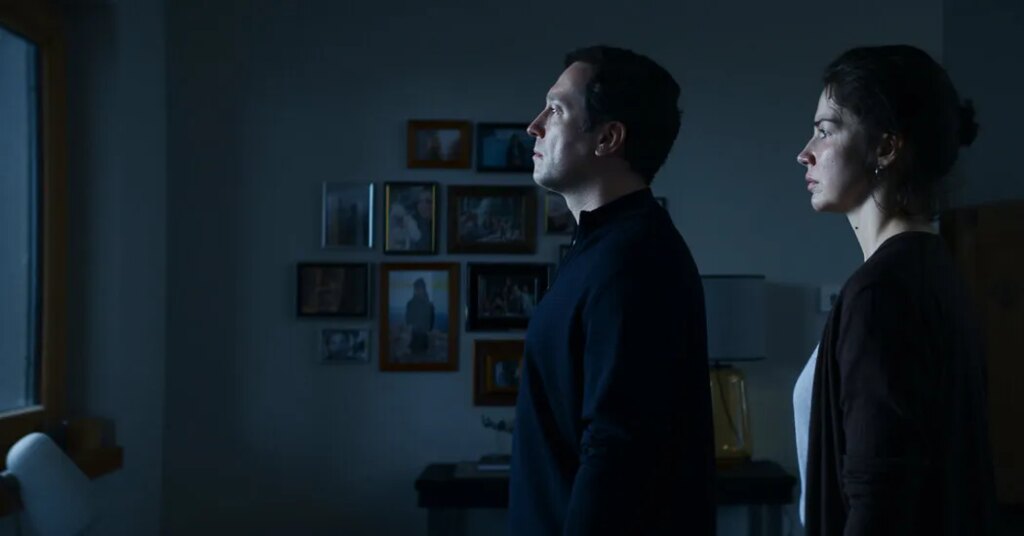
“La Femme Infidèle,” a 1969 exercise in suspense from the French New Wave director Claude Chabrol, is less a great movie than a great template. It concerns a well-mannered businessman who suspects that his wife is having an affair. Eventually, he confronts her lover.
Chabrol’s film was already remade as the Diane Lane scorcher “Unfaithful” (2002). But in “Minotaur,” the Russian director Andrey Zvyagintsev gives the scenario brilliant, chilling new dimensions. This version is set in 2022, during the first year of Vladimir Putin’s war in Ukraine, a backdrop that turns the story into a parable of complicity, class and avoided accountability. In different ways, the characters are aware of killing in plain sight — billboards advertise the war effort — and choose to avert their eyes.
Zvyagintsev, whose past work has included three of Russia’s official Oscar submissions (“The Return,” “Leviathan” and “Loveless”), now lives in France; when “Minotaur” took second place at Cannes in May, he forcefully called on Putin to “put an end to the carnage.” Latvian locations play a fictitious Russian city. Zvyagintsev’s aptitude for light and framing — the protagonist and his family live in an eerily pristine modernist home — gives the locations an otherworldly quality.
Gleb (Dmitriy Mazurov) is an executive at one of the city’s biggest businesses. The mayor (Vladimir Friedman) hands him and his fellow movers and shakers an ultimatum from Moscow: Each must meet a quota of employees to send off to fight. Gleb’s staff is already fleeing the country en masse, and he’s disinclined to betray the loyalists who remain. Clearly, creative accounting — and the recruitment of financially desperate patsies — will be required.
While Gleb schemes at work, he also seeks to balance accounts with his wife, Galina (Iris Lebedeva). She is, as he fears, sleeping with an alluring photographer, Anton (Yuriy Zavalnyouk). In the original, Chabrol, a fervent Hitchcockian, used the men’s confrontation to pay homage to “Psycho.” Zvyagintsev draws out the scene in devious ways. Gleb and Anton eye each other in near-silhouette. The geography of the apartment complex, a minimalist soundtrack (often little more than birds) and an ill-timed phone call all contribute to an impeccably calibrated stretch of extended tension.
“Minotaur” is also a portrait of power inside the marriage. Late in the film, the director supplies a pointed and complicated image of Gleb pulling a crying Galina into a tight embrace, then practically smothering her with a blanket, obscuring her body from the camera. This is a couple determined to cocoon themselves.
Minotaur Not rated. In Russian, with subtitles. Running time: 2 hours 15 minutes. In theaters.
The post ‘Minotaur’ Review: A Chilling Remake appeared first on New York Times.