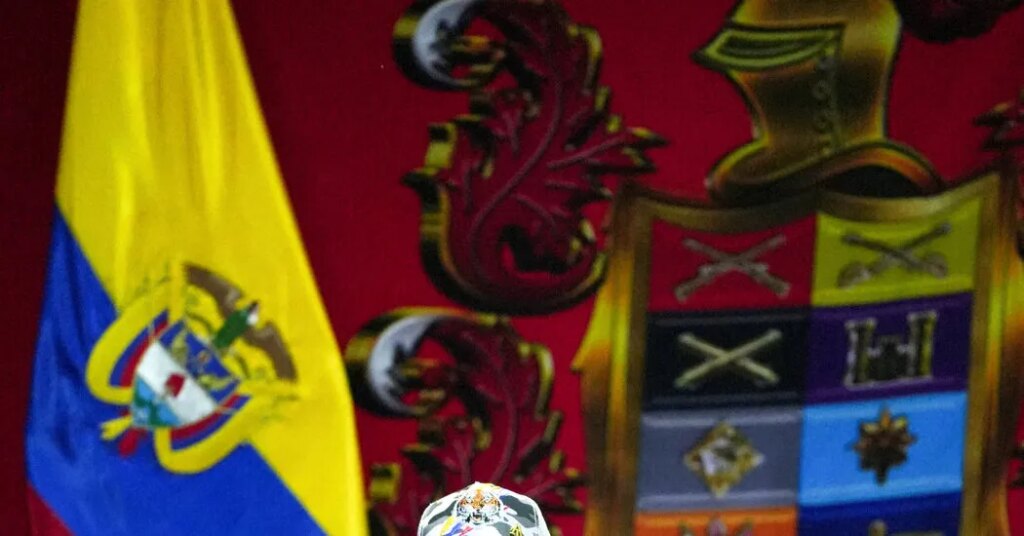
When Abelardo De La Espriella was a lawyer representing accused drug traffickers and money launderers, he said he only took cases so contentious that they gave him vertigo.
In his first 100 days as Colombia’s president, he has shown a similar appetite for controversy.
Following a lethal operation against an armed group, he posed with body bags, ignored the resulting outcry, fought a judge’s order and went on posting images of body bags online. He has also made a routine of confronting men captured in police or military raids and berating them on camera.
The Colombian president’s moves have inspired comparisons to Nayib Bukele, El Salvador’s authoritarian leader, whose slick productions showing off his hard-line security strategy Mr. De La Espriella seems determined to outdo.
His actions have drawn praise and sharp rebukes.
Former Colombian President Juan Manuel Santos, who received the 2016 Nobel Peace Prize for a peace accord that ended a decades-long conflict with the country’s largest rebel group, warned that Mr. De La Espriella could drag Colombia back into the past.
Supporters, however, have cheered his frontal attack on criminal groups, which many felt had been allowed to run rampant under the previous, leftist president, Gustavo Petro, and have celebrated Mr. De La Espriella as “the body bagger.”
Lorena Angarita, 53, who runs a communications workers’ association in Bogotá, said the president had “saved Colombia from imminent disaster.’’
About half of Colombians are “very offended” by the president’s theatrics, said Camilo Restrepo, 52, an artist in Medellín, and half are “very excited.”
The president’s office did not respond to a request for comment.
Mr. De La Espriella, 48, had never held public office before June, when he was endorsed by President Trump and elected in a runoff against a left-wing rival, by less than a percentage point. Experts say his actions as president have done little to unify the polarized population, deepening division instead.
“He is sticking to what worked for him in the campaign,” said Ángel Beccassino, a political strategist who wrote a book about Mr. De La Espriella.
A War on ‘Wokismo’
Like other conservatives elected recently in Latin America, Mr. De La Espriella seized on voters’ fears over security and borrowed culture-war tactics from Mr. Trump.
As president, he has declared an “open and all-out war on wokismo.”
In October, the government removed dozens of works from the National Museum, including feminist, L.G.B.T.Q. and political pieces — then sent riot police to quash protests. (Complying with a judge’s order, the government later returned the works.)
The government also recently opened an investigation into Mr. Petro, over accusations that he gave government contracts to women he met on sex websites. Mr. Petro has denied the claims.
Sandra Borda, a Colombian political scientist, said the new government is advancing the values agenda that Mr. De La Espriella promised the religious right.
The president is also testing out the Trump strategy of “flooding the zone” — doing “something every day to dominate the news cycle,” she said, “so you have everyone talking about one thing, while you’re doing another.”
But Colombians are not so easily distracted, Ms. Borda said.
At the 100-day mark, many are concerned over how an “outsider” government will handle a budget deficit that ballooned under Mr. Petro.
The De La Espriella government’s proposed tax hikes face stiff opposition from conservatives in Colombia’s Congress; its proposed cuts to social spending have prompted left-wing opponents to call for nationwide protests.
Thousands of Colombians affected by Mr. Petro’s stalled health care overhaul are still waiting for the fixes that the new president had promised within 90 days, including restoring access to medicine and care.
And some victims of the 7.4-magnitude earthquake that struck days after he took office are still clamoring for rent relief.
Óscar Montes, a Colombian political analyst who published a book of interviews with Mr. De La Espriella, compared the president to a person “arriving to a house someone else lived in,” and finding “it’s been destroyed from the inside.”
He said the problems left behind by Mr. Petro would require time to tackle and stabilize.
By early November, the new president’s approval rating had slipped modestly, to 48.7 percent, from 51.8 percent in August, according to an AtlasIntel poll for Bloomberg.
‘Iron Hand’
The clear focus of Mr. De La Espriella’s first 100 days has been his security strategy, which keeps him crisscrossing the country.
In online videos, he has patrolled a city at night with a gun on his hip, defying an armed group’s lockdown order. He has appeared to give commands over a walkie-talkie and announced operations with names like Mano de Hierro, or Iron Hand. He has autographed a bomb about to be dropped on an enemy camp.
The Trump administration is pursuing a military response to drug trafficking in Latin America and has focused on Colombia, the world’s largest cocaine producer.
Mr. De La Espriella has been eager to cooperate. He disputed a New York Times report that he had told Washington he didn’t have enough support in Colombia’s Congress to authorize joint military strikes; his foreign minister said the government hoped the move would “quickly” pass in Congress.
At Washington’s urging, Mr. De La Espriella has also moved to restart aerial fumigation of coca, cocaine’s base ingredient, though Colombia’s courts have pushed back.
Nearly every day, the president has announced another “major blow” against crime: arrests, raids, drug and weapons seizures. He has signed nearly 170 extradition orders — with a Sharpie, in a seeming nod to Mr. Trump.
Analysts say Mr. De La Espriella has been emboldened by Washington’s anti-trafficking push, but warn that the offensive could spiral.
Unlike Mr. Bukele of El Salvador, who ordered mass arrests to pacify a compact country of six million, Mr. De La Espriella presides over a large nation with more than 54 million people. Armed groups control significant swaths of territory, financed by cocaine and illicit gold and equipped with lethal drones.
“The military offensive is undeniably having an impact on the number of arrests and operations,” said Jorge Mantilla, a Colombian conflict analyst. “But, so far, it has not translated into greater territorial control, or a reduction in violence, or a defeat of those groups.”
The groups are also starting to hit back, stirring fears of a return to tit-for-tat violence with the state. More than three dozen soldiers and police have been killed since August, according to officials, including in a recent drone strike on a base.
The Strategist
Mr. De La Espriella has become the face of the military offensive.
Many say that is the work of Carlos Suárez, a strategist who steered his campaign. Like Mr. De La Espriella, Mr. Suárez was a lawyer who spent years in Miami and represented high-profile Colombians facing charges in the United States.
Mr. Suárez is shaping the government’s anti-woke campaign, officials have said, and influenced the recent replacement of a moderate interior minister with a religious hard-liner.
He is also behind the videos chronicling the security offensive, which have grown bolder by the week. Mr. De La Espriella has gone from khakis and baseball cap to full camouflage and beret.
Mr. Suárez did not respond to a request for comment.
Juan Nicolás Garzón, a Colombian political scientist, said that “the sight of a president with a pistol on his belt, in uniform,” gives Colombians a sense that their leader is taking charge of security down to “the micro level.”
But Mr. Becassino, who wrote about Mr. De La Espriella years ago, said his strategist was pushing him toward “grandstanding and spectacle, costume changes and bombastic posturing,” adding, “They’re using that to cover up the lack of results.”
María Jimena Duzán, a prominent Colombian journalist and commentator, said the strategy could endanger the president’s credibility abroad, making him look “like a cartoonish strongman dressed up like a soldier.”
Eligio Montes, 55, a handyman in Cartagena, said he voted for Mr. De La Espriella “because he said he would finish off the criminals.” But he was not entirely convinced by what he had seen, he said.
“They say it is pure show.”
Still, by one measure, the strategy has succeeded. After just 100 days, Mr. De La Espriella has become a phenomenon, the latest vivid figure to emerge on the global right. He has inspired memes, parodies, Halloween costumes and imitation by other leaders.
Traffickers have taken notice, too. In October, when the authorities in Costa Rica seized some 250 bricks of cocaine, they found his photograph stuck on every one.
Simón Posada contributed reporting from Bogotá and Cartagena, Colombia.
The post Body Bags and War on ‘Wokismo’: A President’s First 100 Days appeared first on New York Times.