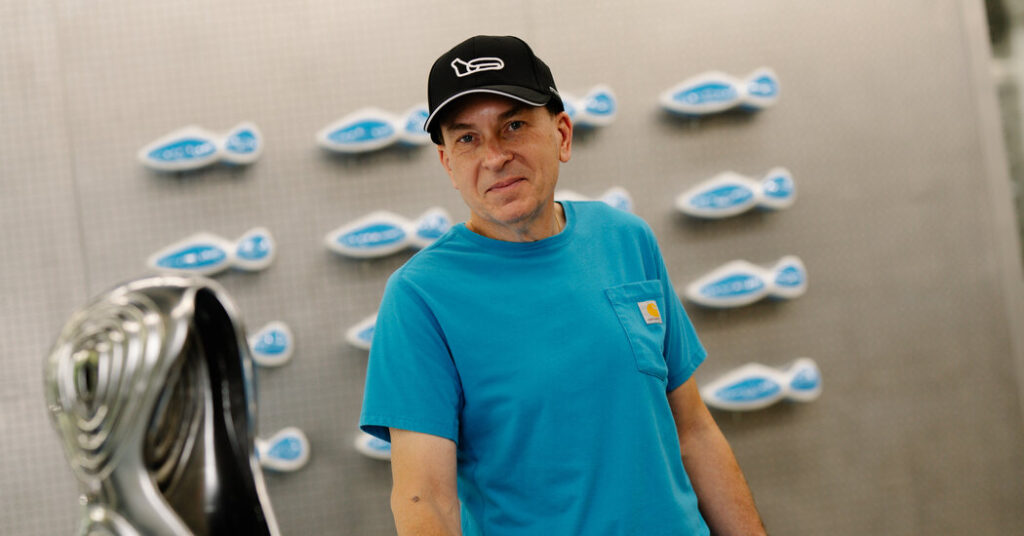
In August of 2024, without warning and quite publicly, Steven Smith was out from his job designing shoes with Kanye West. For eight years, he had helped mint Jet Ski-like sneakers and spartan slides, pushing the reported valuation of Yeezy’s sneaker business alone as high as $3 billion in 2019.
Mr. Smith was loyal. He hung on as his boss’s outbursts skittered into antisemitism and vitriol against perceived enemies. He stayed through Ye’s breakup with Adidas and a flaccid presidential bid. When Mr. Smith was done, he didn’t go quietly.
“He’s lost his mind,” Mr. Smith told Fast Company at the time. “The whole of Yeezy is circling the drain and this is just part of it.”
Still, sudden unemployment was perilous for him.
“If I stop creating, it’s going to kill me,” Mr. Smith, 60, said in Miami early this month. In his default, self-assured way of speaking, he described his creative output as a “fire hose.”
Since starting his career at New Balance in 1986, when he was 21, Mr. Smith has bounced between nearly every major American sneaker company, working on dozens of shoes, many of which continue to fill shelves.
While not quite a household name (the only sneaker designer who rises to that level may be Tinker Hatfield of Nike), he has, over four decades, diligently guided the sorts of shoes we wear.
If you’ve worn Adidas’s awesomely 1990s Artillery basketball shoe, or New Balance’s mousy 574 running sneaker, Mr. Smith has altered your personal style. If you’ve succumbed to a Yeezy slide, your tastes have been influenced by Mr. Smith. (He has said over the years that if he had negotiated a cut of the sales, he would be a tremendously rich man today.)
And so, without a job for the first time in nearly a decade, Mr. Smith turned off his phone and embarked on a fruitless hunting trip in the Michigan wilderness. In solitude, he tried to “figure out what the hell just happened.”
When he emerged from the woods after a week and flicked his phone back on, several job offers awaited him.
A ‘Willing Victim’
“About six companies reached out to me,” Mr. Smith said. From anyone else, this would come off as unverifiable bloviation. But Mr. Smith is, in the words of Brendan Dunne, a footwear-industry pundit who is now an executive at the resale platform StockX, “one of the most important sneaker designers there is.”
His reputation in the cult sneaker world is lofty: Pairs of Yeezys signed by Mr. Smith have sold for as much as $2,000.
But it wasn’t a pure sneaker company like Adidas or Nike that pulled him back into the studio. It was the comfort-clog specialists at Crocs.
“I always say true innovation takes a moment of desperation and a willing victim,” said Mr. Smith, who was named Crocs’ head of creative innovation in November 2024. “Crocs has been a great willing victim.”
In recent years, sneaker fans have groused that entrenched sportswear companies like Nike and Adidas are too content with reissuing reliable “retro” models, and too shy on novelty. Such hype-seeking collectors have, in turn, wandered. Last year, the top-selling shoes brands on StockX were Ugg and Crocs.
“Crocs has way more real estate in the collector world than they ever did before,” Mr. Dunne said. In arriving at Crocs, Mr. Smith may well just be reading the market and acting accordingly.
Still, he said, when he met with Crocs executives, it was really the company’s promise that he would have “complete freedom” that won him over.
Today, he works most closely with just two other employees, both Yeezy veterans. He still lives in Portland, Ore., traveling to Crocs’ Colorado headquarters once a month to check in. He sketches by hand, sometimes shaping samples at his house using foam and a sander.
“We do give him a lot of autonomy,” said Anne Mehlman, Crocs’ brand president. He does not have to create a set number of shoes each year, and Ms. Mehlman said he will work on the company’s broader product line as well.
His mandate, she said, is to “give us the really outside-of-the-box creative thinking.” What, for example, might a Crocs sneaker be? What would a molded recovery slide in Mr. Smith’s hands look like?
“We wanted him to play,” she said.
No Sneaker-Design School
The Crocs Ripple, Mr. Smith’s first clog design for the company, looks like a kidney-shaped pool full of windswept, chlorine blue water. Its Space Age vibe is a tell that Mr. Smith is a child of the ’60s, still mesmerized by the gleaming, imaginative future depicted in “Star Trek” and “2001: A Space Odyssey.”
“Why aren’t we living in that future we were promised?” he said. “It’s a disappointment.”
The $90 shoe will be released officially next year, but the company has done early, small-batch introductions at the ComplexCon streetwear festival in Las Vegas in October, and at Flight Club, a sneaker boutique, during Art Basel in Miami.
Mr. Smith is old enough to remember a time well before “sneaker designer” was a fantasy career for Jordan-hoarding high schoolers. Back in 1986, when he graduated from the industrial design program at the Massachusetts College of Art and Design, the guys (and they were pretty much all men then) sketching the latest shoes for Foot Locker shelves were anonymous draftsmen.
“There was no curriculum toward” sneaker design back then, he said. When he heard about a position creating sneakers at New Balance’s nearby headquarters, Mr. Smith, who ran high school track in New Balance shoes, dropped off his portfolio. He was hired the next day.
New Balance proved to be its own sort of sneaker design school. Sample makers taught him to sew his own spec shoes by hand. His designs, some of which remain available in one form or another, were heavy on mesh panels and grays. They fell in with the modestly sporty aesthetics of the day.
Yet, as Mr. Smith’s career took him to Adidas and then Reebok and eventually Nike, he began to believe that sneakers should do more.
During the ’90s, a Walkman was about the same price as a pair of sneakers. He became fixated on the notion that he wasn’t just competing against other sneaker companies; he was competing with tech companies like Sony and Casio.
“I gotta make something so cool that I get that money from you instead,” he said.
Keeping Things Futuristic
His designs began to simmer with Flash Gordon splash and gadgetry that, presumably, could enhance your athletic performance. The Nike Shox Monster packed coils in the rear of the sole like mattress springs. The Nike Air Zoom Streak Spectrum Plus, a featherweight running shoe, was covered in flames, like the shirts Guy Fieri would wear decades later. The Reebok Instapump Fury, an open-paneled, split-soled sneaker, still looks like a vision of a “Blade Runner”-like future that never fully arrived.
It was the Fury, which Mr. Smith first sketched in 1992, that was “the bridge from pure performance to streetwear,” he recalled. Steven Tyler wore it onstage at the 1994 MTV Video Music Awards. Bjork wore the tottering laceless shoe in several photo shoots.
“Steven’s a guy who’s willing to push boundaries,” Mr. Dunne of StockX said.
Sometimes to his detriment. A professed nonconformist who still listens to the same punk bands he did as a teen and has never had a sip of alcohol, Mr. Smith is not, as his sporadic résumé would reflect, willing to bend himself into the mold of any one corporation. Creative though they can be, Nike and Adidas are still multinational companies with shareholders and stock prices to fret over.
“I don’t think that the organizations inside these brands are particularly kind to people who are mavericks,” Mr. Dunne said. “And I think Steven Smith is very much that.”
By the mid-2010s, Mr. Smith’s career had fizzled. He had left his most recent job as innovation director at Keen in 2016. Unemployed and unsure of what was next, he agreed to be interviewed by Highsnobiety, the streetwear publication.
The resulting article, “Meet Designer Steven Smith, the Godfather of Dad Shoes,” focused mainly on the New Balances he had designed decades before. Initially, he was irate.
“I’m like, no, I do performance and running,” he said. “What the hell is this?” Yet, as he would find out later, it was that article that helped compel Ye to reach out to him.
When the rapper called him, Mr. Smith “didn’t know too much about him,” he said. But he found in Ye a kindred creative.
“We were creative sharks,” Mr. Smith said, who came to think of Ye as a little brother.
Mr. Smith took the job and was named head of product design in October 2016.
At Home With Foam
When he joined, Yeezy was known for the Boost 350, a one-piece knit slip-on sitting on a squishy, éclair-like sole. The shoe had been a runway success. Footwear News called it the sneaker of the year in 2015. (Further evidence of shifting winds in the footwear world: Salehe Bembury, a young designer who worked on versions of the 350, become one of Croc’s most reliable collaborators in recent years.)
But Ye kept pressing him about his New Balance designs, so he began sketching up a denser style, with lots of panels and a fat running-shoe foundation.
The resulting Wave Runner sneaker (officially, the Yeezy Boost 700) came out in November 2017. It sold out online in minutes and ushered in a trend for inflated dad sneakers.
As Mr. Smith remembers: “When it came out, Ye goes, ‘What I made you do is design your New Balance shoe as if you still worked there 30 years later.’ And I said, ‘Yeah, you kind of did.’”
Over the next eight years, Mr. Smith would work on dozens of shoes with Ye, their work progressing into monotone slides and perforated clogs that altered the broader footwear market. By the 2020s, sneakerheads were letting their Jordans gather dust in favor of spongy clogs. On StockX, the resale price for Yeezy’s Foam Runners peaked at more than five times their retail price.
That experience is what converted Mr. Smith to the benefits of molded, rubbery shoes of the ilk that Crocs has been honing for decades. That experience, Ms. Mehlman noted, made him more appealing to Crocs as well.
“You can do shape and form that you could never do with textile fabrics and leathers,” Mr. Smith said. Today he relishes how quickly a one- or two-piece molded shoe can come to market. Because of its simple construction, the Ripple took less than a year from initial sketch to release, a remarkably short lead time for a shoe. He declined to say how many models he was working on at Crocs, noting only that it was “a lot.”
Mr. Smith said that Ye recently came to him and apologized for abruptly firing him. Mr. Smith captured the moment for Instagram, sending Yeezy fans into speculation that they might team up again.
Mr. Smith squashed those rumors. He will be his “friend forever,” but Mr. Smith’s working focus is now on Crocs.
“I want to show them what they can be,” he said.
Jacob Gallagher is a Times reporter covering fashion and style.
The post The Former Yeezy Designer Remaking Crocs appeared first on New York Times.