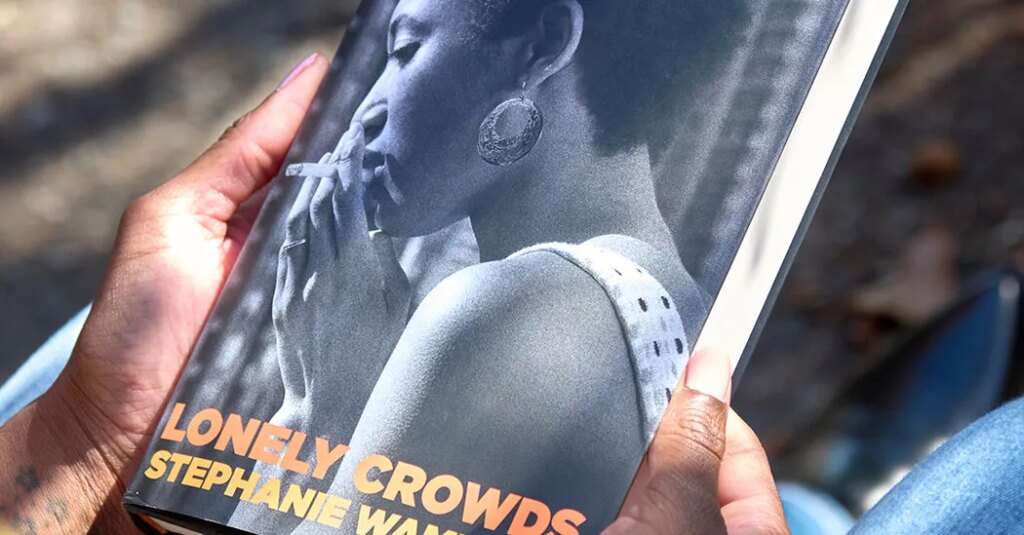
On an evening in late July, Kesi Smyth, a record label manager in her 40s, was sitting with her two children outside her home in Langford, British Columbia, when she found out she was on the cover of an acclaimed American literary novel she’d never heard of.
“Are you on the cover of this book???” her friend Emma Higgins, a videographer in Los Angeles, texted, along with a photo. Higgins had been at a Barnes & Noble when she saw a book that jumped out at her: “Lonely Crowds,” the debut novel by Stephanie Wambugu, published by Little, Brown in July 2025.
Smyth instantly recognized herself in the black-and-white image of a young woman in profile, eyes cast slightly downward as if deep in thought, smoking a cigarette. She knew it had been taken a long time ago, but couldn’t place where or when — let alone understand how it had come to be on the cover of an award-winning novel about two best friends becoming artists in New York City in the 1990s.
“It’s absolutely wild,” Smyth said in a joint video interview with Wambugu. “It doesn’t feel like reality.”
Smyth’s mother located the original photograph on Getty Images, and the accompanying credit triggered Smyth’s memory: Sometime around 2008, she’d taken part in a photo shoot organized by her friends Leigh Righton and Laara Cerman on the balcony of Righton’s apartment in downtown Vancouver.
Smyth did a lot of modeling at the time, but this was the only stock image shoot she ever did, creating generic photos that could then be licensed for specific purposes. (The theme, Righton and Cerman recalled in a video interview, was simply “girls’ night out”; the other photos in the gallery, Righton said, were “less moody.”) Smyth signed a model release, legally clearing the photos for commercial use, and then forgot all about it.
More than a decade later, Gregg Kulick, Little, Brown’s executive art director, was browsing Getty for stock photos he might use on the cover of “Lonely Crowds” when he found the photo of Smyth — a wider shot, originally in color — and purchased it for $300, royalty free. In the final jacket treatment, the photo is cropped and gray-scaled, overlaid with the author’s name and title in bold orange lettering at the bottom.
Before selecting this one, Kulick and Wambugu had discussed a dozen other designs, including digital illustrations and a range of abstract and figurative paintings and collage; none were quite right to her.
“I was very adamant throughout the process and said no to several covers,” Wambugu said. She had seen so many book jackets while working at a bookstore (McNally Jackson in New York City) during graduate school that she had a clear vision of what she was looking for: “I wanted it to be an artful portrait.”
When Kulick presented what turned out to be Smyth’s portrait to Wambugu, she knew they’d found it:“I was sitting in my car and I thought, This is absolutely right. This is definitely the cover.”
Part of what appealed to her was that it didn’t look like other contemporary fiction covers; she compared it to an old, “striking” Miles Davis record.
“It has a kind of subtle power,” Wambugu said, sitting in the office in her Brooklyn apartment, where she happened to have a stack of paperbacks on the floor nearby, all bearing a younger version of the face she was seeing live on her screen.
After receiving Higgins’s text message, Smyth reached out to Wambugu and her publisher on Instagram — only to find that the author had been looking for her for a while.
“I was eager to talk,” Wambugu said, calling it “very, very surreal” to meet the living, breathing person whose image she’s studied so closely for so long.
“I spent some time trying to do reverse image searches, trying to find out who you were,” Wambugu told Smyth, acknowledging the sensitivity of discovering an intimate photo of yourself exposed so publicly. “The cover of the book has come to represent me and my work in some ways more than my own face has.”
Wambugu was careful to respect Smyth’s privacy. “As much engagement as you want is great for me,” she said in the video interview. “And if you don’t want anything to do with me, I respect that too.”
On the contrary, Smyth expressed gratitude to Wambugu and Kulick for “being very respectful and understanding of what that experience might have been like for me.”
Many readers will interpret Smyth’s photo as an avatar for the narrator, Ruth, the daughter of working-class immigrants from Kenya who makes her way from a Rhode Island Catholic school to Bard College and then to the Manhattan art scene, all with her best friend and object of devotion, Maria, by her side.
But for Wambugu, it’s meant to be more ambiguous. “Maybe in some way she’s like a hybrid of both women,” she said. “They’re described as looking alike, so maybe she’s a twinned image of both of them.”
In an email she sent after finishing the novel, Smyth described the woman on the cover as “not quite giving confidence, but also not insecure,” as well as “quiet and a bit forlorn.”
“Funny enough,” she added, “that’s probably exactly what I was feeling in my own experience at that point in my life.”
Having written “Lonely Crowds” from the perspective of Ruth in middle age, Wambugu, who is 28, said she had been “speculating about what it would be like to look back on something that I was just experiencing for the first time.”
“I’m sure, as time passes, I’ll look back on this book and have a different relationship to it, and just think, ‘I didn’t know what I didn’t know,’” she added. “Sometimes I read the book now and I think, Who is that, who’s the person who wrote this book?”
“That’s exactly how I feel,” Smyth replied, “that I didn’t know what I didn’t know, when I look at this.”
On that eye-opening evening in July, Smyth had just returned from a camping trip with her children, who are 11 and 9. She showed them the photo of who their mother had been, years before they existed. Needless to say, they had questions.
“It was a really interesting night,” Smyth said. “One was like, ‘Mom, I didn’t know you smoked.’”
The post She Forgot Posing for the Shot, Until She Saw the Book Cover appeared first on New York Times.