Around three thousand years ago, the kings of Babylon and Assyria shook hands to cement an alliance. We know that because a sculptor carved the moment into limestone, and the work is now on display in a Iraqi museum.
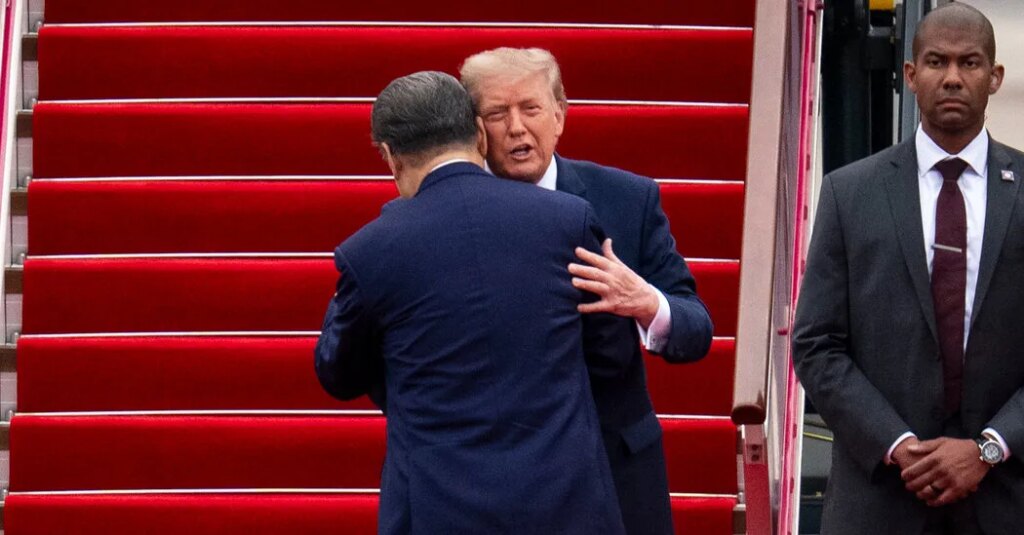
The artifact helps us measure how long world leaders have been making the same gestures of respect, and how long the rest of us have been scrutinizing the slightest differences in their body language. We read volumes into the placement of a hand, let alone subtle deviations from tradition, which is what the world saw on Wednesday when President Trump and China’s leader Xi Jinping embraced each other briefly, ahead of a series of meetings.
Mr. Xi’s presence on the tarmac as Mr. Trump descended from Air Force One in China alone was already a break with decades of diplomatic custom, under which lower-ranking officials are generally sent to welcome visiting heads of state.
China’s state-run news agency reported that Mr. Xi was reciprocating Mr. Trump’s mold-breaking decision to greet Mr. Xi in person when he arrived at Andrews Air Force Base for a state visit to the United States in May.
The leaders of the world’s two superpowers are clearly trying to signal closeness at a time when the entire world seems increasingly fractious, and when relations between their two nations are strained over several tough issues, including trade barriers, nuclear arms control and the artificial intelligence race.
“This gesture likely reflects Xi and Beijing’s desire to show respect to Trump, which they know the U.S. President enjoys,” William Yang, a senior analyst for Northeast Asia at the International Crisis Group, wrote in a social media post. “And it is likely also an attempt to uphold the positive rapport between Xi and Trump ahead of a potentially turbulent period in U.S.-China relations in the coming months.”
Mr. Xi and Mr. Trump will be joined by the Russian president, Vladimir V. Putin, for three-way talks on Thursday, the first trilateral meeting of its kind. Mr. Putin, who has met Mr. Xi dozens of times, was greeted not by Mr. Xi but by Cai Qi, a member of China’s Politburo Standing Committee.
All of this is being dissected by the media and by historians, just as these leaders’ past gestures have been. In 2017, The Times brought on two experts in body language to analyze Mr. Trump’s handshakes with various world leaders after a string of awkward interactions provided ample fodder for speculation about the geopolitical meanings behind his etiquette.
A mangled handshake with French president Emmanuel Macron was “very patronizing,” remarked Jacqueline Whitmore, an author and etiquette instructor. Mr. Trump’s missed cue to shake hands with the German chancellor at the time, Angela Merkel, signaled he was “disinterested,” said Chris Ulrich, who teaches body language and presentation skills.
But Mr. Trump hit the mark with a strong face-to-face handshake with Canada’s prime minister, Justin Trudeau, in 2017, Mr. Ulrich said. It wasn’t just that they made sustained eye contact or touched each other’s left arms. “You face your belly button toward people you like, admire and trust,” he said. “This is a great way to build rapport fast.”
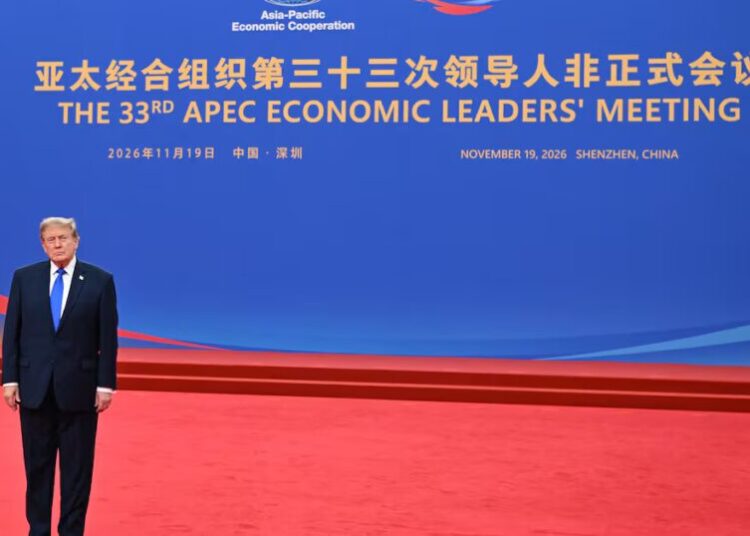
In Shenzhen, where Mr. Trump, Mr. Xi and Mr. Putin have planned their trilateral meeting on Thursday on the sidelines of a larger gathering of leaders for the Asia Pacific Economic Cooperation forum, the differences in greetings were clearer.
Mr. Xi’s personal welcome of Mr. Trump appeared to reflect a desire for a measure of stability despite a growing disagreements. And the more conventional reception for Mr. Putin by one of Mr. Xi’s underlings signaled a kind of continuity in relations between China and Russia.
In contrast, Japan’s prime minister, Sanae Takaichi, was practically shunned by Mr. Xi when she arrived in Shenzhen.
Relations between Japan and China are at their lowest point in decades, and Ms. Takaichi was greeted when she arrived not by a top minister, but by military guards and a woman whom Japanese media said was the Chinese foreign ministry’s ambassador of protocol.
Later, at the hall where the forum was taking place, Mr. Xi barely took note of Ms. Takaichi. He offered her only a slight smile as she made her way to a banquet with other world leaders, and he did not appear to respond when she said a few words to him, just before they posed for a photo.
The post How to Decode the Xi-Trump Hug appeared first on New York Times.