At 8:30 a.m. on Thursday every phone in South Korea buzzed loudly, even the ones set on silent. It was an emergency alert sent by the government, the kind usually reserved for a natural disaster or wartime catastrophe.
But this alert was designed to sniff out would-be cheaters taking a test that is held every November.
The exam, the eight-hour College Scholastic Ability Test, or Suneung, is notoriously grueling and has spawned the country’s cram school culture. Last year’s edition had an English comprehension section so difficult that it prompted an apology from administrators and a resignation. This year, the authorities are worried about students cutting corners, given an alarming rise of A.I.-assisted chicanery.
On Tuesday, just two days before the Suneung, they announced a host of new rules.
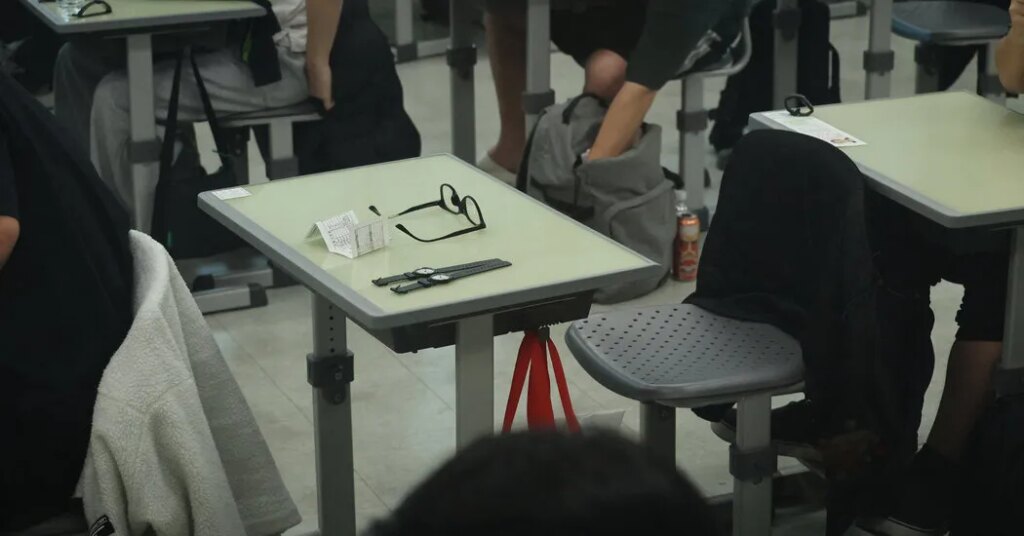
Test takers — more than half a million this year — were ordered to roll up their sleeves. They had to put stickers on their shirt and jacket buttons, blinding any cameras they might have hidden in them. For the same reason, they had to let proctors inspect their eyeglasses. The emergency alert was expected to sound off again at least once during the exam, which started at 8:40 a.m.
The rhythms of life in South Korea change on the day of the test, which is held on the third Thursday of November. Traffic restrictions are put in place around test centers, people delay their commutes and flights are grounded for 35 minutes during the listening portion of the test.
Many students and their parents see the new security measures as a last-minute disruption.
“An alarm would completely disrupt my flow,” a test taker told local news media. “The Korean language portion is all based on flow.” Some even called to postpone the exam until more formal and foolproof measures had been established. Previous changes to test questions and protocol have elicited a similar response.
The test, which is also known as CSAT, is divided into six sections that test students on subjects like English, math, and history. But the questions are not as straightforward as the subjects seem. Past exams had students solving questions about equity capital, risk-weighted bank assets and Piaget’s theory of cognitive development.
Officials defended the last-minute changes, saying they were necessary in wake of recent scandals. “Cheating on exams using high-tech equipment is nothing less than outright theft,” President Lee Jae Myung said on social media on Tuesday. He offered a bounty of at least 100 million won, about $75,000, to informers, who will get more money the more people they report.
Last month, several students were caught cheating with smart glasses in admissions exams for Yonsei University and the University of Seoul, according to lawmakers. Earlier this month, a student at Konkuk University, was caught attempting to use a mini camera in a mock exam, according to local news media.
On Nov. 15, a man named Han Won-seok, who received the top score in a certified tax accountant exam, confessed to using A.I. to cheat on the test. In a YouTube video on his lawyer’s channel, Mr. Han said he used a mini camera to take pictures of the test which were uploaded to a cloud-based generative A.I. service that solved the questions for him. He received the answers using a hidden phone.
“To anyone who might be contemplating cheating like I did,” Mr. Han said, “please, do not hold onto the reckless thought of ‘maybe I won’t get caught.’”
Anyone caught using A.I. to cheat on the college entrance exam will face a 10-year ban from retaking it and possible criminal charges. The government said it would work with A.I. companies after the exam to check for test queries during test hours but did not identify them.
The post A Hunt for Test Cheats With Phone Alerts and Eyeglasses Checks appeared first on New York Times.