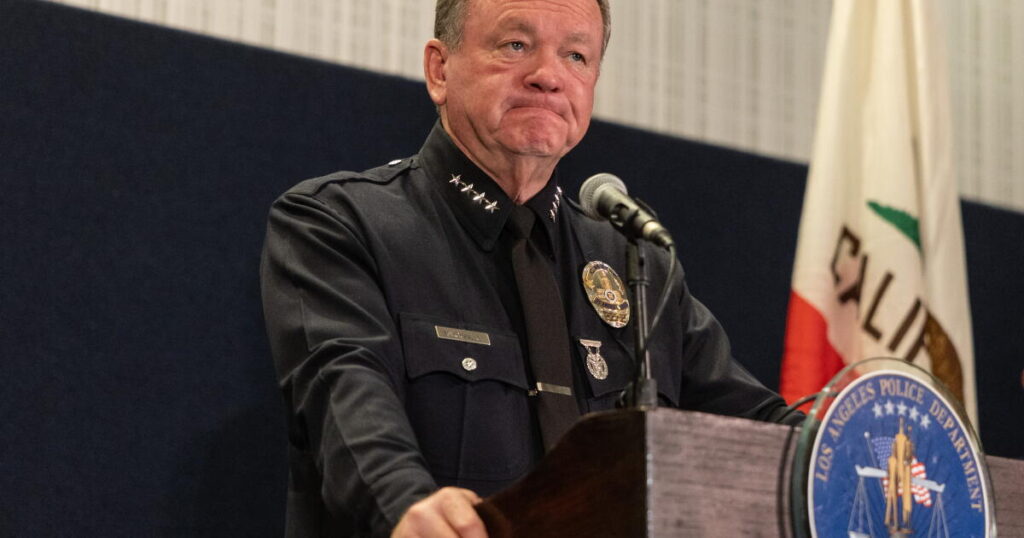
The estimated cost to protect more than 11,00 athletes, officials, dignitaries and a crush of fans at the 2028 Summer Olympics has jumped to between $3.5 billion and $4 billion, Los Angeles Police Chief Jim McDonnell said in an interview Wednesday.
The new estimate from the chief is markedly higher than anything public officials have announced before — and far above the $1 billion that the U.S. Congress approved last year for policing the massive sporting event.
Los Angeles leaders expect money from last year’s federal action to be distributed sometime in 2027, with dozens of police agencies expected to submit formal proposals soon for a share of the $1 billion.
“The billion dollars is certainly helpful, but that’s not going to cover the cost of just policing Los Angeles for the Olympic Games, during that period of time,” McDonnell said in his interview with The Times.
“I think that is about $1.3 billion that we’re going to need” in Los Angeles alone, McDonnell said. “And then to police all of the other venues, I think it’s probably going to be closer to [a total of] $3.5 to $4 billion.”
The police chief’s comments came ahead of a meeting at the U.S. Secret Service’s offices in downtown Los Angeles Wednesday, where he and other law enforcement leaders convened for a quarterly meeting on security for the Olympics and Paralympics. The Secret Service is coordinating the effort because the Department of Homeland Security has declared the sports extravaganzas National Special Security Events.
An LAPD spokesman said the chief got those figures after conversations with many of the dozens of law enforcement leaders who are coordinating safety plans.
Los Angeles Sheriff Robert Luna and California Highway Patrol Commissioner Sean Duryee told The Times they had also had been informed that the total security estimate had climbed to $3 billion or more.
It remains unclear if McDonnell will be overseeing much of the Olympic security surge, as L.A. Mayor-elect Nithya Raman previously suggested she would replace him as chief, perhaps before the Summer Games, which open on July 14, 2028.
In the interview, McDonnell expressed optimism about working cooperatively with the mayor-elect, citing a two-hour phone conversation he had with Raman last week.
“My hope is that we’ll be able to work very closely together and ensure that our people in the field get what they need to be able to do the job, and that we have a great relationship moving forward,” McDonnell said.
Asked for comment, Raman’s staff put out a short non-committal statement. Raman will assure “the city is fully prepared to keep everyone safe during the Olympics,”the statement said, “regardless of leadership.”
The task of securing the Games — from street-level violence to new threats like drones and cyber-warfare — has loomed large since L.A. accepted a bid to host the Olympics about a decade ago.
Within Los Angeles County, alone, athletic venues will stretch from the San Fernando Valley to Venice, Long Beach and downtown Los Angeles. Also hosting sports: Orange County, with indoor volleyball; a half dozen American cities, outside Southern California, with soccer; and Oklahoma City, which will be home to softball and canoe slalom.
The organizers of the Games and L.A. officialshave been counting on financial aid from the federal government to cover all that territory. The $1 billion allocation arrived in President Trump’s so-called Big Beautiful Bill.
But California elected officials have been saying for months that they think more money will be needed.Planners expect to deploy as 16,000 police officers at a time across the broad Olympic region. They will be drawn from a larger pool of as many as 30,000 officers, who will stream into Southern California from dozens of other places.
McDonnell said it will take 9,400 officers a day during the busiest parts of the Olympic schedule, just to protect competition venues. The LAPD plans to provide one-quarter to one-third of those officers, while outside agencies provide the rest, McDonnell said.
“It’s going to cost a lot of money to be able to do what needs to be done to police the games appropriately,” McDonnell said.
The chief said that the new Democratic-controlled Congress due to be seated in January may provide more support to solidly blue California for the Olympics.
“It’s going to probably be good for L.A. because there is such a strong Democrat party representation here,” McDonnell said. “I think we will be able to make our pitch and hopefully be able to be heard and to be able to get the resources necessary to do the best job we can.”
The post Police price tag for L.A.’s ’28 Summer Olympics could hit $4 billion, LAPD chief says appeared first on Los Angeles Times.