The Trump administration on Wednesday confronted mounting criticism from lawmakers and national security experts that it has not effectively responded to rising public anxiety about a spate of technological problems that have plagued major companies and federal agencies in recent days.
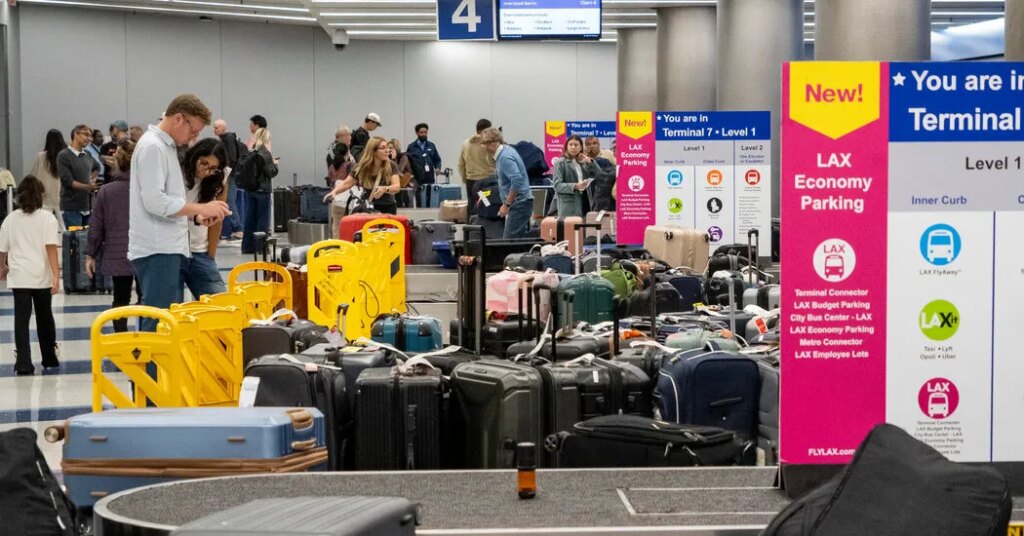
Both Democrats and Republicans said the administration had not done enough to calm acute public concerns after a series of outages that temporarily grounded all commercial air traffic, slowed banking transactions, disrupted email services and shut down a key system at the National Security Agency.
On Wednesday, lawmakers and former government officials said they were concerned that President Trump’s deep cuts to core government functions that would typically coordinate the response to cybersecurity issues could be to blame.
They pointed to the huge loss of staff at the Cybersecurity and Infrastructure Security Agency, or CISA, which was formed in the first Trump administration to coordinate the nation’s response to cyberattacks, as well as the drastic scaling back of the National Security Council, which historically served as a strategic hub to coordinate response to major episodes.
“The spate of disruptions over the past week reinforces just how dependent Americans are on the fragile, interconnected digital infrastructure underpinning our daily lives,” said Jen Easterly, who led CISA during the Biden administration. “Unfortunately, cuts to the agency’s budget and personnel over the past two years have diminished its capacity and eroded trust with key partners.”
Meanwhile, the N.S.A., which is responsible for intercepting the calls and texts of foreign national security threats, experienced on Wednesday a second day of disruptions to its classified internal communications network that officials said was prompted by a security patch. That effectively meant the administration’s largest army of computer experts was at least partially hobbled, addressing its own in-house problems amid the cascade of nationwide technology lapses.
Senator Josh Hawley, Republican of Missouri, earlier this week questioned the administration’s explanation for the outages and said the Senate should receive a thorough briefing.
“We need to know what’s going on,” Mr. Hawley said. “The American people deserve to know. And we should be briefed on it in a way that we can go out and share with the American people what’s happening here.”
“If this is all a coincidence, it’s like the greatest coincidence in the history of the world,” Mr. Hawley added. “I’m completely in the dark, and people at home are in the dark and they shouldn’t be.”
In a statement, the White House rejected the criticism that the cuts to national security staffing contributed to the current tech issues. Mr. Trump has formed a cross-agency group to modernize the air traffic control systems, and the National Security Council’s cyberteam meets weekly to discuss ongoing threats, according to the White House.
Taylor Rogers, a White House spokeswoman, added that the federal government had immediately investigated the various outages.
“There is no indication of malicious foreign cyberattacks or S.I.-related attacks,” Ms. Rogers said, using the abbreviation for super intelligence, which Mr. Trump prefers to artificial intelligence. “The safety and security of the American people have been a top priority of President Trump and the wider Administration since day one.”
For his part, Mr. Trump was silent about the nationwide ground stop on Friday and then dismissed worries about the various technological problems that affected companies like Microsoft, Chase and Apple.
“It’s life,” the president said on Tuesday as he arrived in Manila for a swing through Asia. “When you’re big and powerful and you have all the money, things like that happen. It’s fine.”
Since then, top administration officials have scrambled to try to reassure the public.
Secretary of State Marco Rubio and Jay Clayton, the director of national intelligence, both said there was no evidence that any of the failures were the work of foreign hacking or cybercriminals. They and the top Democrats on the Senate and House intelligence committees said some of the system problems could be caused by companies patching security flaws identified by rapidly advancing artificial intelligence.
“We have no indication that these incidents are related, that they are coordinated; we also have no indication that they are the result of a state-sponsored malign actor,” Mr. Clayton told House lawmakers on Wednesday.
Javed Ali, a former senior director at the National Security Council under Mr. Trump, said he did not blame the public for questioning whether the various technological disruptions were the result of a cyberattack. He said he, too, initially had that thought.
That is why it was crucial for the federal government to provide transparency in a time of crisis, he added.
“The public-messaging side of it just seems to be lacking, and that just raises a lot of questions,” said Mr. Ali, who has worked in counterterrorism and national security for multiple administrations. “Somebody needs to just be very clear with the American public and say, ‘Here’s what we know.’”
It remains unclear who is coordinating the federal government’s response to the spate of tech problems, though Mr. Clayton, who was recently tapped by Mr. Trump to also serve as an A.I. czar, has been assuming a more prominent role in recent days. Vice President JD Vance canceled a planned appearance at The New York Times DealBook Summit on Wednesday, citing meetings in Washington to address the outages. The White House declined to provide any details about those meetings.
Markwayne Mullin, the homeland security secretary, said at the House hearing that administration officials planned at least one call with private-sector leaders about whether companies should provide their customers with advance notice of software updates.
CISA has not been a visible part of the administration’s response to the outages, despite its role overseeing the reliability and resilience of the nation’s critical infrastructure, including banks and aviation.
The agency was severely downsized when Mr. Trump returned to office, still fuming that its director during his first term, Chris Krebs, dismissed the president’s unfounded claims that the 2020 presidential election was stolen from him.
In a statement, Chandler Rebel, a spokesman for the Department of Homeland Security, said that CISA “remains fully equipped and prepared to address any national security cyberthreats that face our nation,” and he accused the agency of previously having “a ballooning budget concealing a dangerous departure from its statutory mission” before Mr. Trump took over.
“Under Secretary Mullin, CISA is focused squarely on executing its statutory mission: serving as the national coordinator for securing and protecting the nation’s critical infrastructure,” Mr. Rebel said.
For its part, the N.S.A. on Wednesday continued to struggle with disruptions to its classified communications network, NSANet. Nonessential employees were initially instructed to again stagger their arrivals to the spy agency’s Maryland headquarters, where the vast majority of its tens of thousands of employees are based, to avoid overloading recovering systems, according to a call box recording that employees use to check for updates and people familiar with the matter. Later in the day, the guidance shifted to instruct nonessential personnel to not report to work at all unless directed by a supervisor.
While mission-critical systems remained generally accessible, NSANet continued to experience interruptions and network login issues, and it may be days before the network is fully operational, people familiar with the matter said.
The issues at the N.S.A. were caused by a need to patch software vulnerabilities discovered by advanced A.I. models and were related to issues with a programming language called PHP, officials said.
Last month, researchers disclosed they had used cutting-edge A.I. models to discover severe flaws in PHP, which is used by an estimated 70 percent of websites. The N.S.A. issued guidance at the time calling for organizations to install patches immediately or take services offline if they could not. On Wednesday, the nonprofit foundation that oversees PHP said it would release more critical bug updates later this week.
N.S.A. officials did not expect that applying the patch with PHP would lead to a significant disruption and were caught off guard by the problem, according to a person familiar with the matter. The agency said in a statement on Tuesday that the outage happened during “scheduled routine maintenance” and that “mission-critical capabilities remain fully operational.” The N.S.A. did not respond to requests for comment on Wednesday.
The problems came amid yet another revelation on Tuesday, first reported by The New York Times, that researchers used a new OpenAI model to uncover a critical software bug in Java, a popular programming language that is used by government agencies and about 90 percent of Fortune 500 companies. Security researchers pointed to the news as more evidence that the discovery of A.I.-driven vulnerability could continue to create technology disruptions for some time.
At the House hearing on Wednesday, Representative Michael Guest, Republican of Mississippi, said his constituents had reached out to ask him what was causing the recent outages.
“Some of those individuals are concerned about the fact that we have had these numerous outages that have occurred in such short proximity to one another,” Mr. Guest said.
Mr. Clayton responded that “your constituents are right to ask those questions,” emphasizing the “great deal of due diligence inside the government” and among the private sector.
Mr. Mullin added that corporations could do more to let their customers know when they are updating software systems, in order to alleviate a sense of panic when a patch or update does not work as planned.
“Maybe the industry that’s doing the upgrade could inform their customers that it is going to take place,” he said. “What happens online is a tremendous amount of fear, and we can understand it, I think all of us can understand it, but there’s no cause for it.”
But lawmakers also said there was also fear that the administration’s own actions had left it without the necessary experts or resources to confront the challenge at hand.
At the congressional hearing, Representative James R. Walkinshaw, Democrat of Virginia, said that he had heard from businesses and organizations that are “frantically patching systems to close vulnerabilities that advanced A.I. can exploit at a speed and scale unlike anything we have ever seen.”
“At precisely the moment that these threats were growing, the Trump administration gutted CISA, the agency responsible for helping protect us against those attacks,” he said.
The post Widespread Tech Outages Put Focus on Trump’s National Security Cuts appeared first on New York Times.