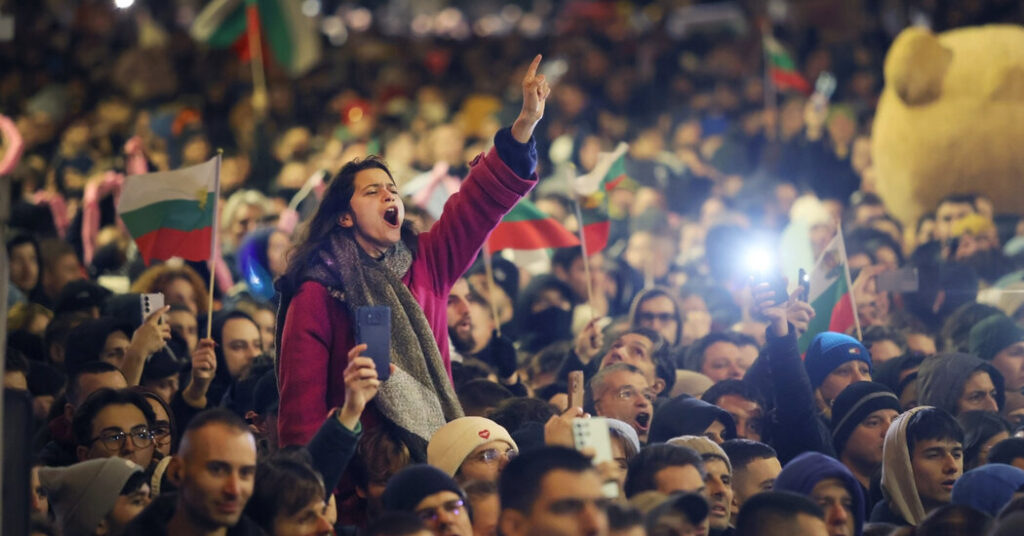
Families were taking selfies over the weekend beside a giant pink polystyrene pig on the street in front of the National Assembly, a leftover from the enormous protests last week that filled the main square and adjoining avenues and toppled the government.
“This is the Bulgarian politician who is stealing from Bulgaria,” said Emily Yordanova, 24, after making a video of herself in front of the pig that she said she would post on social media. “We want a better life, better work and better politicians.”
Bulgaria has had its share of popular demonstrations since the fall of communism in the early 1990s and has seen multiple governments come and go amid corruption allegations, but residents in the capital, Sofia, and around the country said that this time the outrage had boiled over.
The trigger was a budget that raised taxes and lifted the salaries of members of the state security apparatus. Many saw the move as taking money from ordinary people in a power grab. That threat struck a deep chord with Bulgarians yearning for a more prosperous life like that enjoyed by other Europeans.
Anger over the budget brought out a cross section of society, including employers’ associations and trade unions, teachers, students and Bulgaria’s ethnic minorities. But the size of the protests surprised even the organizers, opposition leaders said. On three occasions in just three weeks, the size of the demonstrations reached tens of thousands of people and spread to towns and cities around the country.
As the protests took off, the demands grew, with calls for the government to resign and even for two of the most powerful politicians behind the government to go.
The opposition coalition, We Continue the Change — Democratic Bulgaria, is now focused on building on the momentum of the protests to secure a majority, or enough to form a government, in elections expected in March, said Assen Vassilev, co-founder of the We Continue the Change party.
“It’s up to the people,” he said in an interview over the weekend. “We do not take it for granted.”
The coalition’s aims are ambitious. It wants fresh elections and to break what it sees as the stranglehold of corruption of the main power brokers.
That means forcing out not only the leader of the party that led the government until Thursday, Boyko Borissov, but also the man they hold responsible for much of the corruption, a former media mogul turned politician, Delyan Peevski.
The first move, Mr. Vassilev said, would be to pass a motion to remove the two men’s security detail, to which neither was technically entitled.
Mr. Peevski, the leader of a political party that ostensibly represents the interests of the Turkish minority, was targeted by U.S. sanctions in 2021 but remains an active member of Parliament and is believed by many Bulgarians to wield control over the coalition government that resigned.
According to the U.S. Treasury, Mr. Peevski “has regularly engaged in corruption, using influence peddling and bribes to protect himself from public scrutiny and exert control over key institutions.”
Bozhidar Bozhanov, co-founder of Yes Bulgaria, another party in the opposition coalition, blamed Mr. Peevski for Bulgaria’s yearslong political crisis.
“He has amassed and centralized all the means that the old secret service state apparatus in the communist times had used,” Mr. Bozhanov said.
According to Mr. Bozhanov, Mr. Peevski had acquired compromising files on officials and politicians, collected by secret surveillance. Mr. Bozhanov said that Mr. Peevski had threatened exposure of that information to force officials to carry out his orders and had used prosecutions to pressure members of the opposition.
Many members of the opposition have been indicted, including a city mayor and several other local officials, on charges that those accused have said were trumped up, Mr. Bozhanov added. Mr. Bozhanov himself was due in court on the day of one of the protests, indicted on a charge of divulging classified files, an allegation that he denied.
In October, Mr. Peevski’s party unexpectedly dominated local council elections in the town of Pazardzhik, southern Bulgaria. According to Mr. Vassilev, “What we are seeing is a not-so-subtle move toward autocracy and dictatorship of the hard kind.” Referring to Mr. Peevski, Mr. Vassilev added, “He decided now was the time to go for full control.”
Mr. Peevski’s party did not respond to requests for comment.
Mr. Peevski has dismissed allegations of corruption and accused his opponents of being funded by the financier and philanthropist, George Soros. Mr. Soros has supported projects to develop democracy across Eastern Europe and is often derided by opponents of liberal politics.
Mr. Borissov, leader of GERB, the party that headed the departing government, defended its performance in office in televised comments in the Parliament building after the resignation and accused previous administrations of financial abuses.
Bulgaria was ranked one of the more corrupt countries in Europe by Transparency International in 2024, and there are many in the country who say they are skeptical that things will improve.
The coalition for change has twice been in government but each time lost power when partners withdrew their support and struggled to regain popularity. In the most recent elections in 2024, the coalition lost to GERB but disputed the results.
Mr. Vassilev said that in recent months Mr. Peevski had overreached as he exerted more pressure on his opponents.
When the budget came out two months ago with its extravagant tax-and-spend proposals, the Change party commissioned the pig as an art installation, Mr. Vassilev said. It was originally intended as a piggy bank to remind people of where their money was going. But then the installation took on a life of its own.
The rest was improvisation, he said.
Pink pig stickers appeared on the cobbles of Sofia’s streets inviting protesters to scan a QR code to join the protests and sign a petition calling for the government to resign.
“Don’t feed the pig,” the petition read. “We continue the Change.”
At the protests, the politicians let younger protesters lead. One of the more fiery speakers at the largest protest, on Dec. 10, was Marin Tihomirov, 37, a leader of the Roma minority in Sofia who had opposed the local authorities over the demolition of a Roma settlement in the capital.
Onstage, he railed against a system under which, he said, politicians had paid the Roma to vote for their party but then never followed through on their election promises.
“For 30 years, I watched how Borissov and Peevski bought my parents like tomatoes in the market, and I thought this was normal,” he told the crowd, which roared back in recognition. “They are keeping the Roma community poor so they can buy them off. So I say, ‘Resign. Resign. Resign.’”
After replaying a video of that speech, he said in an interview this past weekend, “What the mafia did was unite the people against them.”
Martin Bakardzhiev, 39, a visual artist, said that the mood was different from demonstrations in years past. “For the first time, I sensed there was a bit of anger,” he said.
“It feels like these people are nested in everything, and there is not a line they cannot cross,” he said of the power brokers. “And what will they do next? That is a reason to be angry and scared and distrustful.”
Carlotta Gall is a senior correspondent, covering the war in Ukraine.
The post ‘Don’t Feed the Pig’: The Anti-Corruption Call That Helped Topple a Government appeared first on New York Times.