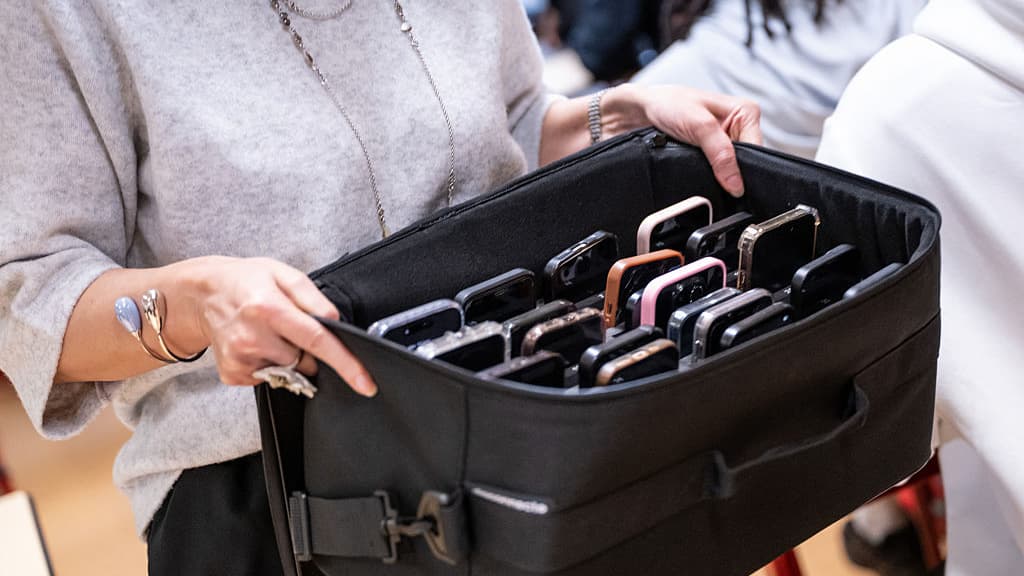
School phone bans were associated with a small but statistically significant improvement in a combined measure of math and reading achievement growth, a new report found. But the literature on the effectiveness of bans is limited, and the question remains whether modest academic improvements are worth the cost and labor involved in enforcing them.
Harvard University researchers analyzed standardized test scores and found that students in schools with phone bans made slightly greater gains—about 0.01 standard deviations per year, which researchers estimate is equivalent to one to two additional weeks of learning.
The study, released Tuesday, analyzed data from approximately 3.3 million students across 4,600 schools—including schools using Yondr pouches and comparison schools—from 2021–22 through 2025–26.
Researchers concluded that performance gains associated with phone bans could potentially offset some of the annual academic decline students have experienced since smartphones became commonplace.
“There’s been a gradual decline in student achievement, not just in the U.S. but in a number of Western European countries, as well as Canada, since around 2013,” Tom Kane, the faculty director of the Center for Education Policy Research at Harvard University, and a lead researcher on the new study, tells TIME. “Surprisingly, we actually haven’t had much research on drawing that connection until now.”
Kane says that smartphones are akin to “a leak” in the education system, and that schoolwide bans are one of the most cost-effective ways to “plug” the leak. “It would cost a lot more money [to] pay a teacher for another week of work,” he points out.
Read more: Young People Don’t Need Another Lecture About Phones
Kane says that the one to two weeks gained back by phone bans can help make up for a “significant share” of the decline in student achievement—and he believes that the benefits are likely to be cumulative, increasingly improving student outcomes the longer they are enforced. Researchers observed that the decline in performance happened gradually, year over year, and they therefore believe that its countereffects will behave the same way.
The study found not just a “modest yet steady positive impact” on student achievement when phone bans are enacted, but a “consistent” effect across elementary, middle, and high school ages.
School phone ban advocates like Kim Whitman, a co-founder of Distraction Free Schools Policy Project, believe the burden of enforcement should shift from individual teachers to school-wide policy and state-level legislation. She tells TIME that the Harvard study validates this approach.
“I’m thrilled to see there is now evidence of academic improvements for the bell-to-bell bans,” Whitman says. From the perspective of a mother, she adds that she has seen how “phones displace the multitude of experiences children need to have in childhood to transition successfully into adulthood.”
“Schools should be a sanctuary where kids can learn, free from the constant pressures of phones and social media, and should also provide an environment where they can develop independent self-discipline and the executive functioning skills needed to thrive as an adult,” Whitman says.
Creating a phone-free school does not necessarily require Yondr pouches. Some schools collect phones in centralized bins; others require students to leave them in lockers. Researchers believe other approaches could produce similar effects if strictly enforced.
At least 40 states and Washington, D.C., require school districts to ban or restrict student cellphone use, according to Education Week. But that widespread adoption has outpaced research into whether the bans work—and recent large-scale studies have produced differing estimates of their academic benefits.
Do school phone bans improve learning?
A national study first released through NBER in April found that lockable phone pouches reduced student phone use but had little effect on average test scores over the first three years after adoption. Researchers also found little evidence of improvements in attendance or students’ perceptions of online bullying. The study combined Yondr purchasing records covering approximately 4,600 public schools with test scores, administrative data, and surveys.
Researchers from both studies say their estimates are broadly compatible, despite differences in methods and interpretation.
The NBER study did find statistically significant improvements in high school math scores, Kane points out—which aligns with his report’s takeaways. But because Harvard University was looking at larger data sets, he says, his team was able to detect smaller changes more precisely.
Thomas Dee, a lead researcher for the NBER study, agrees that “there’s a surprising degree of harmony across these two studies.” Both research teams reported very small annual changes, he says, but they interpreted them differently.
The Harvard study takes the incremental increase in learning outcomes and interprets it as “evidence of students gaining some learning in a small way,” Dee says. “We may find that they are right, but I’m not comfortable with that extrapolation with the data we have.”
Dee and Kane also agree that there is not nearly enough research on how social media use—both on and off school grounds—is impacting student achievement.
“We still don’t know how much of the decline of learning is due to out-of-school use of social media,” Kane admits. “One hypothesis is about the aggregate amount of time kids are spending, deadening their attention spans; another is that it’s late-night use causing sleep deprivation.”
Whitman argues that campus-wide bans are still instrumental in shaping out-of-school phone use—and could enhance any established benefits. “The schools are loud messengers, so what they allow in school helps parents determine what they should allow in their homes,” she says.
Dee says more research is needed to understand which policies will improve student learning over time as technology evolves. The information could help inform further policymaking. Until then, he believes that individual schools will be best at determining which phone ban techniques will be most effective for their learning communities.
“If I were to advise schools, I would encourage them to adopt a phone ban, enforce it really well, and work for yourself really to see if it’s working,” he says.
What are the concerns about school phone bans?
Even among those who support classroom restrictions, questions remain about emergency access, implementation costs, and how far bans should extend.
School safety and emergency access
Some parents argue that phones are essential lifelines for safety, expressing the desire to be able to reach their child, and vice versa, in the event of an emergency at the school.
One study from the Pew Research Center in 2024 found that while most adults approved of phone bans during class, fewer felt it was necessary to have all-day bans. Among opponents of classroom bans, 6 in 10 cited parents’ ability to reach their children as a major reason for their opposition.
That same year, a National Parents Union survey found that 78% of parents whose children took cellphones to school cited emergency access as a reason for doing so.
An October study from Hopelab and Data for Progress, drawing on responses from 487 high school students, found that 64% supported classroom bans, while 80% opposed all-day restrictions.
Amanda Riccitelli, a middle school teacher in Kingston, New York, tells TIME that parents initially pushed back when the idea for Yondr pouches was introduced. The solution was to address their concerns head-on and provide alternative suggestions for being in touch during an emergency.
“We told parents that they could message their children on [Microsoft] Teams,” she says. The district also reassured parents that students could use the landline phones in the classrooms or the front office to call their families if and when necessary.
Cost and budget pressures
Opponents have also pointed out the costs involved with implementing statewide bans. New York City allocated $16 million to public schools to help implement the statewide cellphone and internet-enabled device ban. In Los Angeles, the school district spent more than $6 million on phone-ban implementation products, including $5.42 million on Yondr products.
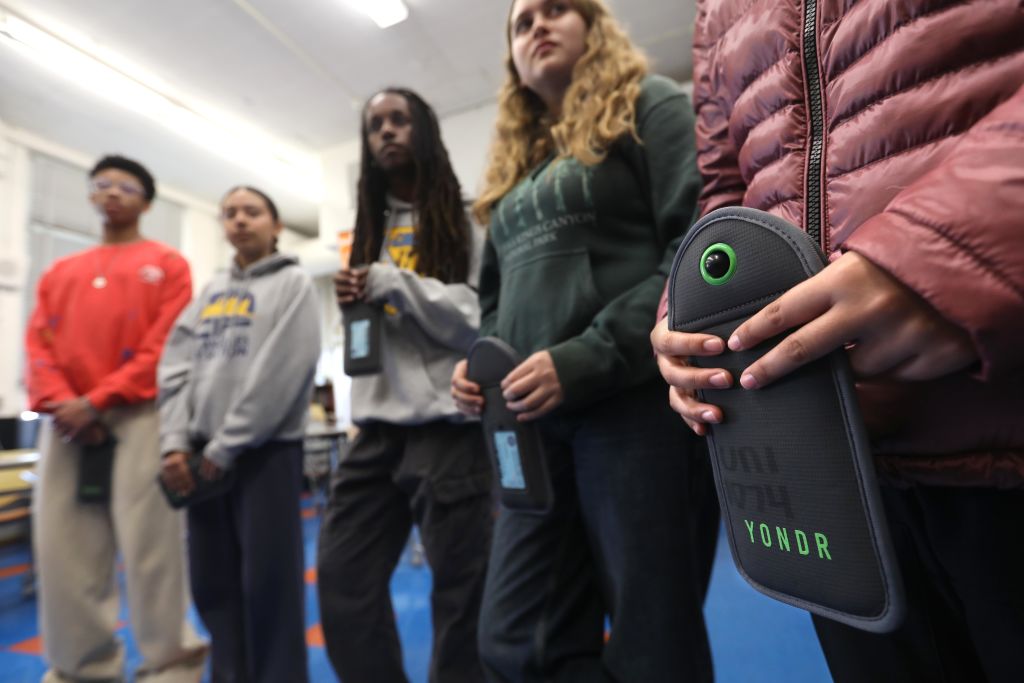
Magnetically sealed phone pouches, like those made by Yondr, are among the most popular phone ban implementation methods because students can keep the pouches with them during the day. This means that administrators and teachers do not need to confiscate the devices or bear responsibility for them during the day. Students typically place their phones in assigned pouches and lock them under staff supervision, then unlock them at designated stations when leaving school. But at approximately $25 per student, according to Harvard’s estimate, purchasing them can represent a substantial expense.
Those costs come as districts face mounting financial pressures: A nationally representative survey by RAND and the Center on Reinventing Public Education found that 54% of district leaders ranked budget shortfalls among their three most pressing challenges in spring 2026, up from 33% in 2025.
What teachers say about enforcing school phone bans
Educators seem to broadly support school phone bans, according to an EdWeek Research Center survey conducted in February and March. It surveyed 79 district leaders, 122 school leaders, and 395 teachers across the U.S. and found that about 7 in 10 respondents said cellphone restrictions improved classroom behavior and student engagement, while smaller shares reported benefits for learning and well-being.
But support for a ban does not guarantee it will be enforced consistently—a challenge Kane, Dee, and Whitman say is central to whether the policies succeed.
“I believe enforcement is key, and that has been a struggle for many districts,” Whitman says. She points out that research concerning specific policies and outcomes may be limited by a lack of data surrounding enforcement methods.
Certain Florida schools, for example, require students to keep their phones out of sight during the school day, but they do not physically prohibit access. Teachers, then, are tasked with monitoring students throughout the day and doling out consequences when the guidelines are not being followed.
“Phone-free policies, when they include inaccessible storage, actually lessens the pressure on teachers and transitions that responsibility to administrators,” Whitman says.
An October 2025 NBER study of a large Florida school district found an initial increase in suspensions, followed by improved test scores in the second year.
The findings were replicated in the broader NBER study from April, which observed an increase in disciplinary actions during the first year of cellphone bans corresponding to roughly a 15% increase in suspension rates. Those disciplinary actions fade in subsequent years, however, the study noted.
“It might be that students interact with disciplinary incidents at schools as teachers try to enforce the bans,” Dee hypothesizes. “It could also be that students who scrolled during class before the bans no longer have that option [and get into trouble during that time instead].”
New Jersey is among a handful of states whose school phone bans went into effect for the first time during the 2026-27 school year. Danielle Schoeck, a secondary school teacher in Jersey City, says that the move has received support from both teachers and students.
“I think students understand that it’s for their best interest—I haven’t heard them complain,” she says, adding: “I have noticed that their attention during instruction has improved.”
But each school district implements the statewide ban differently, and according to their own criteria, she says, meaning that it’s “not enforced in a consistent way.”
“Last year my school had Yondr pouches, but the students were allowed to hold them in their hands, which was about as useless as it gets,” Schoeck says, since the students could find ways to bypass or break open pouches. “My daughter’s school, down the street, has students put their phones in a bin that is locked in the office during the school day, costing them zero dollars, and [it] is more effective.”
Riccitelli describes similar difficulties maintaining an effective ban at her school, now in its third year of using Yondr. While she says she hasn’t seen any significant change in student achievement, she argues that the pouches are important for student safety.
“Our district adopted Yondr bags because we were having a lot of students recording inappropriate things—like fights in the hallways,” she says. “We were seeing they were using the cellphones for bullying and harassment.”
The Yondr pouches, which are kept with the students, at first helped to reduce some of those issues, she says.
By the third year of her school’s phone ban, however, Riccitelli says there was an uptick in problematic circumvention; students were using smartwatches to access apps or claiming that they did not bring a phone with them to school.
“We can’t shake down thousands of kids and enforce the rules on everyone,” she says, noting that students are starting to realize this, too. Her school district leaders and faculty members are now having meetings to decide whether the bans are still working—or worthwhile.
The post School Phone Bans Show Small Learning Gains. Are They Worth It? appeared first on TIME.