If you’re planning to travel to Mars, remember to leave your emojis behind. Martian astronauts, like International Space Station (ISS) astronauts, will have unlimited access to email exchanges with their families at home—and in low-Earth orbit just 250 miles high where the ISS sits, those communications are virtually instantaneous. Not so on Mars, which, depending on its position in its orbit, is between 34 million miles and 250 million miles away. That means a one-way transmission takes up to 23 minutes to land in its recipient’s mailbox. Add a relatively data-intensive emoji to that and you are packing a four megabyte file along for the trip, slowing things down further still.
“That will mean a[n extra] four-minute delay just because I sent a thumbs-up,” says Ross Elder, commander of a year-long simulation NASA recently completed in a sophisticated prototype of a Martian habitat housed in a hangar on the grounds of the Johnson Space Center in Houston. The program, dubbed Crew Health and Performance Exploration Analog (CHAPEA), saw Elder and his team of three others enduring a 378-day stretch, from Oct. 19, 2025, to Oct. 31, 2026, in a 1,700 sq.-ft. enclosure that includes four private sleeping quarters, two bathrooms, a science experiment area, an exercise corner—complete with a stationary bike and rowing machine—a living room with a TV, and a galley kitchen and food-prep area.
The purpose of the mission was to match the duration and workload of a relatively short Mars journey as closely as possible. When trips to the Red Planet actually begin, astronauts will first fly a six-month outbound route, with a brief month or two on the surface, followed by a six-month return. Longer missions and ultimately a Mars base will follow. A target date for that exploration campaign has not yet been established.
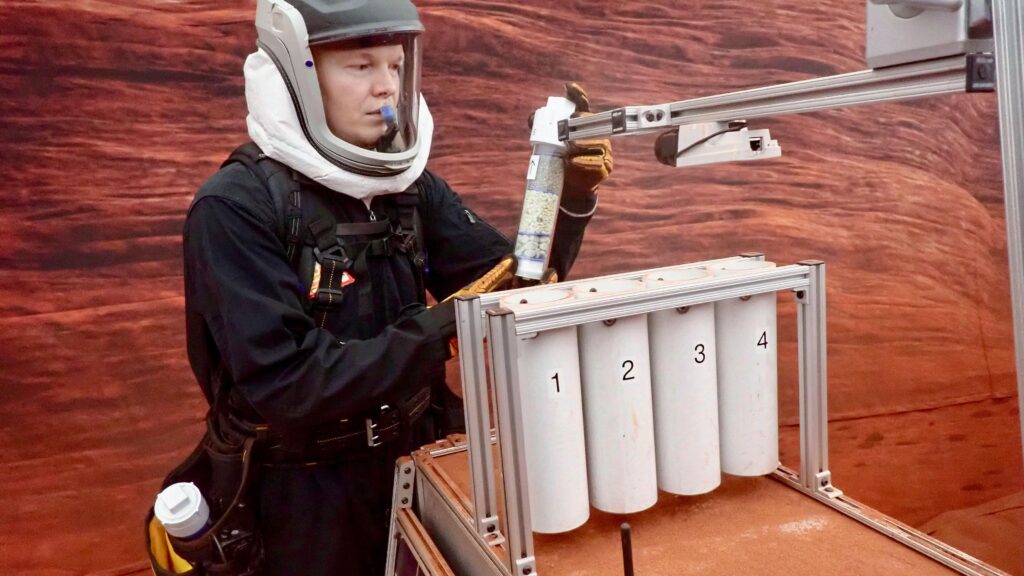
To prepare for that eventual work, CHAPEA’S so-called analog astronauts spent their time running mental and physical tests on themselves, studying water conservation and recycling protocols, analyzing DNA in microbial communities, researching combustion and materials science, and growing crops in a dedicated indoor nursery. They also ventured out on simulated, spacesuited Mars walks, exiting through a mock airlock and exploring what was nicknamed the “sandbox” outside their quarters—1,200 sq. ft. of red soil with a diorama of the Martian landscape on the walls. They also went on longer, virtual reality excursions, walking on a treadmill while wearing VR headsets. And that communications delay was real—with messages the crew sent out taking up to 23 minutes before they appeared in “mission control” or family members’ computers and the responses taking another 23 minutes to reach the astronauts.
“You really need to be clear and concise and get the message across,” says Elder, “to minimize as much as possible the number of round trips.”
The data the crew will provide to teams planning future, actual missions to Mars will be invaluable. “We looked at a lot of science around [Mars walk] performance, exercise science, exercise performance, cognitive load and cognitive performance, as well as a lot of physiological measures, like blood work and and other types of biomedical data points,” says Sara Whiting, the CHAPEA project scientist, who was not part of the crew.
The analog astronauts’ days were kept fully scheduled with experiments, maintenance, and trips to the sandbox, and controllers made things busier still, tossing in occasional alerts about simulated breakdowns or emergencies, known benignly as “injects.”
“They’re part of the things that CHAPEA is trying to figure out in terms of equipment failures,” says Whiting. “Some of them are injects and some of them are real.”
Life aboard the habitat was by no means all hardship. The crew brought board games with them and had a DVR-type system crammed with favorite movies. “I am a huge fan of movies,” says Elder, so I had a very large collection. You name it, I probably had it. I think most of my allotment for the digital data side of the house was movies, so I brought them all.”
The sleeping quarters were comfortable and private, measuring 60-sq. ft. with a twin bed, a desk and chair, storage space, and adjustable lighting. The showers were hot and real—a luxury space station astronauts don’t have, relying on wet wipes and dry shampoo. But the showers were, also, necessarily brief, as the crew had to be conscious of conserving water, soap, and shampoo as they would on Mars. The food was passable—not unlike what’s on the space station menu, which is itself similar to military-style meals-ready-to-eat (MREs), thermostabilized and rehydratable rations that come in a variety of entrees, sides, and desserts. But the CHAPEA crew also supplemented that preserved fare with fresh vegetables grown onsite. (On a real mission, oxygen for the crew and carbon dioxide for the plants will be both carried aboard and then harvested from the planet’s CO2 atmosphere.)
“We had things like tomatoes, peppers—whether they were spicy or sweet—lots of leafy greens and different lettuces, and tons of different herbs,” says Elder. “We had mint and basil, so just different options to add to the food that we already had.”
The crew was made up of three men and one woman. Elder, an Air Force test pilot, as well as Ellen Ellis, a U.S. Space Force officer; James Spicer, a technical director in the aerospace industry and an FAA instrument-rated commercial airplane pilot; and electrical engineer Matthew Montgomery. When four people are confined to a small space for more than a year, personality differences are all-but certain to occur, but Elder sidesteps that question, pointing to a program the crew attended at the National Outdoor Leadership School to build camaraderie and interpersonal skills.
“All of the crew members got to learn everything about each other in a setting that was very comparable to the challenges that we would face inside of the habitat,” he says. “So we got additional reps before going in to better understand each other, to better understand the mission that we were getting ourselves into.”
While the real Mars will present multitudinous dangers to real crews, the CHAPEA team was not without risks, most involving physical health. None of the crew members was a doctor, nurse, or other caregiver before coming in, but Ellis was designated and trained as the medical officer, adept at using medical equipment and making basic diagnoses. Had there been a real health emergency, the mission would not necessarily have come to an end. Depending on the severity of the illness and other considerations such as whether it was contagious and may have infected the rest of the crew, removing just the sick member might have been an option.
“Some of it is kind of on the fly,” says Elder, “having to think about what are the dangers in this situation. But there are definitely plans in place before we start any of these missions to protect the health and safety of the crew members. First and foremost is ‘do no harm’.”
Now, out in the world and back with their families, the CHAPEA crew is restless for another cosmic journey—this one for real. NASA recently opened its books to new astronaut candidates, with the application period running from Nov. 7 to Dec. 3. The announcement of the winners will be made next fall. All four CHAPEA crewmembers are working on their applications and all mean to make that final cut.
“We’ve joked that you’ve got four crewmembers already who are ready to make the trip,” says Elder. “So it’s an easy selection.”
The post Astronauts Just Finished a Year-Long Mars Habitat Simulation. Here’s What It Was Like appeared first on TIME.