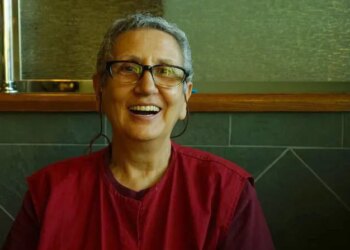
The Spanish curator and museum director Elvira Dyangani Ose has given a lot of thought to the meaning of home. “The question I keep returning to in my work is what brings people together,” she said in an email interview, “and home is the most intimate, complex version of that question.”
That question has been central to her role as artistic director of the Public Art Abu Dhabi Biennial, a collection of 22 contemporary art installations — 20 of which are new commissions — across the emirate that is presented this year under the theme “Home: A Glossary for a Communal Sense of Place.” The biennial, which takes place in Al Ain and Abu Dhabi, is free to visit and the works will be on view through Feb. 15.
It opened last month in Al Ain, a UNESCO-listed oasis city about an hour and a half from the capital of the United Arab Emirates. In a country known for its oil-driven economy and for building modern megacities in the desert, Al Ain, which bears evidence of thousands of years of human history, offers a counternarrative.
The works Dyangani Ose commissioned for exhibition in Al Ain echo that history.
In the Al Qattara Oasis, one of several oases that makes up Al Ain, the Spanish artist Asunción Molinos Gordo created “Bil Hana wa Al Afia” (2026), a series of rammed-earth walls that trace the channels of the ancient irrigation system which allowed the area’s palm groves to flourish.
In the work “Thresholds: Requiem (The Last Call)” (2026), Reena Saini Kallat, an artist from India, installed large hornlike acoustic locaters through which visitors can hear the calls of extinct or threatened birds, including those native to the Persian Gulf, like the Socotra cormorant.
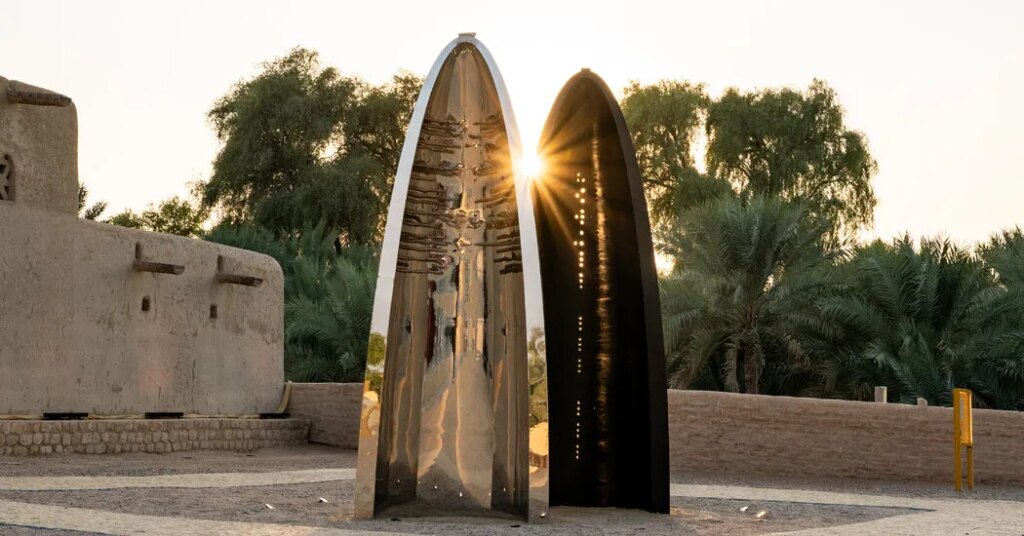
And in “I am not the stone thrown into the water, but the seed sown in the field” (2026) the Moroccan artist M’barek Bouhchichi reimagined the pigeon tower, a structure common to North Africa and the Middle East, in stainless steel, perforating the surface to reveal a poem recited by Emirati seafarers that can be read in Braille.
Each of the works, Dyangani Ose said, explores a theme that relates to Al Ain: irrigation, extinction and refuge. “Each one listens” to the site in the Al Qattara Oasis, she said, adding that she, too, had learned to consider what was no longer present.
“The water that once ran through a channel, the birds that no longer pass overhead, the boats that have left the yard,” she said. “Several of the commissions grew out of those absences.”
The fourth work exhibited in Al Ain was conceived by an artist from the city, an inclusion in the biennial’s program that Dyangani Ose described as essential. “Without it, the biennial would be a visiting exhibition rather than something that belongs to the emirate,” she said.
“Tassa,” which is an 80-meter (260-foot) sculpture installed in the center of a roundabout close to where the artist Roudhah Al Mazrouei went to school, was inspired by a traditional gold Emirati headpiece she found in her family’s collection. It was a work Al Mazrouei had envisioned years before, Dyangani Ose said, adding that “the biennial gave her the means to make it at that scale, and the theme gave it a context.”
In Abu Dhabi, where the biennial opened on Sunday, Dyangani Ose had more future-focused considerations.
“Abu Dhabi was changing rapidly as we conceived and developed the project,” she said. “To work there, you need to know the city’s earlier lives, but also what it is becoming, with the new institutions on Saadiyat,” she said, referring to museums — notably the Louvre Abu Dhabi and the Guggenheim Abu Dhabi — that have opened or are soon to open on Saadiyat Island.
The development of the island into a dedicated cultural district, a cornerstone of the nation’s efforts to diversify its economy and position itself as a destination for cultural tourism, has drawn criticism as well as fanfare.
Yasser Elsheshtawy, an adjunct professor at Columbia University’s Graduate School of Architecture, Planning and Preservation, described Saadiyat as “essentially a cultural enclave, physically and socially detached from the everyday life of the city.” He argued that it would have been more meaningful to have integrated the institutions into the existing urban fabric of Abu Dhabi. “Culture, after all, should not be confined to spectacular buildings or exclusive destinations, but should be accessible to the wider population and embedded in the life of the city,” he said.
The city has presented the biennial as an answer to that issue. “We hope residents and visitors come to see the city differently, through the works themselves and through the places they inhabit,” said Reem Fadda, the culture programming department director at the Department of Culture and Tourism for Abu Dhabi.
The public nature of the biennial, which is showing some works on Saadiyat Island as well as in other locations across the city — including the MiZa neighborhood and the Souq Al Mina in the Mina Zayed port area — serves to open it to a broader audience.
“These artworks sit in people’s everyday places. They meet people where they live, and in the spaces they move through,” Dyangani Ose said. “People come across a work on their way to the fish market, when meeting with friends and family to dine outside or to pick up their children from school.”
She hoped, she said, to create a communal sense of place in a city where it was still possible to ask what public space might mean to future residents.
“In Abu Dhabi, people who arrived last year and families who have been here for generations share its streets, its coastline, its daily rhythms, without sharing the same histories, the same rights or the same relationship to the land,” Dyangani Ose continued. “I wanted the biennial to make room for both.”
The post Finding a Sense of Place Through Public Art in Abu Dhabi appeared first on New York Times.