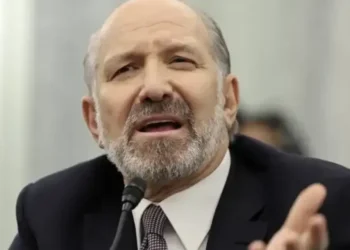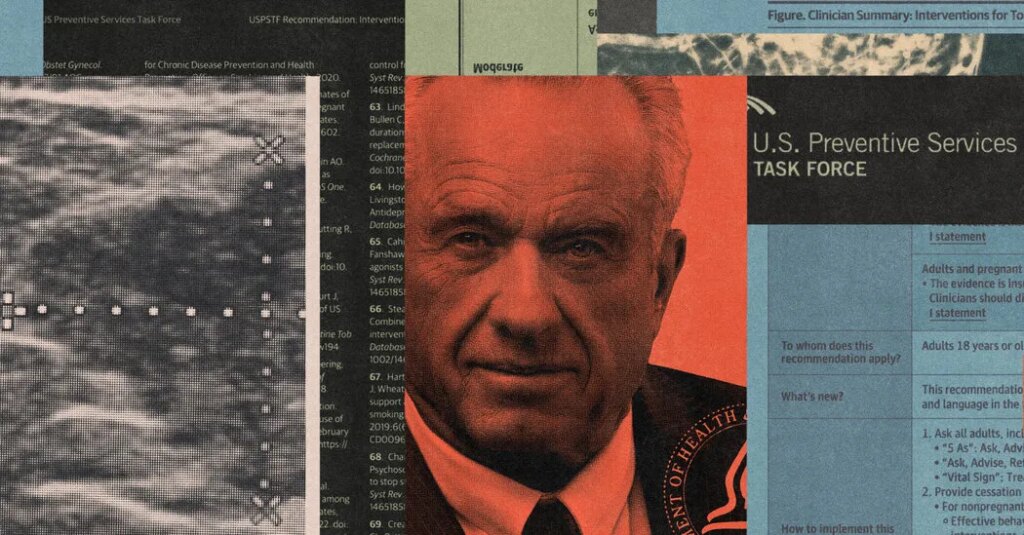
Dr. Roger D. Klein wanted to know why artificial intelligence couldn’t guide Americans’ medical screenings.
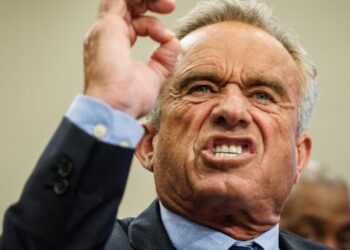
It was early 2026, and Health Secretary Robert F. Kennedy Jr. hadn’t let the 16-member United States Preventive Services Task Force meet in almost a year. Its recommendations, which inform everything from mammograms to prostate cancer screening for 340 million Americans, had ground to a halt.
Now Dr. Klein — a molecular pathologist and lawyer appointed by the Trump administration to lead the task force’s parent agency, the Agency for Healthcare Research and Quality — was suggesting jettisoning the research centers that systematically reviewed the evidence on which the task force based its decisions.
His assistant could do that with A.I., he said, according to two officials who heard him, including Tess Miller, then the agency’s acting scientific director for the task force.
The task force, normally composed of experts in primary care and research, was established in 1984 to evaluate preventive services: tools to prevent or diagnose disease early in asymptomatic people. Its work isn’t visible to most Americans, but its influence is vast; clinicians follow it, and most insurers must cover what it recommends. When people receive a colonoscopy at no cost, it’s because of the task force. When doctors screen for hypertension during pregnancy or offer medication to help a smoker quit, task force guidance informs them.
The task force typically meets in person three times a year and can publish around a dozen recommendations. But for nearly a year and a half, it has been unable to make any new recommendations or update existing ones. Guidelines on at least 18 topics, including cardiovascular disease, H.I.V. screening, food allergies and more, have stalled, leaving clinicians and patients without up-to-date information.
Fifteen former task force members and agency employees, some of whom spoke on the condition that they not be named to avoid retaliation, described dysfunction and political interference, particularly after a June 2025 Supreme Court ruling gave Mr. Kennedy more control over the panel. Courtney Spencer, a spokeswoman for the Department of Health and Human Services, said work had been suspended until the department “understood how best to move forward” in response to the ruling.
A former agency employee recalled telling a medical journal repeatedly to delay publication of a recommendation on cervical cancer screening, because political appointees weren’t signing off despite repeated requests. Former members and employees described how, in a departure from the task force’s decades of scientific independence, Dr. Klein called for changes to drafts, including cutting references to race. On one occasion, two said, he described evidence-based medicine as “socialized medicine.”
After preventing the task force from meeting in person since March 2025, Mr. Kennedy revived it this September by appointing eight new members. All 16 are scheduled to convene on Thursday.
But the panel and the agency that supports it are profoundly changed, and public health experts fear the lost time will reverberate.
“No one will be able to point to a single moment or a single unique decision and say, ‘That’s when it went wrong,’” said Karina Davidson, a former chair of the task force. “It’s going to show up years from now in our public health surveillance, in later-stage diagnoses, in missed interventions, in preventable deaths that didn’t have to happen. And by then, it will be too late to undo.”
Grinding to a Halt
The first signs of conflict came almost immediately after Mr. Trump’s second inauguration, when he issued executive orders targeting diversity, equity and inclusion and transgender rights, and some federal agencies forbade or discouraged phrases like “transgender,” “Black” and “men who have sex with men” — language important for describing how medical findings and risk differ among groups.
Task force members began to discuss whether they could achieve the same public-health goals with different words, and revised a recommendation on intimate partner violence.
But the turning point, former members and agency employees said, was in June 2025, when the Supreme Court affirmed that Mr. Kennedy could replace task force members before their terms ended and overrule recommendations.
The administration interpreted its new authority broadly.
Agency employees were told that a political appointee had to approve all public task force actions, including posting documents for public comment and publishing recommendations, said Dr. Justin Mills, who was a medical officer supporting the task force; Dr. Miller; and several other former employees.
Research plans, drafts and final recommendations all had to be reviewed, they said — and the reviewers never signed off.
The task force met in March 2025 and issued five recommendations in the first half of that year, with the last one published in June. It hasn’t met or published guidelines since.
Interference From a Political Appointee
Dr. Klein, appointed in June 2025, didn’t reply to task force leaders’ emails and rarely responded to agency employees, even as they pressed him to clear the growing backlog of documents and actions needing approval, said Dr. Michael Silverstein, then the task force’s chair; Dr. Miller; and several others.
But occasionally, Dr. Klein broke his silence.
He called a draft recommendation on preventing alcohol abuse “worthless,” Dr. Miller said, and asked for removal of mentions of race from other documents, Dr. Mills and another employee recalled.
In a response to a draft about risk assessment for cancers related to BRCA genes, which Dr. Silverstein shared with The New York Times, Dr. Klein disputed the task force’s conclusions. Among other things, he seemed to conflate genetic testing guidelines for people with breast cancer and without it.
He also challenged pieces of the task force’s methodology, in comments that Dr. Silverstein said showed “no understanding of how the task force assesses both the benefits and the harms of preventive services.”
Ms. Spencer, the H.H.S. spokeswoman, said Dr. Klein didn’t recall the alcohol conversation “as described” but had believed resources might be better spent on other topics. On race, she said he had wanted “precise descriptions of patient populations and the clinical relevance of the findings.” On BRCA-related cancers, she reiterated what Dr. Klein had written. She also said “secretarial oversight of task force recommendations predates this administration.”
But Dr. Silverstein, Dr. Mills and several other former task force members and agency employees said that before 2025, interference from political appointees was unheard-of. Oversight did not involve editing or objecting to conclusions, they said.
“There was a thick firewall, and a high premium was placed on the independence of the task force members,” said Dr. Elisabeth Kato, who worked at the agency for more than 15 years, including a stint as acting associate scientific director for the task force.
In July 2025, The Wall Street Journal reported that Mr. Kennedy might purge the task force, and an in-person meeting was canceled — the first of four consecutive cancellations.
With those developments, it “became very clear to us what it meant to conduct scientifically rigorous work under threat of being fired,” Dr. Silverstein said. “What if we found something in the data, or what if we interpreted the data in a way that made the administration angry?”
A Crumbling Support System
Task force members continued to meet virtually to review evidence and develop recommendations. They wrote their annual report to Congress, said Dr. Silverstein and Dr. Esa Davis, who was a vice chair, outlining topics that could use more research funding; this edition was focused on women’s and children’s health.
But they couldn’t vote, publish anything or send the report without in-person meetings or approval. Among the stalled items were the guidelines on cervical cancer screening, endorsing a new self-collection option; another agency later released similar guidance, but the task force still hasn’t.
“We had to keep saying, ‘Maybe now, maybe now, maybe now,’” said Dr. Miller, who was in touch with the journal’s editors. “We moved it I don’t know how many times.”
There was growing anguish, members said, at being unable to publish information with concrete implications for people’s health.
“It was clearer and clearer that we weren’t going to be able to get the work done at some point,” said Dr. David Chelmow, a former member. “There was going to be a tipping point.”
The agency supporting the task force lost employees as Elon Musk’s DOGE sliced through the government, and more as dysfunction led people to resign in frustration. The task force division’s medical officers, who had reviewed evidence, sifted through public comments, written drafts of recommendations and more, are all gone.
John M. Ruiz, a former member, and several others said the panel, whose members are part-time volunteers, couldn’t function without them.
By late March 2026, the panel had gone from 16 members to 10 as terms expired and no appointments were made.
In May, the two remaining leaders — Dr. John Wong and Dr. Davis — were invited to meet with Dr. Klein for the first time. They thought it was finally a chance to discuss the task force’s needs.
Instead, they found Dr. Klein with an H.H.S. lawyer, who fired them.
An Unusual Selection Process
Normally, the scientific director for the task force — a nonpolitical employee at the parent agency — vetted applicants with the task force chairs, four people previously involved in selection said. The agency director made final calls but generally respected the scientific director’s and chairs’ judgments.
Now, Dr. Klein and other political appointees led the process.
A Federal Register notice said nomination and application materials would be publicly accessible, but agency officials denied access to a Times reporter. Through a lawsuit, The Times obtained the names of 247 nominees and 40 who received interviews.
Dr. Alex Krist, a former chair; Dr. Quyen Ngo-Metzger, a former scientific director; and Dr. Silverstein reviewed the list of interviewees for The Times and said it included some strong candidates, but that Mr. Kennedy’s appointees didn’t meet the usual standards of primary care and research expertise.
Most of them are specialists; only two are primary care experts, and they don’t have the level of experience with systematic research that was typical for past members. The new chair, Dr. Seth J. Corey, is a pediatric hematologist-oncologist whose publications show minimal experience with systematic evidence reviews.
“Hard to see how his expertise fits here at all,” Dr. Ngo-Metzger said.
Through the H.H.S. press office, Dr. Klein said the appointees “were chosen for expertise, experience and diversity of settings and geography.” He said Dr. Corey’s master’s degree in public health gave him “advanced formal education in evidence analysis and evaluation as well as epidemiology,” and that he had done extensive medical research and reviewed manuscripts for journals. (Dr. Corey did not respond to requests for comment.)
Several appointees also have broad financial conflicts that former leaders said would previously have been disqualifying.
While H.H.S. said it would have a process to require recusal from individual topics, it hasn’t been made public. New members are set to begin assessing topics Thursday.
Among those interviewed but rejected were Dr. Davis and Dr. Wong, whose termination letters from Mr. Kennedy had encouraged them to reapply for membership.
In Dr. Wong’s interview, he said, Dr. Klein pressed him to defend the concept of evidence-based medicine, describing it as “socialized medicine” to control costs. Dr. Mills, the former medical officer, was present and confirmed Dr. Wong’s description.
“Dr. Klein does not believe evidence-based medicine is socialized medicine,” Ms. Spencer said. “His point concerned how the rigid application of evidence-based medicine techniques, which are often biased against taking action, were early on embraced by socialized systems.”
Thursday’s meeting will provide the first indications of how the new panel will operate, under substantial scrutiny. Last week, seven former task force chairs urged congressional committees to subpoena Mr. Kennedy and Dr. Klein. Senator Angus King, a Maine independent aligned with Democrats, and Representative Maxine Dexter, an Oregon Democrat, have proposed legislation to codify some previous membership criteria, as well as the panel’s independence.
Another challenge looms.
Three members are scheduled to leave at the end of the year. Normally, replacements would be named months in advance. So far, none have been.
Dani Blum contributed reporting.
The post How Kennedy Upended a Group Guiding Health Care for All Americans appeared first on New York Times.