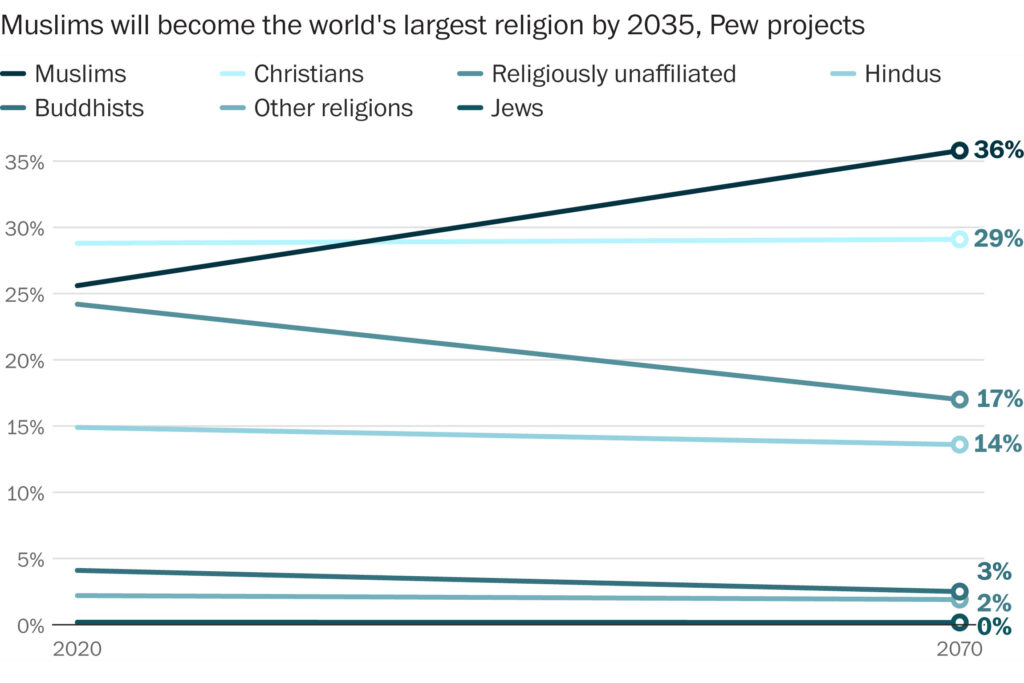
The number of Muslims worldwide is on the cusp of surpassing the number of Christians, and the Democratic Republic of Congo will eventually replace the United States as the most populous Christian nation. Those are among the projections from new research released Wednesday mapping out how shifting fertility, life expectancy and immigration patterns, among other factors, will reshape religious populations by 2070.
The Future of World Religions project, done by Pew Research Center and Poland’s Center for Advanced Studies of Population and Religion (CASPAR) forecasts that some parts of the world will change significantly between 2020 and 2070, while others will maintain the same denominational mix.
China’s population will decrease by an estimated 421 million, resulting in the world’s population of religiously unaffiliated people — who now mostly live in Asia — to plunge as a percentage of the planet. Because of fertility rates, the locus of the majority of the world’s Christians will shift from North America and Europe to sub-Saharan Africa.
“One misconception people might have is, if Muslims are the largest, it comes at the expense of Christians,” Conrad Hackett, a senior demographer at Pew who co-led the project, said of Muslims becoming the largest group, which will happen by 2035. “But 74 percent of Muslim population growth will happen in countries that are already Muslim-majority. And most Christian growth is in places where there are already Christian majorities.”
The math of demographics, Hackett said, can add up to facts that feel differently depending where you live.
For example, most countries will see an increase in religiously unaffiliated people — also called “Nones.” But because China’s population is so huge, the huge decrease in people there will shrink the overall “Nones” from 24.2 percent of the world’s population to 17, the report projects.
The percent of Muslims will continue to grow in the Asia-Pacific region, which extends from Turkey to the Philippines and is now home to 59 percent of Muslims. However, because of especially fast Muslim growth in sub-Saharan Africa, the Asia-Pacific no longer will be home to the majority. Nigeria’s Muslim population will double, to 282 million, due to its young average age and high fertility rates, the study projects.
The entire world population will grow by 29 percent between 2020 and 2070, Pew projects, compared with 80 percent for Muslims and 30 percent for Christians.
The number of Jews will grow from 15 million to 18 million, Pew projects, with the majority of the world’s Jews living in Israel. Today Israel has 6.8 million Jews, the U.S. has 5.7 million, and Europe has 1.3 million, according to the Berman Jewish DataBank.
The changes in the survey reflect long-predicted shifts.
Those include a growing Muslim population, due to their low average age in most places and high birth rates in many places. Muslims’ fertility rate is 3.1 children per woman compared with 2.0 for non-Muslims. In sub-Saharan Africa, Muslims’ fertility rate is 5.1.
All 53 countries and territories that were majority-Muslim in 2020 are projected to remain so, Pew’s report said. Muslims will make up 90 percent or more of the population in most of these places. In many other countries, Muslims are expected to remain a relatively small minority.
The shifts long underway include the move of the numerical center of global Christianity from the West to the Global South.
Mark Noll, a historian of Christianity, noted that the expression of Christianity in Africa, where the faith is most booming, is different from that of many American Christians in that it’s mostly charismatic.
“The supernatural elements in Christianity that were always present but modified and restricted in the West are anything but in most of the Christian world,” Noll said.
Christianity and Islam in Africa, he said, also are marked by competition because both faiths are so large.
In this report, the projected shifts in religious groups’ sizes derive from simple math. Pew did not try to forecast considerations such as whether religiosity will grow or shrink. Rather, the focus is on the fact that in the 21st century, most of the world’s population growth will happen in Africa, especially sub-Saharan Africa. And the vast majority of people in that region are Muslim or Christian.
Muslims and Christians are the only groups analyzed in the Pew project that are expected to keep pace with a global population rise of 29 percent between 2020 and 2070.
The global number of Hindus will grow by 199 million between 2020 and 2070, to a total of 1.4 billion. However, Hindu fertility rates have been dropping in recent decades, to 1.9 children per woman, compared with 2.3 in the population overall.
Migration patterns also are expected to affect Hindu populations, especially to North America, the Middle East and Europe. Hindus are projected to go from making up 0.9 percent of the United States in 2020 to 2.0 percent in 2070.
The report assumed current rates of religious “retention” or “switching,” Hackett said — people moving in and out of faith groups — rather than trying to delve into things such as secularization theory, which predicts that the nonreligious population will inevitably grow in the modern world. In other words, it didn’t take into account things like theology or evangelization.
The slipping of American Christians into the minority — from 64 percent today to a projected 48 percent in 2070 — will set up “complex” questions about whether U.S. democracy relies in some ways on the contributions of Christianity and Judaism, Noll said. American Christians, he said, will need to look to Christians in other parts of the world where they are minorities, or to the church’s early centuries, when they also were.
“There are resources in the world and from history to guide believers when they are no longer in control,” he said.
Todd Wallack contributed to this report.
The post Muslims to outnumber Christians worldwide by 2035, study finds appeared first on Washington Post.