The battle within the Democratic Party is usually framed as one between progressives and the establishment. There’s a fair bit of truth to that, but political analyst Nate Silver recently offered an assessment suggesting there’s another, more stylistic aspect to the division. Silver’s intriguing analysis does more than broaden understanding of the intra-Democratic divide: It also points to the central role that Black voters and leading candidates will play in resolving it.
Silver argues that Democrats are actually fighting on two dimensions: ideology and inclination. That second aspect distinguishes fighters (people who want to battle opponents, whether within the party or outside it) from uniters (those more inclined to find common ground with adversaries). A chart with his piece used those two categories to create four handy quadrants for visualizing the relative positions of 13 potential Democratic 2028 presidential contenders.
As you might expect, there’s some symmetry between ideology and temperament. Silver’s upper-left quadrant contains candidates who are progressive and fighters. The candidates land at different points in that square, but the ones found there are unsurprising. Rep. Alexandria Ocasio-Cortez (New York) is the most progressive potential contender, with fellow progressive firebrand Rep. Ro Khanna (California) right behind her. Others in this group include Govs. Gavin Newsom (California) and JB Pritzker (Illinois) and Sen. Jon Ossoff (Georgia).
The lower-right quadrant, meanwhile, contains figures more favored by the party establishment — politicians who are more moderate and more inclined to unite. Gov. Josh Shapiro (Pennsylvania) appears as both the most moderate and the strongest uniter, followed closely by Gov. Andy Beshear (Kentucky). Former transportation secretary Pete Buttigieg and Sen. Mark Kelly (Arizona) also land in this region.
To me, the most interesting quadrant is the lower left. This is the one that contains progressives who also are temperamentally uniters. Three potential candidates, all of them Black, fit here. In this group, former vice president Kamala Harris is rated as both the most progressive and the most inclined to fight. Gov. Wes Moore (Maryland) is rated as the least progressive and the least inclined toward divisive battles. Sen. Raphael Warnock (Georgia) sits between the two.
Silver’s placement is reflected in the history of Black voting patterns in Democratic presidential primaries. Black voters historically make up 15 to 20 percent of the Democratic primary electorate nationwide. They tend to back less-progressive candidates; they gave Bill Clinton, Hillary Clinton and Joe Biden crucial support in their 1992, 2016 and 2020 campaigns. Their support for the Barack Obama, however, was the crucial factor in his 2008 victory, as they joined with the party’s left to defeat Hillary Clinton.
Black voters’ strong opposition to Sen. Bernie Sanders (I-Vermont) in his campaigns is also a major reason he lost both times. In 2016, Sanders lost every Southern state, failing to receive 30 percent in any of the five Deep South states where Black people are large shares of Democratic primary voters. His performance in 2020 was worse: He couldn’t even get above 20 percent Black support in any of the five Deep South states and failed to win a single delegate in Louisiana and Georgia.
Urban Black voters have tended to give progressive presidential candidates a higher share of their vote than rural ones, but they still overwhelmingly lean toward the less progressive option. This historical pattern has continued in the epic primary contests of the past two years. In 2025, New York Mayor Zohran Mamdani fared poorly with Black voters in his primary race. This year, so did progressives Abdul El-Sayed (Michigan) and Francesca Hong (Wisconsin).
This inclination to back incrementalist liberals is reflected in the choices made by most Black senators and representatives once in office. There are certainly Black members of Congress who are in the progressive-fighter group, such as Reps. Ayanna Pressley (Massachusetts) and Summer Lee (Pennsylvania). Most, though, are more like Democratic leader Rep. Hakeem Jeffries (New York) and longtime Democratic power broker Rep. James E. Clyburn (South Carolina). Both are clearly on the left, but they prefer to fight for what’s attainable rather than push to shift the Overton window through a more performative politics.
This suggests Silver may have put his finger on the decisive factor in the 2028 presidential battle. If the moderate uniters can’t get the support of Black voters, they cannot beat someone from the progressive-fighter camp. But if the progressive fighters can’t counter the long-standing tendency of Black voters to shy away from their brand of politics, they are unlikely to prevail either.
This means that perhaps analysts should be looking at one of the Black contenders more seriously than many are. Clearly, Harris’s two national campaigns have not gone well, but recent polls show her as the front-runner primarily because she leads with Black voters. If she can hold that support, White voters who might otherwise prefer a Buttigieg or Shapiro would probably choose her over a progressive firebrand in the crucial Super Tuesday contests.
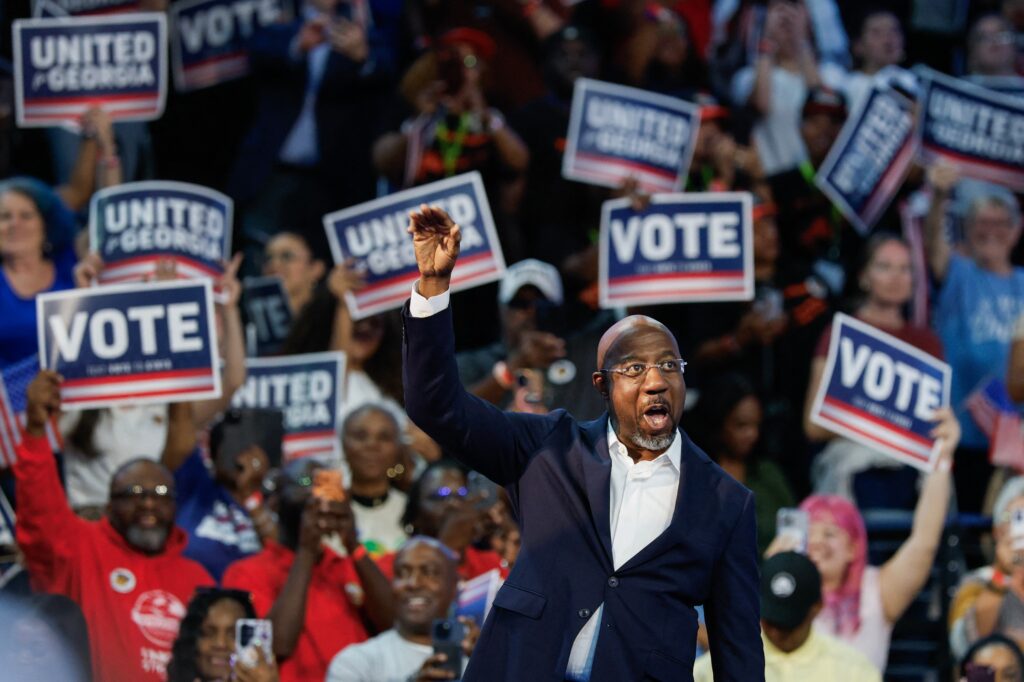
A Harris failure could open the way for Moore, Warnock or perhaps Sen. Cory Booker (New Jersey). Warnock is probably the most intriguing potential candidate from this group, given his position as senior pastor at the Rev. Martin Luther King Jr.’s Ebenezer Baptist Church in Atlanta. No candidate can match that level of leadership lineage.
Republicans salivate at the prospect of the Democrats nominating an unrepentant progressive. Much of the Democratic establishment wants a unifying moderate. Don’t be surprised if the eventual nominee, drawing on strong support from Black voters, splits the difference.
The post Black voters could decide the Democrats’ fighter-vs.-uniter battle appeared first on Washington Post.