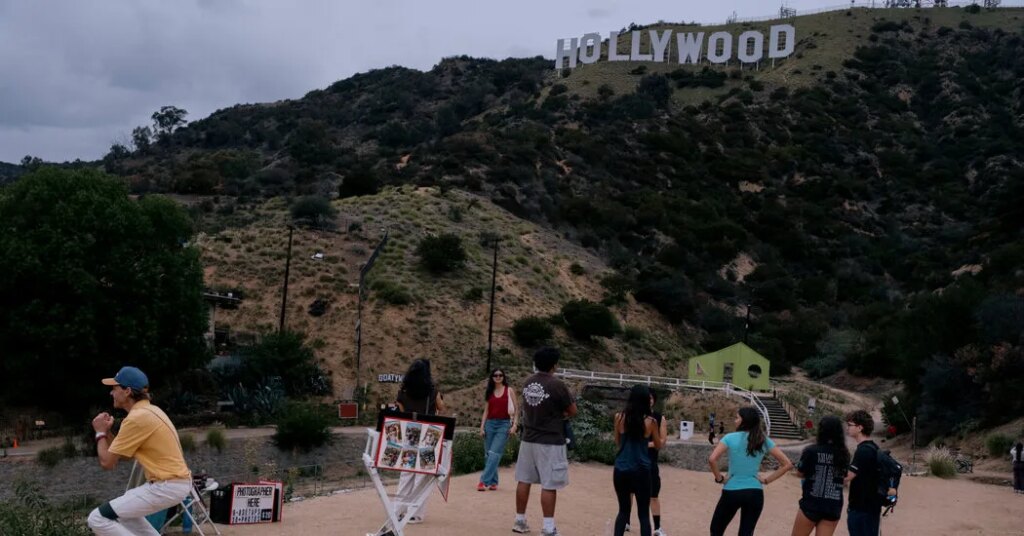
The Hollywood sign is an irresistible attraction to tourists and Californians alike, but it’s created a traffic nightmare in the wealthy neighborhoods just below it.
And that has spurred local residents into action, trying to impose some order on an unruly jumble of vehicles seeking the best viewing spots.
“You can’t park in the red and you can’t park on this side of the street,” yelled Lisa Hope, who lives nearby in the Hollywood Hills, admonishing a driver who parked in the fire lane facing oncoming traffic.
That driver moved away, but Ms. Hope was fighting a losing battle against the unrelenting parade of vehicles fixing to do the same.
On a recent Friday, cars and vans clogged the narrow, serpentine roads that connect the multimillion-dollar homes in the Hollywood Hills. Traffic was at a standstill on a sharp incline adjacent to Lake Hollywood Park. The imminent risk of collision seemed to lurk at the many hairpin turns on the way up to the sweeping views of the sign and the city of Los Angeles below.
Few, if any, Los Angeles landmarks carry the allure of the nine, 45-foot high white letters that stand atop the Hollywood Hills — and few neighborhoods could be less suited to accommodate the crowds that turn out in force to see them.
And as civic disputes go, few highlight the intersection of moneyed privilege and public access so vividly.
The tourist-driven disorder is not new, but the increased threat of wildfires in recent years has alarmed the people living nearby. Late last month, a group of them sued the city of Los Angeles, accusing it of failing to adequately address complaints going back years about the dangers posed by hordes of sightseers and their vehicles. The suit claims that the city has encouraged the mayhem.
The lawsuit does not seek damages. Instead, it asks a judge to force the city to find a way to stem the grinding traffic in the hills and put an end to the illicit activity that comes with the high volume of tourists. Otherwise, the plaintiffs say, the crush of cars and blatant parking violations will present a dangerous obstacle to firefighters seeking access to a blaze roaring through the hills, or to local residents trying to evacuate.
They also cite the many cigarette butts that visitors have dropped as a serious fire risk.
“No one is seeking to prevent tourists from seeing the Hollywood sign, this truly iconic, historic landmark,” said Ilan Wurman, the lawyer representing the plaintiffs. “But the neighbors are entitled to a clean and safe and healthful environment in the public spaces of their neighborhood, as any neighborhood is, and we believe the city can accomplish both things.”
Absent help from the city, Ms. Hope and two of her neighbors, Marissa Allen Cohen and Cindy Cobb, tried to take matters into their own hands on the recent afternoon.
The trio took stock of the scene: a line of cars parked in a fire lane; a handful of street vendors selling fruit, coffee and souvenirs; people descending into the foliage of a ditch to relieve themselves; and a man lighting up a cigarette not far from a no smoking sign featuring Smokey Bear.
“There’s no smoking,” Ms. Hope hollered at the man. He nodded and offered an apologetic smirk before putting out the cigarette.
“Some people just go, ‘I don’t care,’” Ms. Hope said.
Over the summer, Ms. Cobb and her neighbors helped raise money to hire Mr. Wurman, whose firm had successfully secured judgments against other cities over their management of public spaces.
In Phoenix, for example, Mr. Wurman’s firm successfully argued that the city was liable for mitigating any public nuisances created by a third party on property owned by the city. It persuaded a judge to order Phoenix to clear a large homeless encampment that had taken over a neighborhood.
The lawsuit against Los Angeles claims that the city has had a direct hand in encouraging the increase in tourists in the neighborhood. It points to an area of brush that was cleared and graded by the City Council in 2011. The spot happened to have a perfect view of the Hollywood sign, and its location soon appeared on online maps and was labeled a viewing site.
With the advent of GPS, and the ability of social media to help publicize viewing spots, tourists knew how to get to the cleared area. Now, the lawsuit says, the cleared brush is one of the main “nuisance” sites.
In response to the lawsuit, the office of Mayor Karen Bass said that the city had already taken steps to address the traffic and safety issues, including putting more police in the area during peak visiting hours.
But the homeowners’ complaints have also raised questions about wealth and entitlement.
Angelenos reacting to local news reports on the lawsuit have derided the legal effort, saying that the homeowners put themselves in the predicament by choosing to live near a site as famous as the sign, which was constructed in 1923.
“That sign didn’t pop up yesterday, and you don’t get to close off public access to public land because you feel it’s a nuisance,” one person commented.
Melody Hernandez, who grew up and lives in Los Angeles, recently took her uncle and cousin who were visiting from Guatemala to see the sign. She was sympathetic to concerns about fire safety, but worried about an outcome in which well-off locals could effectively cut off access to a popular public place.
“I just hope their concerns are really based off their safety,” Ms. Hernandez said.
Local residents acknowledge that their complaints might seem like a special form of NIMBYism from wealthy Angelenos living in one of the toniest neighborhoods of the city. They argue that some problems are not just a nuisance, but a danger to sightseers and homeowners alike.
Ms. Cobb, a school counselor who lives around the corner from Lake Hollywood Park, says she spent thousands of dollars to fence off an area behind her home because it had become a hangout for visitors looking to smoke.
In another section of the hills, Max Martens, also a plaintiff in the suit, started uploading to YouTube videos he filmed of tense standoffs between motorists outside his home. The videos capture drivers yelling at each other, Mr. Martens and neighbors pleading with parking enforcement officers to issue tickets, and emergency vehicles such as ambulances and fire engines stalled in traffic jams. Mr. Martens and Ms. Cobb said their ultimate concern was a fire, which would threaten the lives of tourists, homeowners and street vendors equally.
“There’s people from all over the world up there that don’t know how to get out during an emergency and are dropped off by Ubers,” Ms. Cobb said. The dangers she seeks to address extend to people of all economic backgrounds, she said.
The Palisades and Eaton fires last year were a “wake-up call,” Mr. Martens said. “We are terrified of the fire danger and if we don’t do something, evacuation would be deadly.”
Ms. Cobb and other plaintiffs say they are equally concerned about the smoking.
Ms. Cobb says she has spent some weekend mornings picking up the cigarette butts she finds in her neighborhood, collecting hundreds inside a large plastic bag.
It’s up to the city to figure out how to alleviate the tourist frenzy and the risks it creates, said Mr. Wurman, the lawyer. That could include ramped-up traffic enforcement, capacity restrictions or any other number of measures, including returning the graded viewing area back to the shrubby undeveloped patch of land it was previously, he said.
The sightseers and those conducting business in the area acknowledge the problems, too.
Ricardo Guerrero, a photographer who makes his living taking photos of people in front of the sign, said that he and other photographers do their best to pick up trash and keep the viewing areas clean. The vendors making a living there — selling snacks and cold drinks — also have a stake in keeping order, he said.
Andreas Bircher, 36, who was visiting from Utah — and acknowledged that he had parked in a fire lane to snap a quick photo — said that if he were a resident, he would be frustrated, too.
But he also pointed out that there was little anyone could do about what was at the root of the problem: the enduring appeal of the sign itself.
“Unless they get rid of the sign, there’s always going to be people coming up here to try and get a picture,” Mr. Bircher said.
The post Fans Flock to This Famous Sign. Neighbors Say, Get Off My Road. appeared first on New York Times.