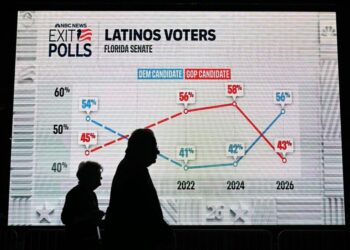
As major U.S. manufacturers have increasingly moved their production overseas in the last few decades to reduce costs, President Trump’s hallmark global tariffs were designed to force these companies to do their manufacturing stateside. But the tariffs proved unpopular, with the conservative think tank Cato Institute reporting in August that there is no factory building boom and that manufacturing is only expanding in industries facing the lowest tariffs, like electronics. The cost of living soared so high that Democrats won control of the House and the Senate in the 2026 midterm elections on Nov. 3—though it remains to be seen to what extent they will be able to challenge President Trump’s tariffs.
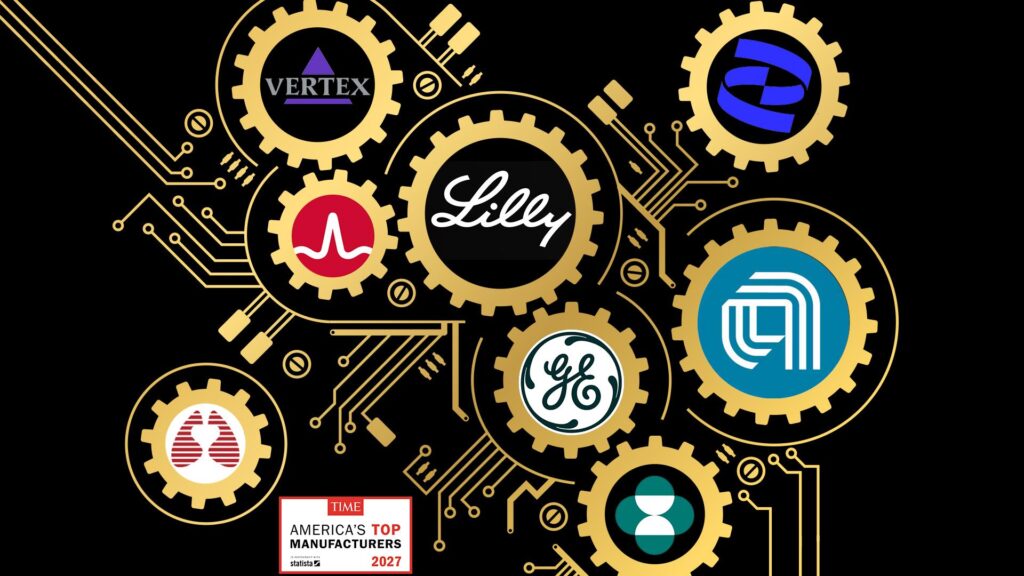
Despite all this, manufacturing is still one of the largest sectors of the U.S. economy, with 12.6 million manufacturing workers as of September 2026. TIME has partnered with data firm Statista to rank the companies that are thriving. The list features companies with at least $100 million in 2025 revenue and production facilities in the U.S., and analyzes company disclosures, public databases, and patent analytics. Companies were assessed on revenue growth from 2023 to 2025, as well as R&D expenditure in that same time frame; and workforce growth, retention, and workplace safety through data from Form 10-K filings, ESG/CSR reports, and the Occupational Safety and Health Administration’s database.
Methodology: How TIME and Statista Determined America’s Top Manufacturers of 2027
Most of the companies fall in the Industrial & Electrical Equipment sector (64), followed by companies in Electronics & Semiconductors (48)—both sectors that Trump claims are growing in America due to tariffs. Biopharma also dominates, making up 70% of the top 10, with Eli Lilly leading the list, the first drugmaker to hit $1 trillion in market share, due to the demand for its weight-loss drugs. As part of a $27 billion investment, the company is building four new manufacturing facilities in the U.S., which it says will create 13,000 manufacturing and construction jobs.
In a report that the White House published on Nov. 1, it declared “America is in the midst of a Manufacturing Renaissance,” boasting about $380 billion in investments towards manufacturing plants. But other industry experts aren’t seeing a renaissance. Economic policy analysts at the Center for American Progress reported earlier this year that since Trump announced tariffs in 2025, 89,000 manufacturing jobs have been lost—“the equivalent to the closure of more than 2,800 average-size manufacturing establishments nationwide.” They report that the war in Iran has made it harder to manufacture in America because it’s led to higher freight costs and supply chain shortages.
Rachel Slade, author of Making It in America: The Almost Impossible Quest to Manufacture in the U.S.A. (And How It Got That Way), also argues that it isn’t Trump, but his predecessor Joe Biden, who “put policies in place to incentivize investment in the Rust Belt and struggling economies, and we are starting to see the fruits of that.” One example she cites is the 2021 Build America, Buy America act, which mandated that federally-funded public infrastructure projects use American-made iron, steel, and construction materials. Other efforts designed to boost manufacturing include the Inflation Reduction Act and the CHIPS act (acronym for “Creating Helpful Incentives to Produce Semiconductors”), both enacted in 2022.
Manufacturing abroad—known as offshoring—has always been a hot-button political issue, but especially after the North American Free Trade Agreement was negotiated under President George H.W. Bush’s administration. It received bipartisan support because, as Slade sums up the thinking back then, “It would be better for Americans if stuff was made cheaply. We could then buy more because stuff is cheaper, and companies could make more profit because they were manufacturing for less…and we don’t have to deal with the stress of working with environmental laws, labor laws.” Slade argues that Trump’s tariffs paradoxically make it harder to manufacture in the U.S. because “if you are tariffing raw goods, parts that they need, their costs go way up, and then it just becomes so much more difficult to manufacture in America.”
J. Christopher Love, faculty co-director of the MIT Initiative for New Manufacturing, says summing up the state of American manufacturing is complicated: “We have really strong manufacturing here in the United States, and that it’s not uniformly declining or uniformly thriving. What we have is a lack of consistency across the entire industrial base.” He argues that economic policies should not only be about bringing manufacturing back to America but also bolstering the manufacturing capabilities already stateside, equipping them with the latest technologies. “We shouldn’t be trying to rebuild a manufacturing economy from another era.”
Case in point, as data center construction explodes amid an AI boom, the electrical equipment sector of manufacturing is surging—and that’s the industry boasting the most companies on the TIME list of America’s top manufacturers. One of these manufacturers is Generac (no. 85) which Reuters reports is planning a $250 million factory expansion by the end of 2027 so it can make new versions of its generators for data centers. Analysts at Wood Mackenzie predict that the U.S. data center electrical equipment market will grow from $20 billion in 2025 to $65 billion by 2030, making up 40% of the total US electrical equipment market.
See the full list of America’s Top Manufacturers of 2027 below.
The post America’s Top Manufacturers of 2027 appeared first on TIME.