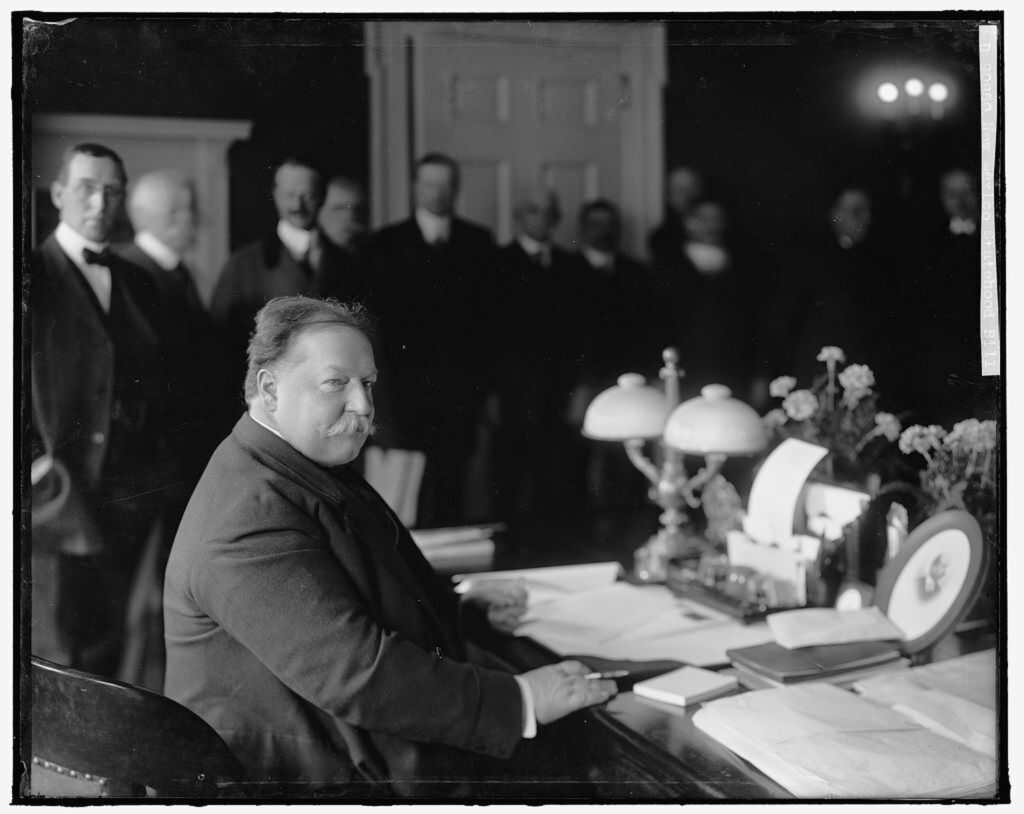
In 1913, during his last weeks as president, a bill to use literacy tests to ban “undesirable” immigrants came to William Howard Taft’s desk. A senator explained the bill: Immigrants included many “thugs, desperados … anarchists and criminals.” Sound familiar?
Taft, noting that many immigrants were “illiterate because opportunities have been denied them,” vetoed the bill. The Senate voted to override his veto, but the House sustained it.
Also, the Senate had recently approved constructing the Lincoln Memorial where Taft wanted it — where it is today, on the Potomac. The House, however, was recalcitrant: Maryland and Pennsylvania representatives favored a Lincoln Memorial highway to Gettysburg. But Taft’s ameliorative personality melted House opposition. Imagine that.
Taft served only one presidential term, which was agreeably lacking in drama. And his public services before the presidency (especially as governor of the Philippines) and after (on the Supreme Court) vindicate Walter Stahr’s judgment in his nifty new biography, “William Howard Taft: A Great American Life”: “It is hard to think of any American who has served his nation for so long and in such significant ways.”
Although Taft always most wanted to be what he eventually became, chief justice, he also desired the presidency, as his strenuous campaigning in 1908 demonstrated. His loss in 1912 was constructive because he robustly opposed the anti-constitutional populism of his presidential predecessor, Theodore Roosevelt, who had become unhinged by his desire to regain the presidency.
Roosevelt was elevated from the vice presidency in 1901 by the assassination of William McKinley, the third presidential assassination in 36 years. Elected in 1904, he declined to run in 1908 in deference to the norm against third terms.
Roosevelt’s (almost) irresistible charm — he was learned and ebullient — did not compensate for his misguided enthusiasms: for war, imperialism, eugenics and, especially, unfettered presidential power. He thought presidents may do whatever they are not explicitly forbidden to do. This anticipated Taft’s successor, Woodrow Wilson, who rejected the separation of powers as an anachronism impeding properly uncircumscribed presidencies.
In Roosevelt’s 1912 campaign, the most radical in the history of presidential politics, he said property rights were inferior to the community’s right to do whatever it wishes. He proposed giving “the National Government complete power over the organization and capitalization of all business concerns engaged in inter-State commerce.” Even worse, he advocated procedures for the popular recall of judges, and the overturning, by referendums, of unpopular court decisions.
Taft opposed all this. He said ascribing to the president “an undefined residuum of power” would do “irremediable injuries to private rights.” He started calling himself a “conservative.” He lost the election to Wilson (finishing third behind Roosevelt) but began defining 20th-century conservatism.
Taft at times weighed more than 340 pounds, and sleep apnea caused him to doze off in meetings, while playing cards and in public. Yet his astounding stamina propelled him “grasshopping” (his term) around the country, bellowing speeches without amplified sound. He reached the top of two of the government’s three branches, and persuaded the third to pass legislation giving the Supreme Court control of its docket, thereby enabling the court to concentrate on seminal cases.
Taft’s record on the court was mixed. He concurred with Justice Oliver Wendell Holmes’s vile opinion affirming the constitutionality of state laws enforcing compulsory sterilization of certain people, in this case an 18-year-old woman in the Virginia State Colony for Epileptics and Feebleminded.
The Taft court did, in 1927, admirably hold that Congress has the investigatory power to compel, by subpoenas, testimony from witnesses. As 2027 and a Democratic-controlled Congress draw near, the current president’s minions are intimating a reprise of his 2019 vow, made after Democrats took control of Congress, to contest “all” subpoenas. Taft still casts a big shadow.
The 27th president rests in Arlington National Cemetery. You can see where Taft is buried from the Lincoln Memorial. At least you can until a gigantic arch (proposed by, and for the sanctification of, the 47th president) spoils the view.
Which would be singularly inappropriate. “More than any president since George Washington,” Stahr writes, “Taft deserves credit for the overall design of Washington.” Taft gave us the National Mall and other results of the bill he signed creating the Commission of Fine Arts.
“Genial” was contemporaries’ recurring description of Taft, who — such happy days are not here again — was known for his affability, infectious laughter and scarcity of enemies. Taft described his as a “humdrum” presidency. This now describes a national yearning.
The post A presidency in the William Howard Taft tradition would be refreshing appeared first on Washington Post.