MANAMA, Bahrain — President Donald Trump appears eager to put the unpopular war with Iran behind him, as Democrats prepare to assume the majority on Capitol Hill after Republicans’ staggering midterm losses.
But there is no indication that the war Trump and Israeli Prime Minister Benjamin Netanyahu started is anywhere near finished. The major issues of the conflict — control of the Strait of Hormuz and the U.S. naval blockade, the fate of Iran’s nuclear program, Tehran’s support for regional proxies — remain unresolved. And Tehran’s perception of waning U.S. political will has left it emboldened.
Over the past week — following remarks by Trump at Arlington National Cemetery in which he said the war had been “won” — Iran three times has targeted the small nation of Bahrain, home to a massive U.S. naval base, with drones. On Wednesday it said it targeted a military base in Kuwait that is also home to U.S. forces in a drone and missile attack.
The renewed Iranian strikes on Persian Gulf countries, the first in months, come as Yemen’s Iran-aligned Houthi rebels hit Saudi Arabia, and on top of severe economic damage wrought by Iran’s attacks in the Strait of Hormuz.
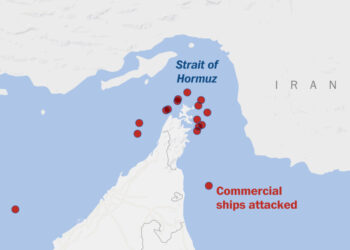
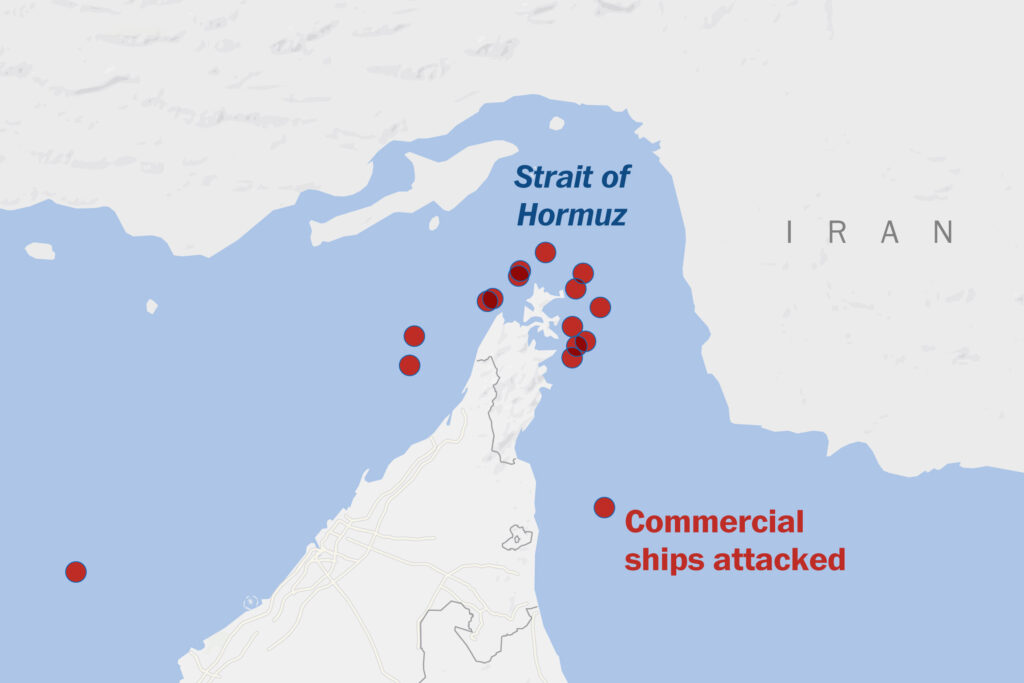
In the strait, a vital waterway for the region’s oil shipments, videos verified by The Washington Post show tankers on fire and plumes of smoke billowing amid daily attacks this month.
Iranian leaders, riding high on what they see as the U.S. voters’ rebuke of Trump in the midterms, show little sign of backing down.
Mohammad Bagher Ghalibaf, the speaker of Iran’s parliament, warned in a speech on Sunday that the status quo of international economic pressure, which Trump has embraced as a key strategy to force eventual capitulation, is not sustainable. While Iran is open to negotiations if the United States accepts its demands, he said, Iran’s military “will determine the geography of the battlefield” if the U.S. “makes another mistake.”
Both Iran and the U.S. “are scared of being seen as weak, and so they don’t want to make the first concession” in negotiations, said Abdulla Banndar Al-Etaibi, an assistant professor of international affairs at Qatar University.
The two sides are so unpredictable, he said, that “anything is possible” in terms of escalation.
“How can this be considered anything other than a victory for Iran?” asked Alex Vatanka, a senior fellow at the Middle East Institute, a Washington think tank.
“The regime is surviving. The nuclear program is damaged but will be reconstituted, and they have realized what a jewel they have in terms of the Strait of Hormuz,” Vatanka said. “They will hold Gulf states hostage for years to come.”
In response to requests for comment about ongoing violence in Hormuz and the resulting economic costs, the White House said in a statement that Iran is a “failed country” and that the U.S. “is in a very strong position with control of the Strait of Hormuz and the Iranian economy collapsing.”
Trump has said that a combination of a U.S. naval blockade and sanctions are crushing Iran’s economy and will force Iran to make a deal. The Trump administration has claimed that a massive U.S. military operation protecting vessels shuttling oil from the Persian Gulf into the Gulf of Oman, which launched in August, has helped get oil flows to prewar levels.
But in the first 16 days of November, there were 16 attacks on ships in the Strait of Hormuz, according to data from the Washington Institute for Near East Policy — following a record high of 37 attacks in October. In one of the most dramatic videos, posted on social media Nov. 8 and verified by The Post, a massive red Navig8 tanker is seen in flames near the coast of Oman as another boat sprays water on it.
Satellite imagery captured by the European Space Agency satellite Sentinel-2 of the site of the attack shows a plume of smoke so large that it touches the shore. Oil spilled from damaged tankers has reached the shores of the United Arab Emirates and Oman, according to local media reports.
Iranian state media has also reported that at least eight ships struck mines last week and over the weekend while traveling in waters that Iran considers restricted. U.S. Central Command posted a video Nov. 7 showing it firing “multiple precision munitions” at a commercial ship traveling in the Gulf of Oman that it said ignored U.S. warnings.
CENTCOM forces disabled a commercial vessel in the Gulf of Oman, Nov. 7, after the ship’s civilian crew ignored repeated warnings and attempted to violate the naval blockade against Iran multiple times. A U.S. military aircraft fired precision munitions at the stern of St.… pic.twitter.com/NS5PzRmYkS
— U.S. Central Command (@CENTCOM) November 7, 2026
The price of oil is down from record highs as the market has priced in the risk of travel through the strait, said Gregory Brew, a Middle East energy analyst with the consultancy Eurasia Group. But prices are still dramatically higher than before the war, he added, and overall traffic through the strait a fraction of what it was before the war.
“The Strait of Hormuz is neither open nor closed — it is contested,” Brew said. “The U.S. leaning back does not mean the war ends, especially for the Gulf.”
The war has left the region mired in simmering conflict with no clear path to a decisive military outcome or broad peace agreement.
In the early weeks of the war, when Iranian drones and missiles rained down on the Gulf, hitting hotels in Dubai, the U.S. military base in Bahrain and Qatar’s liquefied natural gas plant, Gulf officials publicly doubled down on their partnerships with the United States.
Privately, many in the region bemoaned Trump’s decision to go to war and wondered whether the region would be left to pick up the pieces when he grew tired of the war they had warned him not to start.
Nearly nine months in, with Trump saying the diplomatic solution sought by Qatar and backed by the rest of the Gulf is unnecessary, there is a sense of resignation. No one wants to publicly criticize Trump — the U.S. is still the Gulf’s main security guarantor — but speeches by top officials these days focus more on regional cooperation and expanding partnerships than the U.S. relationship.
In interviews in recent weeks in Qatar, Bahrain and the UAE, residents said they felt both whiplash and a sense of hopelessness.
Across the wealthy Gulf, nations have taken economic hits because of the war: The International Monetary Fund projects that gross domestic product will have contracted by an average of nearly 5 percent this year.
But impact has been uneven, and most dramatically felt in Bahrain, Qatar and Kuwait, which do not have ports or any other viable options to bypass the Strait of Hormuz.
In Qatar, which has long ranked as one of the world’s wealthiest countries by GDP per capita, state revenue dropped in the first half of the year by 42 percent, Emir Tamim bin Hamad Al Thani said last month. But the impact on everyday life has been limited, residents said.
In Bahrain, an import-reliant island nation of 1.6 million that has far less oil and gas wealth than others in the region, the impact has been more acute. The country has seen its economy devastated by continued turmoil in Hormuz.
Around the capital Manama on a recent day, storefront after storefront was shuttered, “for rent” signs in the windows.
A supermarket manager said residents are only filling half their carts because of price hikes. Hair stylists said that their salon, empty on a recent Thursday afternoon, would have been bustling before the war.
“I am nervous all the time,” said an artist. A steep drop in tourism forced him to close his shop. “It is the whole world that is suffering.”
“We just want the U.S. to stop interfering,” said the artist, speaking on the condition of anonymity because of concerns about criticizing the U.S., a Bahraini ally.
Sirens rang out across the country Sunday morning and again on Tuesday, as Iran’s Islamic Revolutionary Guard Corps said its drones were targeting U.S. military equipment. The government once again warned residents to seek shelter.
Bahrain’s media office said in a statement that the country had been “subjected to repeated and unjustifiable Iranian attacks on its territory.”
As the sun set and a group of men prepared to head to the mosque for evening prayers, they bemoaned the situation. Abdul Aziz said that he used to make a living importing motorbikes and bicycles that he sold to U.S. soldiers at the naval base in Bahrain.
Now, he said, goods that used to take a month to arrive are taking four. The Americans he used to sell to are gone — thousands of them evacuated from the base ahead of the war.
The market, he said, “has died because of the war and because of Hormuz.”
“I don’t know until when we will suffer,” he said. “But we just want things to be normal again.”
George and Steckelberg reported from Washington, and Piper from London.
The post Trump is trying to put the Iran war behind him, but it’s not over appeared first on Washington Post.