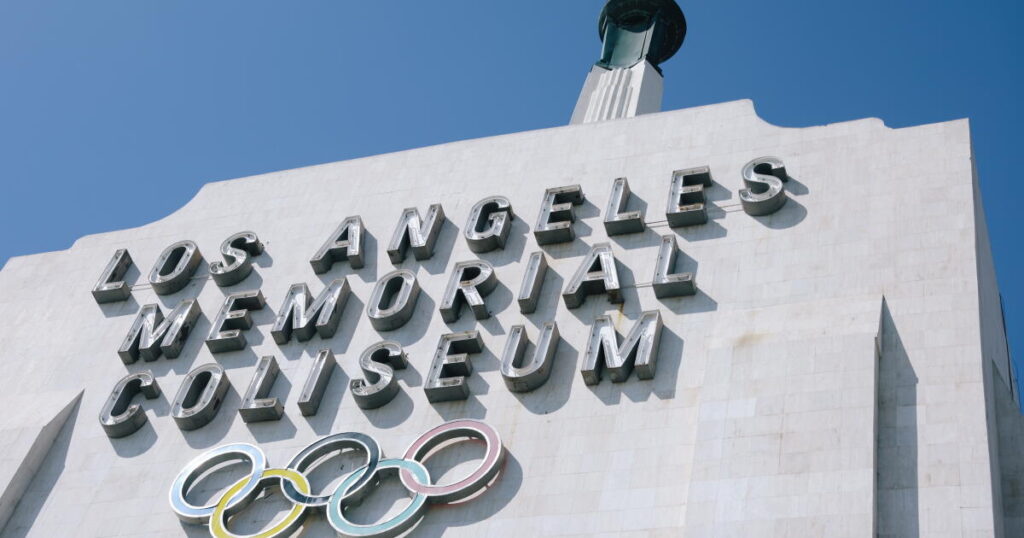
There are many plans in the works for LA28’s Cultural Olympiad. Just don’t expect to find a coordinated effort behind them from an official Olympics-related organization.
With a little more than 18 months until the event, those responsible for planning the arts and culture programming accompanying the Olympic and Paralympic Games have offered little more than a marketing opportunity for eager participants, critics say.
LA28’s cultural leaders say they will promote independently organized programming through a digital platform and help subsidize admission, but won’t pay to produce those projects — leaving other groups rushing to fill the void.
Nora Halpern, executive director of LA28’s Cultural Olympiad, said the organization aims to support the breadth of cultural activity already underway, rather than act as “grant makers.”
“It’s not our job to put a neat bow around the variety that’s on offer,” she said in an interview. “Our mandate is to celebrate the ecosystem that is L.A. It’s not a place that can be simply lassoed into one particular approach.”
One museum leader noted that a recent conversation with Halpern made clear that LA28’s support would center on marketing.
The situation has left Los Angeles arts groups to join forces — and seek funds — for cultural celebrations around the 2028 Olympics, as LA28’s organizers promise to promote independently organized projects but leave the cost of producing them to others.
Foundations and private donors are beginning to respond. The Perenchio Foundation and Kohl Family Foundation recently launched “Summer of ’28 — Only in L.A.,” an open call to the Los Angeles arts community for “performances, live experiences and immersive works.” Concepts from arts groups with an annual operating budget of at least $1 million are due Dec. 11. “Dream at the scale of this moment,” the announcement urges artists and organizations. “Reach across disciplines and communities.”
The initiative offers a potential source of support as organizations develop exhibitions, performances and neighborhood celebrations that could help shape the Cultural Olympiad.
For many arts administrators, LA28’s approach differs from what they had hoped for.
Cristian Hamilton, president of SoCal Museums and the Autry Museum of the American West’s vice president of advancement, had envisioned something resembling Getty’s PST ART, which combines exhibition funding with coordinated promotion. Instead, “We understood that we were going to have to go for resources as nonprofits sort of on our own,” Hamilton said, adding that he will lead an ad hoc Olympic committee to coordinate programming and promotion among SoCal Museums members, potentially involving other cultural organizations, and is planning a meeting with Halpern.
This appears to be a necessary step in a leadership vacuum. Especially since some artists are still seeking a way into Olympic planning. Artist and activist Patrisse Cullors sees the Crenshaw Dairy Mart, the arts organization she co-founded near Inglewood’s Olympic venues, as a potential gathering place for art and music, but said she doesn’t know how to reach those leading the effort.
Mixed funding models have precedent: Paris 2024 worked with France’s Culture Ministry and local governments to develop its Cultural Olympiad, combining directly funded projects with independently financed events that received official designation and promotion, according to a 2025 report by the Organization for Economic Co-operation and Development. The 1984 Olympic Arts Festival was financed by private donors and the Los Angeles Olympic Organizing Committee.
LA28’s own plans include 16 official Olympic and Paralympic art posters and 28 free film screenings, some paired with food and live performances. Its promotional tools include a Cultural Olympiad mark recognizing participating programs and a digital calendar and mapping platform. More programming will be announced next year.
“We have the largest megaphones and the largest audience, both locals and visitors, and we really want to make [the Games] accessible,” said Dwayne Jones, LA28’s senior vice president for the Cultural Olympiad and stakeholder events.
At an October legislative hearing, Jones described a fundraising ambition in the “tens of millions” of dollars. In a subsequent interview, he said money raised would support program delivery and ticket underwriting but did not disclose how much had been secured.
Independent organizations are looking elsewhere for production money.
Before the foundations’ announcement, philanthropist Jerry Kohl said he was gathering prospective supporters willing to invest $1 million or more in ambitious cultural projects, with plans to award grants to applicants in February.
Kohl and his wife, Terri, co-founders of Brighton Collectibles, have given $5 million to the L.A. Operaand $15 million toward the building of the Hollywood Bowl Artists Pavilion. They were also major contributors to the LA Arts Recovery Fund, administered by the California Community Foundation, which awarded $41 million for post-pandemic rebuilding from 2021 through 2025.
“We don’t want to begin by deciding how much money we must raise,” Kohl wrote in an email. “We want to begin with extraordinary ideas and then determine what it will take to make them happen.”
He envisions participation by major institutions, independent artists, smaller organizations and public cultural agencies. Kohl says he has spoken with LA28 and sees the effort as complementary to the organizers’ work.
The California Community Foundation has also been bringing funders and local organizations together. President and Chief Executive Miguel A. Santana described that work as being in “alignment” with Kohl and Perenchio’s initiative and said he expects to announce more about the effort in the first quarter of 2027.
“We want to also make sure that community-based organizations in every part of Los Angeles have the opportunity to also celebrate who they are, their expression and culture and art,” he said.
There is no shortage of ideas.
The Music Center is collaborating with other Grand Avenue cultural institutions on a proposed multiday expansion of their annual Grand Avenue Arts All Access event, including dance performances.
“’28 is a time for scale,” said Julia Diamond, senior vice president of TMC Arts, the Music Center’s programming division.
Santa Monica Cultural Affairs Manager Sofia Klatzker envisions a “Museum West,” with coastal sites displaying public art associated with local and possibly national museums. She also identified $250,000 in available Art of Recovery funding for grants.
The Skirball Cultural Center plans an exhibition exploring Deborah Sussman’s designs for the 1984 Los Angeles Olympics, including a building wrap inspired by those designs. It is expected to open in January 2028.
Arts groups are also building networks to coordinate such efforts.
“There’s a need to connect the dots between everything that’s happening,” said Gustavo Herrera, chief executive of the nonprofit advocacy organization Arts for LA. Herrera, like other arts administrators, says he has met with the LA28 team, but hasn’t seen a plan for distributing resources.
Arts for LA is helping develop Mosaic LA, a framework for funding, coordination and promotion of neighborhood cultural programming. Organizers have discussed budget scenarios, including what arts and culture nonprofit LA Commons CEO Karen Mack, a Mosaic LA co-chair, called a “dream budget” of roughly $90 million.
“We see it as being resourced by private philanthropy,” Herrera said of Mosaic LA’s initial development.
Mack has also helped convene the Los Angeles Cultural Districts Network to address infrastructure, communications and connections between cultural destinations.
Public agencies have separate plans. Los Angeles has committed $15 million from its existing arts budget to programming that includes festivals across all 15 council districts. The county is building on existing grants, youth programs and cultural partnerships. In October, the City Council directed the Department of Cultural Affairs to report within 60 days on planning, consulting LA28 and other stakeholders.
The division between promotion and production has precedents. UCLA historian Tawny Paul compared LA28’s approach with the 1987 Fringe Festival/Los Angeles, staged “in response” to the popular 1984 Olympic Arts Festival, which some faulted for showcasing international artists.
“[Fringe Festival] catered to local artists, who had to provide their own funding (or access private funding), and the Fringe infrastructure provided organizing and visibility … like what the Cultural Olympiad is proposing,” she wrote in an email.
Aaron Paley, president of Community Arts Resources (CARS), who co-directed Fringe Festival/Los Angeles, sees LA28’s approach as business as usual for nonprofit arts organizations accustomed to raising their own money.
“You’re going to need to figure out where your funding is coming from yourself … because I don’t see the cavalry coming,” he said.
Money is not the only complication. Hamilton said Olympic cycling events in Griffith Park could restrict access to the Autry on certain days, although no closures have been finalized. Paul also cautioned that Olympic crowds do not necessarily translate into museum visitors.
To reach audiences beyond museum buildings, the Los Angeles History Collaborative is seeking grants for “LA Stories,” videos exploring neighborhood histories around 17 Olympic zones. The coalition of museums and researchers formed after the 2025 fires and is developing the project with PBS SoCal as a distribution partner, co-facilitator Ben Fitzsimmons said.
CARS is working under contract on the Southern California Ass. of Governments’ community-hubs initiative, Paley said, and will produce 12 projects across the region, similar to the popular World Cup watch parties.
Other events could precede the Games. Gallerist Jeffrey Deitch said he is hoping to produce another Art Parade, following the nearly mile-long procession he staged with the Los Angeles County Museum of Art in June. Paley hopes to pursue an event inspired by Celebrate LA!, the 2018 LA Philharmonic centennial celebration CARS helped produce.
Others are looking beyond 2028. Arts for LA is exploring a countywide ballot measure for 2028 to support cultural and community investment after the Games, said Herrera.
“There’s an overriding desire to make sure that Los Angeles is better as a result of the things happening [at the Olympics],” said Maria Rosario Jackson, former chair of the National Endowment for the Arts and a co-chair of Mosaic LA.
Diamond sees lasting value in the relationships formed through regional planning. Those collaborations, she said, already feel like “an important legacy that’s being left.”
While arts groups continue to devise plans, Halpern is confident that LA28’s marketing push — along with the efforts of independent fundraisers — will get them over the finish line.
“Our job is really to help them make the best of what they … present to the world,” she said. “We’re exactly where we feel we need to be.”
The post Who will pay for L.A. Olympics arts programming? It’s a mad dash to fill a leadership void appeared first on Los Angeles Times.