In the end, Mary Peltola may not have needed two Dan Sullivans on the ballot after all.
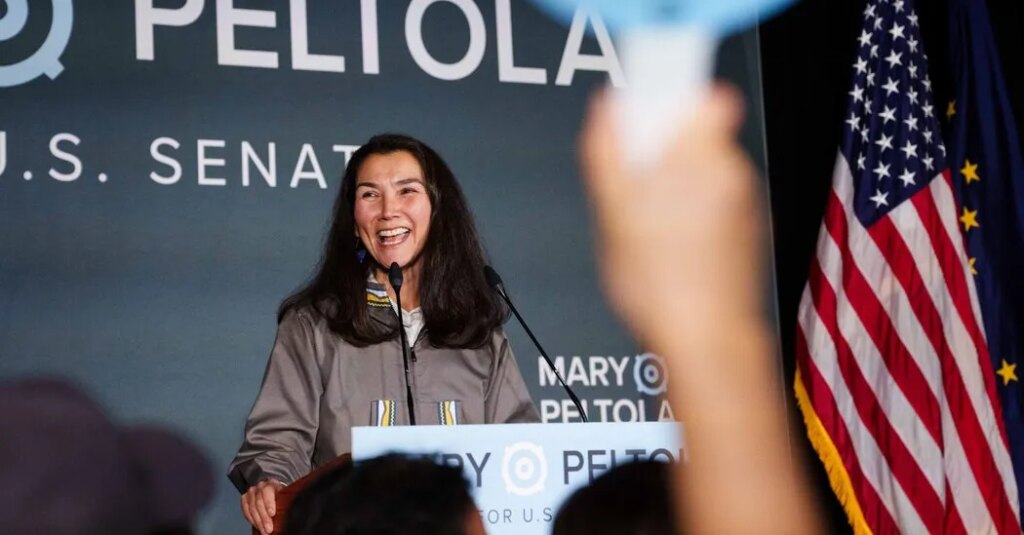
A final batch of votes pushed Ms. Peltola, the Democratic former congresswoman, across the threshold to victory against Senator Dan S. Sullivan of Alaska late on Tuesday, according to The Associated Press. Ms. Peltola’s victory secured a 56th seat in the Senate for her party in a midterm election that Democrats swept.
She won by over 12,000 votes, more than the roughly 4,700 earned by Daniel J. Sullivan, a retired teacher whom Democratic operatives had recruited into the race in an apparent effort to confuse Republicans and siphon their votes from an incumbent with the same name.
Around the country, the presence of that other Dan Sullivan on the ballot dominated coverage of the race. But in Alaska, Ms. Peltola laid the groundwork for a dominant victory over the incumbent through more conventional means, attacking him on the cost of living and positioning herself as a working-class champion.
Like other Democrats who flipped G.O.P. seats this month, Ms. Peltola capitalized on voter anger over high gas and diesel fuel costs, the war in Iran and an unpopular president. But in Alaska, where regional matters and politicians’ personal brands play an outsize role, Ms. Peltola’s win also reflected her success running as a broadly palatable challenger steeped in local concerns. By the end, seemingly everyone knew Ms. Peltola’s campaign slogan: “Fish, Family, Freedom.”
“They had a good strategy,” said Ashley Reed, a nonpartisan state lobbyist who, like many supporters of the incumbent, begrudgingly acknowledged that Ms. Peltola’s attacks had hit home. “They just hammered away, and one of the things that worked real well is the Sullivan campaign did not counter some really harsh claims.”
While the senator focused on communities in the Mat-Su Valley and the Kenai Peninsula, conservative areas outside Anchorage, Ms. Peltola was trekking to tiny rural villages in far-flung parts of the state, many of which are reachable only by boat or small plane. She flew in and out of distant towns for days in a row, covering thousands of miles. She reached some of them by snowmobile.
“It matters who shows up,” said Gloria Burns, the president of the Ketchikan Indian Community in southeastern Alaska, who supported Ms. Peltola. “That attracted me, because I have to be thinking about who pushes for and supports policies that are best for my people.”
Ms. Peltola’s travel seemed to pay off. An analysis of voting data by district showed that the remote rural regions of Alaska shifted the most toward Democrats when compared with 2024. And although turnout was down across the board compared with the presidential election that year, the rural districts generally saw the smallest turnout declines.
Outside money and other resources flooded the state, aiding both candidates. The state’s Democratic machinery went into overdrive, with the AFL-CIO knocking on more than 28,000 doors of fellow union members, according to Bronson Frye, the group’s secretary-treasurer — far more than the roughly 10,000 the union might knock in a normal year.
From the beginning, Ms. Peltola’s allies knew that toppling a two-term incumbent would be difficult. Mr. Sullivan was seen as a low-key and relatively uncontroversial figure, and he had forged deep relationships with various constituencies in the state, including certain Alaska Native corporate interests and those working in the oil industry. The Democrats saw opportunity, however, in the senator’s understated persona, capitalizing on his struggle to differentiate himself from Mr. Trump.
“He didn’t know what to do in a campaign where the Republican brand wasn’t going to save him,” said John-Henry Heckendorn, an Alaska political strategist who worked with super PACs supporting Ms. Peltola.
Mr. Heckendorn said a moment crystallizing that struggle came in late October, when thousands arrived in Anchorage for the 60th annual Alaska Federation of Natives convention.
It was a high-profile opportunity for political candidates to sway a crucial swing bloc just before the election, and attendees were eager to watch the top two candidates face off in a forum. But Mr. Sullivan didn’t show up, giving Ms. Peltola the stage to herself to talk about how to reduce large-scale commercial fishing and bring down high costs, and to link Mr. Sullivan to Mr. Trump.
The senator had delivered a solo speech earlier at the convention. A senior adviser for his campaign disputed the idea that the decision not to appear onstage with Ms. Peltola was an unforced error. The adviser, who spoke on condition of anonymity to describe internal campaign strategy, argued instead that the national environment was the main culprit in Mr. Sullivan’s loss.
The adviser also acknowledged, however, that Democratic attacks against Mr. Sullivan, which had begun even before Ms. Peltola entered the race, appeared to have left a mark. He said Democrats’ efforts to recruit potential spoiler candidates including Daniel J. Sullivan, which were revealed in a New York Times article in October, had aided Ms. Peltola’s campaign beyond just vote tallies, by dominating news headlines and deflecting attention from her.
Mr. Sullivan did find opportunities to go on offense. He pushed Ms. Peltola to engage in more televised debates. And Ms. Peltola at times proceeded with caution, skipping chances to engage with her opponent and avoiding the national media spotlight. Mr. Sullivan derided her as “No Show Peltola.”
Still, Ms. Peltola had become well-known in Alaska after campaigning statewide three times for the House. A former commercial fisher who later served in the State Legislature, she also led a commission that served as an intermediary between Alaska Natives and outside agencies that enforced rules on fishing.
She focused heavily this year — as she always has — on her opposition to large-scale trawlers, which compete with subsistence fishers seeking to fill their freezers before Alaska’s long winters.
Ms. Peltola’s message began feeling increasingly relevant, Alaskans said, as the fishing crisis grew more acute, and as skyrocketing prices of diesel and other goods were putting the state on edge. (Mr. Sullivan also opposed trawling, focusing particularly on Russian and Chinese fleets, but he didn’t make the issue a centerpiece of his campaign.)
Four years ago, “she was a little bit alone in this critique of the way Alaska’s managing this resource,” said Joelle Hall, the former president of the Alaska AFL-CIO, the state’s largest labor union. “As time goes on, more and more people realize, ‘Oh, what’s going on?’”
Art Hackney, a veteran G.O.P. strategist in Alaska who worked for super PACs backing Mr. Sullivan, said the senator’s campaign assumed that voters knew about his legislative record, which allowed Ms. Peltola to drive a “relentlessly dishonest” narrative that he was not working to address the cost of living even as his family business had continued to make profits.
“I don’t think Dan’s campaign inoculated himself well” against the attacks, Mr. Hackney said. He added: “People just wanted to punish anyone in Trump’s realm,” and Ms. Peltola “was just riding the tide.”
Ms. Peltola was also on the defensive at times. In September, The Times reported that she had been verbally abusive to her employees, used offensive slurs and even shoved a former aide. Her campaign denied some of the allegations and said others had been exaggerated.
The next month, The Times reported that her campaign participated in an effort to recruit candidates into the Senate race, including Daniel J. Sullivan — a charge that Ms. Peltola had denied for months and continues to contest.
Republicans seized on the news, with the Justice Department suing to block certification in the event Ms. Peltola won. Mr. Trump suggest it amounted to voter fraud, though no illegal activity had been alleged.
Ms. Peltola sought to dismiss the controversies as unwanted distractions coming from the Lower 48. Even so, as the state’s round-the-clock summer sunlight gave way to snowfall in the final weeks, she remained locked in a competitive battle with Mr. Sullivan.
“I don’t think there was ever any moment where it’s like, ‘Oh yeah, we’ve got it,’” said Martha McKenna, a longtime political consultant for Ms. Peltola. “This felt like an underdog race every single day.”
By the end, Mr. Sullivan was openly acknowledging high prices in his stump speeches, and national Republicans were swooping in to help his campaign. “Too many families are having a real hard time making ends meet,” he said at an early October rally with Vice President JD Vance in Fairbanks.
Mr. Sullivan argued that Democratic control of Congress would worsen Alaska’s economic woes by squeezing the oil industry. But like many other Republicans on the ballot this year, he struggled to find a response that resonated with voters who were angry about prices in Mr. Trump’s second term. Unlike some Republican lawmakers who voted for a resolution to curtail the president’s ability to continue to the war with Iran, which drove up oil prices, Mr. Sullivan largely supported the president on the conflict.
For more than a year, Ms. Hall, a Peltola ally, had worried that the president would show up and deliver an October surprise that could give Mr. Sullivan a final boost. Mr. Trump did just that, announcing at a rally in Wasilla last month that South Korea would invest $54 billion in a long-delayed natural gas pipeline in the state.
But as Ms. Hall saw it, Mr. Trump’s credibility had become so damaged that voters weren’t interested.
“By that point, Alaskans were like, ‘You know what, this guy’s full of it,” she said.
On election night, as the Democratic landslide swept many of his Republican colleagues out of office, Mr. Sullivan predicted that his state would defy the trend.
Two weeks later, he was swept out, too.
Christine Zhang contributed reporting.
The post Fish and High Prices: How Mary Peltola Triumphed in Alaska’s Senate Race appeared first on New York Times.