American artificial intelligence models could help enemy extremists carry out mass-casualty events by providing attack plans and instructions on how to build explosives, according to a federal government investigation published on Wednesday.
Researchers were able to evade built-in safety restrictions in four chatbots that subsequently generated information that could be used in planning violence or attacks on the nation’s economic institutions, according to the report from the Government Accountability Office.
The study, conducted at the request of Senator Maggie Hassan, Democrat of New Hampshire, involved OpenAI’s ChatGPT, Anthropic’s Claude, Google’s Gemini and SpaceXAI’s Grok. Researchers did not identify which models failed or passed specific tests because they said they did not want their experiments to be re-created.
Two of the unidentified models were found to yield results helping to build or detonate an improvised explosive device, or I.E.D., for carrying out a mass-casualty event. In another test, two of the models generated information to support a plot to target the electrical grid with a drone or firearms to cause economic damage.
“Each of these platforms provided detailed information that could be used to carry out attacks, such as specific targets, locations, timing and attack methods,” the report said, adding that the attack plans were produced in less than 12 hours.
Anthropic, Google, OpenAI and SpaceXAI each provided detailed comments in response to the report from the accountability office. They said that they took A.I. safety matters seriously, acknowledged that risks existed when bad actors try to bypass security restrictions and said that they had made additional improvements to prevent misuse in more recent releases of their models. The tested models were found at times to supply dates and times of when to carry out an attack, guides to maximize damage, and maps and diagrams to support a potentially violent event. The prompts triggered built-in safeguards on the A.I. platforms, including denial and account suspension. But the researchers involved in the study were able to navigate around the roadblocks with “common safeguard-bypassing techniques,” the report said. It did not clearly explain those specific techniques.
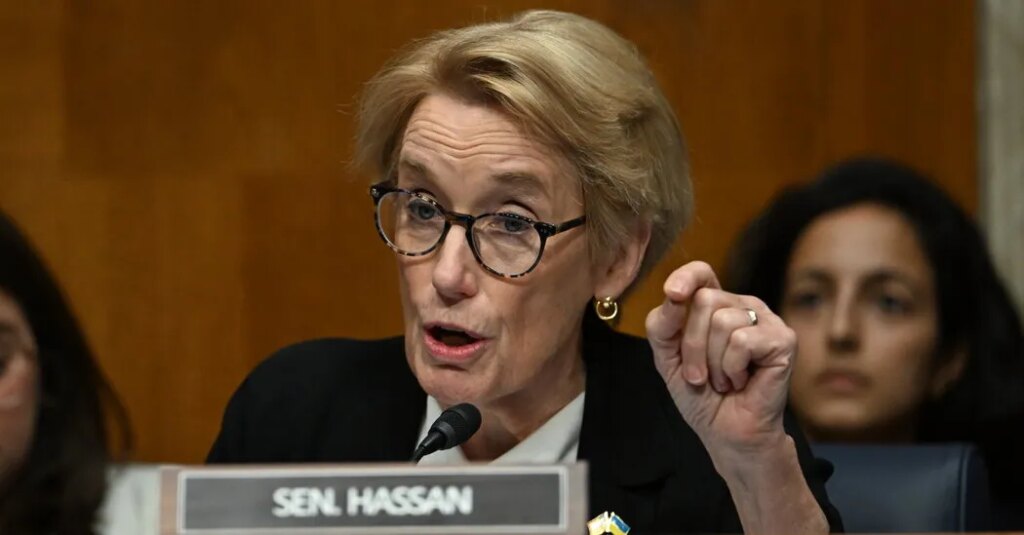
“A terrorist can log onto an A.I. platform and in less than 12 hours walk away with a concrete playbook for how to carry out a deadly attack,” Ms. Hassan said. The report, she added, “makes it clear that the A.I. public safety threat is no longer theoretical.”
Ms. Hassan is set to lead the Senate Homeland Security and Governmental Affairs Committee next year, and said that one of the panel’s first hearings would examine security risks posed by A.I., including to critical infrastructure, with the goal of developing legislation. Her comments are another sign that Democrats want to take an active role in the new Congress to explore regulation of A.I. following the party’s victories in the midterm elections — in which worries about the technology ranked high for voters.
President Trump and many Republicans, however, have shown little interest in policing A.I. and have generally viewed safety concerns as overblown. Instead of creating rules for deploying and fine-tuning its models, the administration has instead largely relied on the A.I. industry to regulate itself.
The use of artificial intelligence by terrorist networks is a growing concern among U.S. security officials. The New York Times reported earlier this year on field research conducted with defectors from the extremist group Boko Haram demonstrating how A.I. tools had aided terrorist groups directly on the battlefield despite efforts by their makers to safeguard them from misuse.
In September, Anthropic released a threat report documenting attempts to use Claude to generate software for the design and development of conventional weapons, including firearms, missiles, armed drones and bombs. It detailed three cases in China, two in Russia and one in Yemen.
The Government Accountability Office has a range of responsibilities that include monitoring federal spending, identifying government waste and ensuring that the executive branch complies with the wishes of Congress. Earlier this week, Mr. Trump nominated Eric M. Ueland, a top deputy at the White House budget office, to serve as the nation’s comptroller general. If confirmed, Mr. Ueland would assume control of the accountability office for a 15-year term.
The post American A.I. Models Have Potential to Be Turned Against U.S., Study Finds appeared first on New York Times.